
Lichtfeld in Transition: Tracing a Community’s Sense of Place
Graham Schellenberg
A few years ago, during an event organized by the Neubergthal Heritage Foundation, I had the opportunity to speak with the late archivist and historian Lawrence Klippenstein. Seated on well-worn chairs, we quickly discovered a shared interest in Altbergthal, a small community southwest of Altona, Manitoba, whose former school building now stands on the grounds of the Neubergthal Commons. Born and raised in Altbergthal in the 1930s and 1940s, Klippenstein shared roots with my maternal Klassen ancestors, who were among its first families. They attended the local school and settled southeast of the village. That serendipitous encounter laid the groundwork for an unexpected friendship and mentorship, which continued until he passed away in 2022.
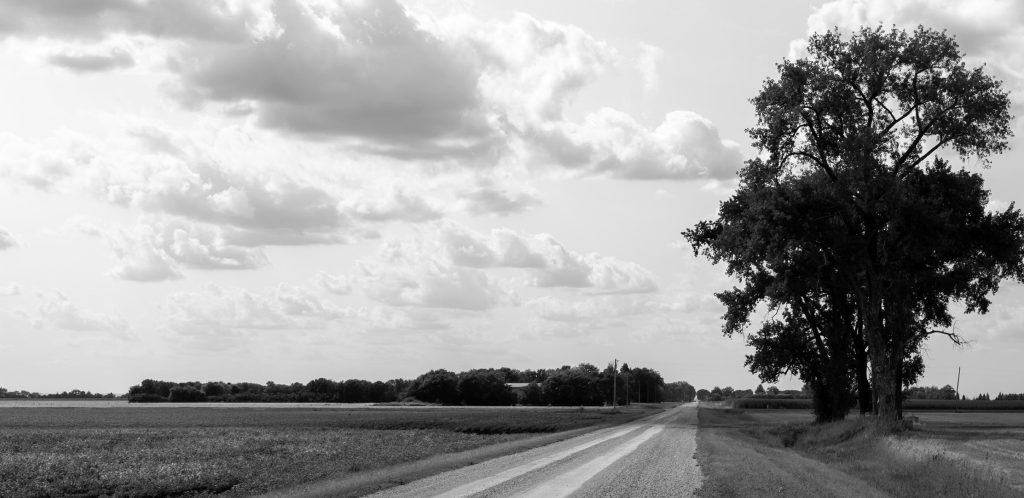
As our discussions progressed, I soon became intrigued by Lichtfeld, a little-documented community with no discernible pre-settlement ties to Altbergthal. The village was situated less than a kilometre away – close enough for a person to wave down the township road from the end of one village to someone at the end of the other – yet Lichtfeld’s history was surprisingly overlooked in accounts of Altbergthal’s past. This gap in the historiography captured my interest and prompted years of research into the village, uncovering new connections and revealing its distinct, intertwined history with Altbergthal.
I found Lichtfeld’s historical trajectory and its significance over generations a challenge to interpret. Evidently the village had a robust history, and its residents and descendants were influential. Among them was Abraham D. (A. D.) Friesen, who later managed the West Reserve Bergthaler Church’s mutual aid institution, served as a councillor for the Town of Altona, and pursued various business, civic, and religious interests. His sibling David W. (D. W.) Friesen was a respected businessman and Bergthaler deacon who, among many achievements, founded the company now known as Friesens, a leader in the Canadian printing industry.
Notable descendants of Lichtfeld contributed significantly to their communities, such as Henry J. Gerbrandt, a Bergthaler minister, historian, and field director for the Mennonite Pioneer Mission; Martha (Dyck) Martens, a local historian and archivist of the Evangelical Mennonite Mission Conference; and Bernie Wiebe, a Bergthaler minister, educator, and counsellor who served as coordinator of conflict resolution studies at Menno Simons College, edited The Mennonite, and founded the Faith and Life Singers.
Once a cohesive agrarian community, the village of Lichtfeld eventually dissolved and its identity faded and was subsumed into Altbergthal. In tracing this history, I have employed the concept of “sense of place,” developed by scholars to examine the relationships between people and their environments. This concept has been defined by three dimensions: place identity, place attachment, and place dependence.1 Place identity describes the mental associations people form with a location, shaped by its tangible and intangible features, such as physical markers and cultural practices. Place attachment refers to emotional bonds formed with a place, often expressed through feelings of pride, nostalgia, and belonging. Place dependence describes how people rely on a location to fulfill functional personal or communal needs. This framework highlights how Lichtfeld’s proximity to Altbergthal initially augmented place identity and place attachment, while over time socio-economic shifts eroded place dependence, which ultimately led to Lichtfeld’s temporary integration into a regional identity formed around Altbergthal.
Community Dynamics
The late nineteenth century marked a period of profound transition for the Mennonites of the Bergthal Colony in southern Russia (Ukraine), who migrated to Manitoba in the 1870s. While many initially settled in the Mennonite East Reserve, hundreds of families moved west between 1878 and 1882 in search of better opportunities. Among these new settlements was Lichtfeld, founded in 1879 by Mennonites originally from the village of Heuboden.
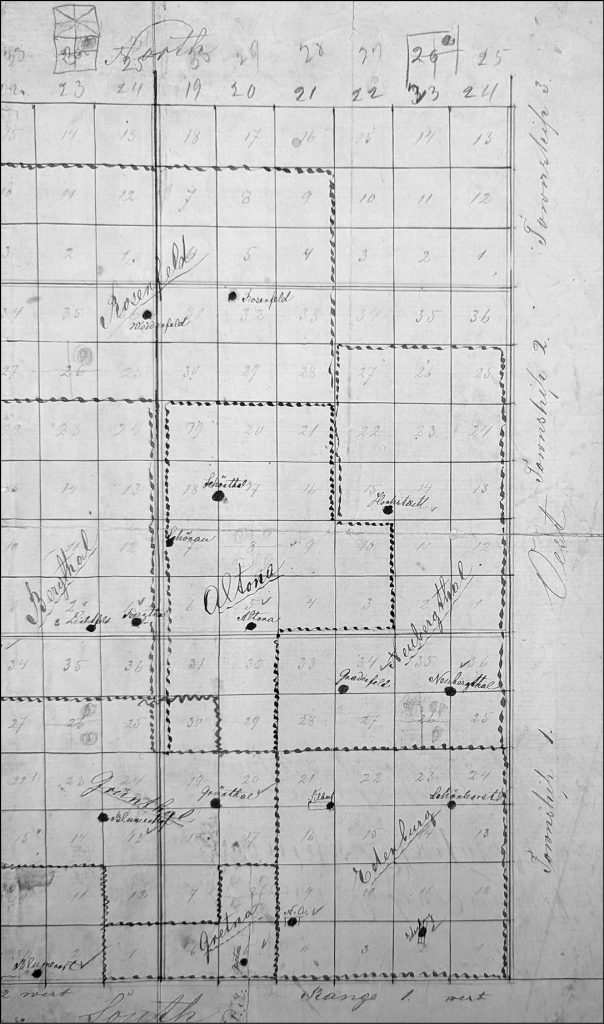
Lichtfeld’s first settlers included the Bergen, Gerbrandt, Giesbrecht, Reimer, Toews, and Wiebe families.2 Intermarriage produced an interconnected familial network with a shared history that formed a strong foundation for place identity among Lichtfelders, further reinforced as they worked together to create infrastructure, cultivate land, and participate in local governance. These efforts fostered place dependence during the settlement era and nurtured a collective place attachment rooted in feelings of belonging and pride. At the same time, Lichtfeld’s proximity to Altbergthal set it apart from other communities, fostering inter-community collaboration that augmented both place identity and place attachment. Shared education, the natural environment, and spiritual practices became central to this distinctive relationship.
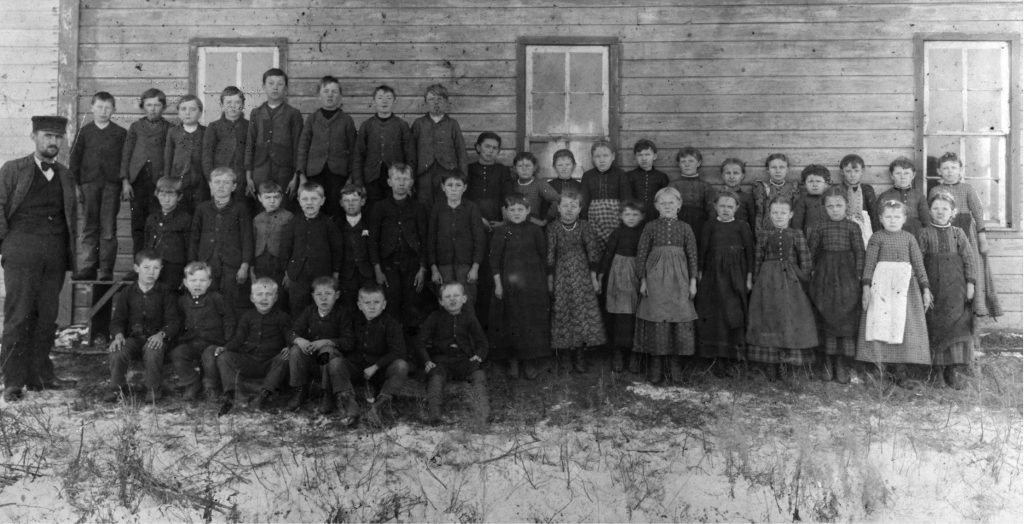
In 1884, the two villages jointly established a public school named after Altbergthal, with local men from each community, such as Klaas Gerbrandt and Heinrich Wiebe of Lichtfeld, appointed as school trustees.3 This educational system became a symbol of collaboration and fostered strong connections among young Lichtfelders and Altbergthalers that endured for decades.4 Upon her move from Morden to Altona in 1962, former Lichtfelder Anna Gerbrandt informed readers of the Steinbach Post that Altona “is only three miles east of where my cradle stood, Lichtfeld, and my school, Altbergthal.”5 Similarly, when residents commemorated the school’s amalgamation into a regional district in 1965, Cornelius J. Bergmann’s stepson A. D. Friesen reflected on the close relationships he had formed and maintained since his youth in the 1890s.6
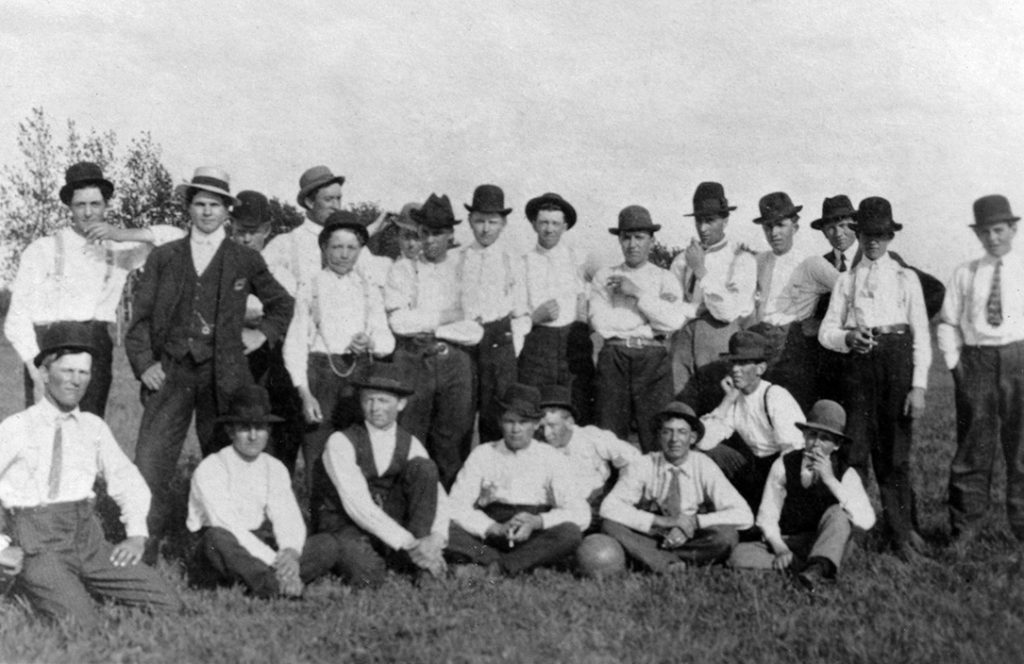
The natural environment also bonded the two communities. Altbergthal, situated along the eastern bank of Buffalo Creek, became a hub for recreation and socialization by the late 1890s, as evidenced by reports of skating in winter and photos of boating in summer.7 However, the creek primarily served as a vital water source for both people and livestock and as a productive hunting ground.8 This dual role occasionally attracted non-residents, which led to conflicts over property and safety.
In an 1897 letter to readers of Der Nordwesten, Lichtfeld’s Heinrich Wiebe condemned reckless hunters and cited three specific examples of endangered livestock and people near the creek: “We only wish that the hunters would take care not to shoot in the Altbergthaler and Lichtfelder Buffalo Creek in such a brutal way as last year, because sheep and cows were considered ducks. . . . Hunters should therefore be warned not to go hunting without a hunting permit this year, because we will hold anyone who hunts on our land without permission to account, no matter who he may be.”9 Wiebe’s objections to reckless behaviour near Buffalo Creek reflected more than practical concerns; they reveal a deep connection to the land as an extension of each community.
Spiritual practices also united Altbergthal and Lichtfeld, specifically through the influence of Altbergthaler Johann Funk, who was elected bishop of the West Reserve Bergthaler Church in 1882. Funk welcomed several local men to the ministerial council, such as Lichtfelder Isaak Bergen and Altbergthalers Abraham Schroeder and Isaak Giesbrecht. His home became a central venue for leadership meetings, while the local school occasionally hosted worship services.10
Despite a schism between Funk and his followers in the early 1890s, which saw the majority of Altbergthalers and Lichtfelders distance themselves from the so-called “Funk Church,” families continued to gather at the local school – albeit often after a winter storm – to hear Funk preach.11 These gatherings illustrate how strong connections transcended spiritual divides and bound the communities together.
Over time, however, opportunities for growth and prosperity began to redefine the priorities and daily lives of residents around individual pursuits. High agricultural yields, the arrival of the railway, and the growth of regional trading centres such as Altona soon provided Mennonites with greater access to new markets.12 These foundational changes set the stage for broader socio-economic shifts in the West Reserve, along with the gradual dispersal of families from Lichtfeld.
This process began in 1885, when Heinrich Wiebe relocated to establish a homestead across the township road, and accelerated in the 1890s, when several families followed suit or left the area altogether.13 Lichtfelder A. D. Friesen witnessed the transformation of Lichtfeld firsthand, and recounted to Lawrence Klippenstein that “one by one, families moved away from the village, and so it ceased to be, but Altbergthal remained.”14 These departures marked a critical shift in place dependence and gradually weakened intergenerational place identity and place attachment.
Local Ambitions and Dissolution
Despite the dissolution of the village, Lichtfeld played a brief but notable role in the broader West Reserve through the economic and political interests of key figures, which fostered a functional, external reliance on the community. Historical records indicate that Lichtfelders such as Peter Reimer, Heinrich Wiebe, and Cornelius J. Bergmann acquired substantial land holdings in Lichtfeld and the nearby communities of Bergfeld and Neuhoffnung.15 Bergmann even attempted to establish a town on his land northwest of Lichtfeld, along the Midland Railway of Manitoba’s new regional line, although the site ultimately served only as a railway siding for grain transportation.16
Lichtfelders such as Bergmann, Wiebe, and Abraham Giesbrecht also held significant roles in regional governance. Each served as a municipal councillor and participated in various community initiatives. Bergmann emerged as a particularly influential figure. He hosted municipal council meetings at his home throughout the 1890s, was involved in the development of the Mennonite Educational Institute, and served as reeve of the Rural Municipality of Rhineland in 1900, 1902, and 1903.17 His ambitions also extended to provincial politics, where he was among the first Mennonites to run for a seat in the legislature in 1907.
Bergmann’s and Wiebe’s political affiliations diverged before the 1907 election. Initially united in their support of the Liberal Party, Bergmann later switched allegiance to the Conservative Party and became its candidate in Rhineland, while Wiebe remained loyal to the Liberals.18 The campaign culminated in Bergmann’s defeat by incumbent representative Valentine Winkler. According to a newspaper report, Winkler “hired Mr. Heinrich Wiebe of Lichtfeld to help him with the campaign. . . . [Winkler] is counting on the influence of his campaign workers, especially Mr. Wiebe, who has promised to dedicate all his powers to influence the election.”19
While these ventures brought brief regional prominence to Lichtfeld, they did not halt the community’s dissolution in the early twentieth century. As the physical and social structures of Lichtfeld dissolved and its residents dispersed, its place identity and place attachment were gradually absorbed by the broader regional identity centred around Altbergthal.20
Regional Identity and Contemporary Symbolism
By the Second World War, the area historically known as Lichtfeld had become associated with three homes west of the original village site, owned by the families of Abram A. Friesen, Klaas P. Kroeker, and Simon J. Schroeder. Maps and historical records increasingly began to misidentify this area as the original location of the village. Lichtfeld soon existed primarily in occasional newspaper correspondence and the familial memory of a few descendants of the Gerbrandts, Toewses, and Wiebes who remained in the area.21
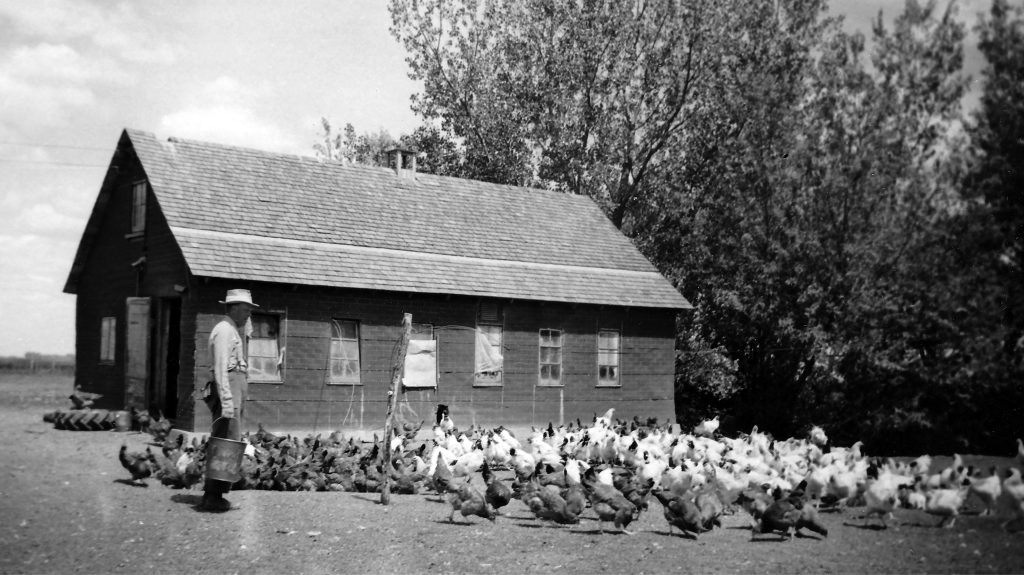
With each new generation, physical and emotional ties to Lichtfeld faded and gave way to stronger associations with Altbergthal. The local school played a pivotal role in this transition, becoming a unifying symbol that fostered a strong sense of place identity and place attachment to Altbergthal. Lichtfeld descendant Bernie Wiebe, who was raised on the homestead his grandfather established across from the former village, later reflected on this: “My father still signed our home address as Lichtfeld, [but] for so many years, of course, we saw that name there every day: ‘1296 Altbergthal.’ I was a student there for ten years, so it was very hard to refrain from identifying with Altbergthal.”22
Even after its amalgamation into a regional school district in 1965, the Altbergthal school building remained a focal point for residents. Preservation efforts in subsequent decades centred on this structure, which became a way to honour and reaffirm Altbergthal’s identity. These preservation efforts, led by descendants of the Klippensteins in Altbergthal and the Wiebes in Lichtfeld, safeguarded Altbergthal’s legacy. However, they offered little acknowledgment of Lichtfeld’s unique contributions to the area and connections to Altbergthal. Efforts to document Altbergthal’s history and families have also largely overlooked Lichtfeld, focusing instead on Altbergthal’s centrality and identity.23
Nevertheless, recent developments illustrate the formation of new place dimensions, as Lichtfeld has experienced a symbolic revival in the twenty-first century. This renewal was inspired by the establishment of the Lightfield Mennonite Church in the former Neuhoffnung school building. The congregation, which belongs to the Eastern Pennsylvania Mennonite Church, adopted for its name an anglicized form of Lichtfeld, the closest historic community, creating a new sense of place identity rooted in nostalgia.24 Increasing interest in the original village site has also brought historical connections back into focus. Some historically minded residents, such as Joanne Bergen, who lives on a homestead next to the former village site, have reclaimed the name Lichtfeld. With the construction of new homes nearby, they have reasserted its significance and brought new meaning to its sense of place. These contemporary reinterpretations demonstrate how connections between people and place continually shape identity.
Conclusion
Lichtfeld’s history offers a compelling case study of how people form and interpret their sense of place, illustrating that history is not static; it lives in how we engage with it, the stories we tell, and the meaning we derive. It is a privilege to contribute to Lichtfeld’s story and to deepen our understanding of its shared history with Altbergthal. While collaboration with Altbergthal appeared central to Lichtfelders’ sense of place, Altbergthalers seemingly regarded this relationship as more peripheral. By continuing to explore these stories, we ensure the spirit of these places, and the people associated with them, remains alive – not as mere echoes of the past, but as evolving narratives that bridge generations.connecting us to those who came before and those yet to come.
Graham Schellenberg is a Winnipeg-based public relations professional and local historian, descended from Mennonite and Volhynian settlers on Treaty 1 territory.
A version of this paper was presented at the conference “Subjects, Settlers, Citizens: The 1870s Mennonites in Historical Context,” hosted by the Centre for Transnational Mennonite Studies in October 2024. The author is grateful to Hayley Stacey, Lawrence Klippenstein, Martha Martens, Bruce Wiebe, Ed G. Krahn, and Ben Nobbs-Thiessen for their valuable contributions and support.
- Christin Dameria, Roos Akbar, Petrus Natalivan Indradjati, and Dewi Sawitri Tjokropandojo, “A Conceptual Framework for Understanding Sense of Place Dimensions in the Heritage Context,” Journal of Regional and City Planning 31, no. 2 (Aug. 2020): 139–63. ↩︎
- “1881 Federal Census: Rural Municipality of Rhineland – Eastern Part,” in Bergthal Gemeinde Buch, ed. John Dyck, 2nd ed. (Steinbach, MB: Hanover Steinbach Historical Society, 2001), 376–77. ↩︎
- Manitoba Department of Education, Half-Yearly School Returns, 1884, Archives of Manitoba (AM), Winnipeg; Henderson’s Directory of the City of Winnipeg, 7th ed. (Winnipeg: Winnipeg Directory Publishing Company, 1886), 82; and Henderson’s Directory of the City of Winnipeg, 11th ed. (Winnipeg: Winnipeg Directory Publishing Company, 1890), 64. ↩︎
- Amid the transition from private to public schools in the 1890s, perspectives on education and community identity varied. In October 1894, local teacher Abraham Ens wrote to the Mennonitische Rundschau that he had “resumed teaching at the Alt-Bergthaler and Lichtfelder school.” The following year, some residents proposed a new public school named after Lichtfeld. However, the effort was unsuccessful, as many families appeared content with the private school in Altbergthal. The private school operated until 1904, when a new building was constructed to house a public school named after Altbergthal. Abraham Ens, “Gretna,” Mennonitische Rundschau, Oct. 17, 1894, 1; Rural Municipality of Rhineland, Council Minutes, Aug. 6, 1895, Mennonite Heritage Archives (MHA), Winnipeg; and “Historic Sites of Manitoba: Altbergthal School No. 1296,” Manitoba Historical Society, last modified July 19, 2024, http://www.mhs.mb.ca/docs/sites/altbergthalschool.shtml. ↩︎
- Anna Gerbrandt, “Morden, Man.,” Steinbach Post, Apr. 10, 1962, 13. ↩︎
- “Altbergthal Fellowship Supper Marks End of School District,” Red River Valley Echo, Aug. 4, 1965, 2B. ↩︎
- Heinrich Wiebe, Der Nordwesten, Mar. 18, 1897, 5; and Lawrence Klippenstein Family Photograph Collection, MHA. ↩︎
- The Rural Municipality of Douglas constructed the first known bridge over Buffalo Creek at Altbergthal in 1885. Within a few years, deterioration necessitated repairs. Rural Municipality of Douglas, Council Minutes, Sept. 1, 1885, MHA; Manitoba, Legislative Assembly, Sessional Papers, 1887, no. 3, “Alteration of Existing Roads and Opening Up New Ones,” 37; and Rural Municipality of Rhineland, Council Minutes, Oct. 4, 1892, MHA. ↩︎
- Two years later, Abraham Ens echoed Wiebe’s concerns in a letter to the Mennonitische Rundschau: “It is hoped that in the future outside hunters will give up their illegal hunting along the river and that sheep or cows will not be mistaken for waterfowl anymore.” Wiebe, Der Nordwesten, 5; and Edward Enns, In Search of Abraham Ens, 1861–1935, 2nd ed. (Winnipeg: pub. by author, 2002), 5. ↩︎
- “Altona Churches: First Church Buildings Erected in Late 1880’s,” Red River Valley Echo, Nov. 25, 1970, 14. ↩︎
- Henry J. Gerbrandt, Adventure in Faith: The Background in Europe and the Development in Canada of the Bergthaler Mennonite Church of Manitoba (Altona, MB: Bergthaler Mennonite Church of Manitoba, 1970), 90–94, 151. ↩︎
- John H. Warkentin, The Mennonite Settlements of Southern Manitoba (Steinbach, MB: Hanover Steinbach Historical Society, 2000), 137–40. ↩︎
- Isaak Bergen immediately established a homestead northwest of Lichtfeld, outside the village. During the 1890s, Abraham Giesbrecht moved to Altona to operate a general store, Jacob Gerbrandt settled in Lowe Farm, Peter Reimer passed away, and Abraham Reimer relocated to Saskatchewan. Homestead application files, MHA; Margaret S. Braun, “The History of Abram R. Giesbrecht,” in Furrows in the Valley: A Centennial Project of the Rural Municipality of Morris, 1880–1890, ed. Lenore Eidse (Inter-Collegiate Press, 1980), 679–80; Henry J. Gerbrandt, En Route – Hinjawäajis: The Memoirs of Henry J. Gerbrandt (Winnipeg: CMBC Publications, 1994), 12–13; and John Giesbrecht, Neu-Hoffnung School District No. 1310 (Winnipeg: pub. by author, n.d.), 28. ↩︎
- A. D. Friesen, interview by Lawrence Klippenstein, Aug. 16, 1973, Abraham D. Friesen fonds, audio cassette 29, MHA. ↩︎
- Morden Land Titles Office, Abstract Book, Teranet Manitoba; and Friesen, interview. ↩︎
- Bergmann later tried to develop a suburb in Winnipeg. Manitoba and Western Canada Land Company Limited, corporation documents, Manitoba Companies Office, AM; “Bergman: The New Residential Suburb,” Winnipeg Tribune, July 23, 1906, 5; Hans Werner, “Reorienting the West Reserve: Mennonites and the Railway,” Preservings, no. 39 (2019): 18–20; and Bruce Wiebe, “Abandoned Railway Town-sites or Stations in, or near, the Mennonite West Reserve,” Preservings, no. 31 (2011): 36–38. ↩︎
- In 1893, the municipal council agreed to hold its meetings at the Bergmann home near Lichtfeld. Meetings continued there until 1901, when the council relocated to Heinrich Klippenstein’s home near Altbergthal. Rural Municipality of Rhineland, Council Minutes, Jan. 3, 1893, MHA; A. D. Friesen, “Forty-Eight Years Ago,” Altona Echo, June 28, 1944, 2; and Gerbrandt, Adventure in Faith, 259. ↩︎
- “Lisgar Liberals,” Manitoba Morning Free Press, May 5, 1900, 6. ↩︎
- “Gretna,” Rhineland-Bote der Germania, Feb. 28, 1907, 7. ↩︎
- Lawrence Klippenstein, “Altbergthal, 1879–2000,” in Church, Family and Village: Essays on Mennonite Life on the West Reserve, ed. Adolf Ens, Jacob E. Peters, and Otto Hamm (Winnipeg: Manitoba Mennonite Historical Society, 2001), 306. ↩︎
- These families included Wilhelm H. Toews (son of Jacob W. Toews), Margaretha Dyck (granddaughter of Klaas Gerbrandt), Peter D. Wiebe (son of Heinrich Wiebe), and brothers Peter G. Wiebe, Abram G. Wiebe, Jacob G. Wiebe, and Bernard G. Wiebe (grandsons of Heinrich Wiebe). Bernie Wiebe, interview by author, June 22, 2019; Bernie Wiebe, “By Chance and by God’s Grace,” in Why I Am a Mennonite: Essays on Mennonite Identity, ed. Harry Loewen (Kitchener, ON: Herald Press, 1988), 312–14; Terry Wiebe, The Family of Johann H. Wiebe (Altona, MB: pub. by author, 1992), A1, A3, A4, A5, A6, A7, A10, A11, A12, A13; Martha Martens, Memories of My Life: Martha Dyck Martens, 1935– (Winkler, MB: pub. by author, 2018), 5–6; “Life Story of Leroy Lesley Friesen,” Wiebe Funeral Home Altona, Sept. 2015, https://www.wiebefhaltona.com/obituaries/leroy-friesen; Katie Hildebrand, interview by author, Jan. 25, 2020; C. H. Hiebert, “Morden, Man.,” Steinbach Post, Feb. 25, 1932, 3; A. K. Barkman, “Reichenbach und Umgebung,” Steinbach Post, Nov. 12, 1947, 5; Peter U. and Tina Friesen, “Grunthal, Man.,” Steinbach Post, May 12, 1948, 7; J. U. Kehler, “Rosenfeld und Umgebung,” Steinbach Post, Apr. 25, 1956, 5; and Jakob P. Gerbrandt, “Steinbach, Man.,” Steinbach Post, Mar. 10, 1964, 3. ↩︎
- In 1904, Altbergthal was designated as School District No. 1296. Wiebe, interview. ↩︎
- Lawrence Klippenstein, “Alt-Bergthal: Fragments of a Village History,” presented at the West Reserve Village Seminar, Manitoba Mennonite Historical Society, Oct. 27, 1987, MHA; and Klippenstein, “Altbergthal, 1879–2000,” 287–308. ↩︎
- Congregants initially sought to name the church after Neuhoffnung but faced resistance from residents of that community. Private conversations with the author, 2019. ↩︎