
An Immigrant Industry in America: Transfer, Development, and Demise
Rachel Pannabecker
Like all immigrants, Mennonites leaving imperial Russia in the 1870s and 1880s had to decide which material possessions to leave behind, and what to take with them to North America. Shipping a bulky silk reeling machine was not a likely choice, and would have been irrelevant to families that participated in the transition from domestic silk production to centralized reeling centres. Perhaps a finely carved gear or the cocoon-soaking basin were packed for their new homes. An easily portable option would have been mulberry seeds, brought with the hope of restarting a silk industry.1 Unquestionably, knowledge of sericulture and experience in reeling silk were transferable and thus offered a clear route to economic security.
Silk Reeling in a New Land
Abraham Thiessen, an activist for land reform in imperial Russia, immigrated to the Kleine Gemeinde community that had settled around Jansen, Nebraska, in 1876 or 1877.2 Thiessen, a vocal promoter of sericulture, imported Russian mulberry seed which he sold along with seedling trees and silkworm eggs.3 At the 1881 Nebraska State Fair, he received a monetary prize for “the first silk reeled in Nebraska and spun from the silk worms bred there.”4 Thiessen’s silk reeling machine was built by Mr. Bose (Abraham Boese?) of York County, Nebraska.5 In 1884, Thiessen published a booklet in English on silk culture, in which he printed an illustration of a silk reeling machine being operated by women.6 Later that year, he sent a silk reel as well as samples of cocoons and silkworm eggs to the World’s Industrial and Cotton Centennial Exposition in New Orleans, for the Nebraska exhibit.7
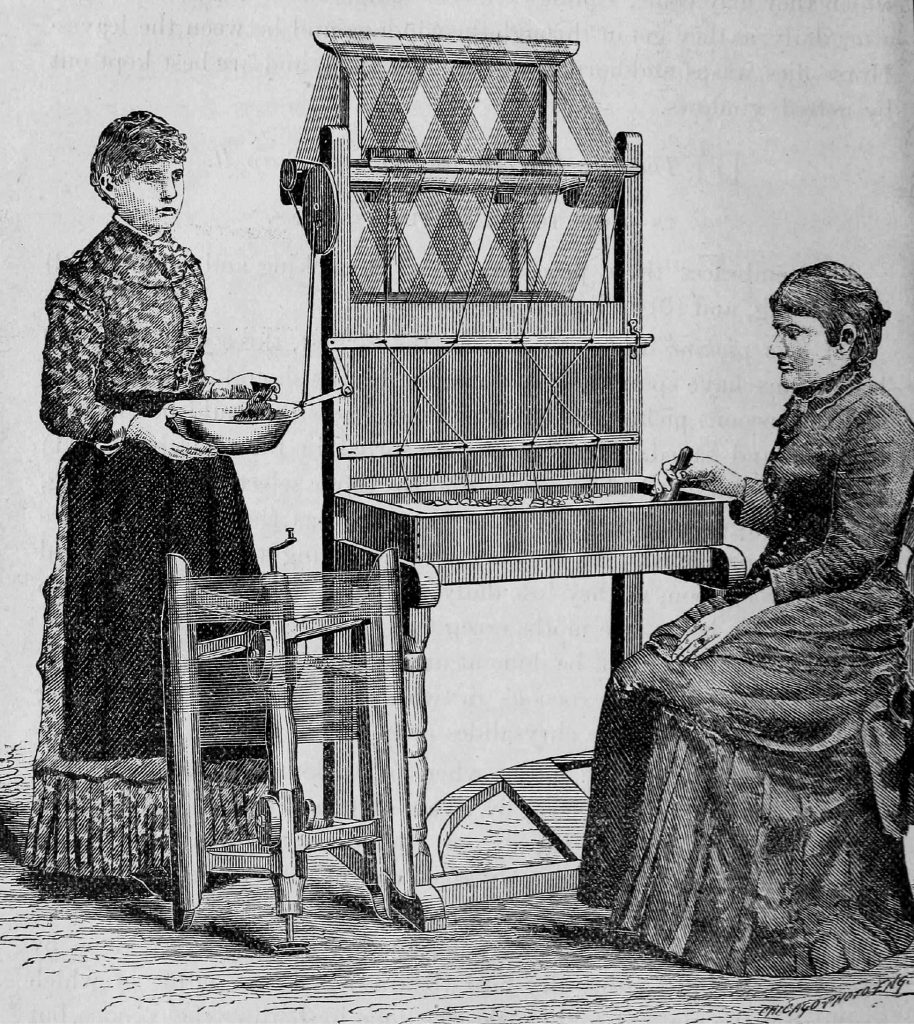
The opportunity to exhibit at this world’s fair attracted other Mennonite immigrants. The “Russian colony” at Mountain Lake, Minnesota, sent two large cases with five bushels of cocoons to show the processes of silk culture and manufacture, including a handkerchief made from raw silk.8 Abraham Penner, a Mountain Lake immigrant involved in multiple commercial enterprises, likely initiated the project, as he had previously worked with an agent to send skeins of raw silk to eastern manufacturers to determine their market value.9 The first known silk reeling among Kansas Mennonites was in 1881, when German-language
newspapers reported that “Brother Krause in New Alexanderwohl put the first silk reel into operation in Kansas and delivered a sample of reeled silk, which was sent to silk manufacturers in the East.”10 The following year, a journalist watched the wife of Johann Krause producing raw silk on “a rude twister and reel of home construction.”11
Towards Factory-Based Reeling
The examples of Thiessen, Penner, and Krause, and their deliberate efforts to connect to a wider public and East Coast manufacturers, fit the definition of proto-industrialization: artisanal production of goods in a rural, domestic setting that are destined for an external market. Such pre-factory manufacturing was often a sideline to agriculture. Mennonite immigrants to the Great Plains, having experienced in imperial Russia the centralization of yarn reeling by skilled operators and overseers to produce raw silk for Moscow manufacturers, were primed to respond to growing interest in developing an American silk industry. The goal of this effort was to replace imported raw silk, the basic material urgently needed by the mechanized throwing (thread-manufacture) and weaving mills based in the mid-Atlantic states.
The United States Department of Agriculture clearly articulated the economic rationale for a silk industry: an unfavourable imbalance of trade, national debt due to foreign imports, and a perceived need for industrial independence through the creation of a home market.12 Simultaneously with Mennonite immigrants reeling silk, the US Congress appropriated $15,000 in 1884 for the establishment of a Silk Division within USDA’s Bureau of Entomology.13 The Silk Division was given the mandate to distribute sericulture literature, silkworm eggs, and mulberry trees to the American public, as well as to buy cocoons and raw silk to establish a profitable reeling industry.14
This federal initiative was championed by the Women’s Silk Culture Association in Philadelphia, the state of California, and private investors, particularly in the southern states, all of whom had been experimenting with small-scale silk filatures, or reeling centres. Citizens in Kansas actively promoted a silk industry, and a report to the Kansas Board of Agriculture acknowledged the valuable experience of Mennonites from imperial Russia: “The reeling was done wholly by experts, who were required to obtain a license from the Government. A number of these persons, who were licensed reelers in Europe, have settled here and will reel the cocoons raised here, when the industry is further advanced.”15
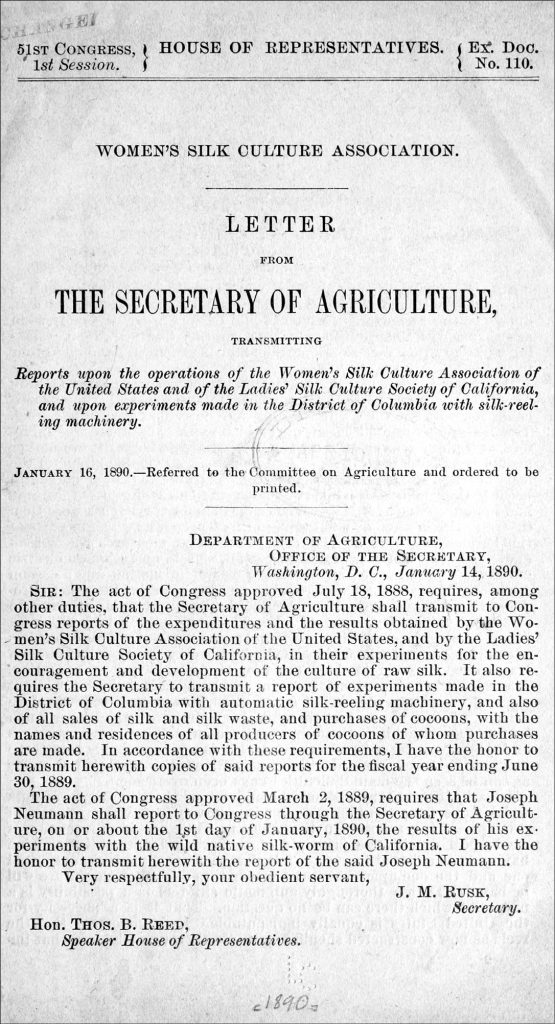
Isaiah Horner, a vigorous advocate of sericulture from Emporia, Kansas, travelled throughout the state lecturing on sericulture with specimens of raw silk reeled by Helen Kroeker, a Mennonite woman from Hillsboro.16 Mennonite immigrants had dealt with tsarist officials in imperial Russia, and used that experience to advocate for the establishment of a state silk station. In March 1887, seventy “Russians” from Hillsboro signed a petition supporting J. H. Morse of Peabody as one of three appointments to the Kansas Silk Commission.17 This public display of interest proved to be significant when the Kansas governor selected Morse for the Silk Commission, which was followed by its selection of Horner as the first station superintendent and the town of Peabody for the silk station – within twenty miles of Mennonite settlements around Hillsboro, Newton, and Goessel. The Kansas legislature appropriated $13,000 to launch the Kansas Silk Station, with a building that would house a cocoonery on the upper floor, a filature with reeling machines on the ground floor, a basement for storing mulberry leaves and cocoons, and a flat roof for drying cocoons.18 From the first days of raising silkworms in March 1887 through its years of active operation, the station employed immigrant Mennonites from the Hillsboro community.
Mennonite Men and the Business of Machines
In its first year the Kansas State Silk Station expended $2,461.27 for “machinery and fixtures.”19 A local newspaper reported that the first reeling machine at the station went into operation on May 5, 1887, and was “worked by foot power, such as the Mennonites use.”20 While the interior of the building took longer to be furnished, by late July three silk reelers were at work on machines treadled by foot, but with the expectation of soon activating reeling by steam power that would also supply hot water for the soaking basin.21
These machines were built by Bernhard Jansen, who was one of the petition signatories.22 Jansen had learned clockmaking in imperial Russia from his father, Abraham Janzen, whose silk reel inventions had been important to the Mennonite silk industry. In 1879, Bernhard immigrated to Hillsboro, where he was described as a watchmaker and an “experienced sericulturist.”23 One local report claimed that Bernhard had been awarded a silver medal by the tsarist state at an international exhibition for his expertise in silk reeling and the invention of a patented silk reel, “the original design being still in Mr. Jansen’s possession.”24 While the journalist could have confused father and son regarding the award and invention, Bernhard was undoubtedly knowledgeable about silk reeling machines used by Mennonites in imperial Russia, from his father’s upright models meant for domestic reeling to improved machines for factory production.
Apparently the “very visionary” Horner ignored Jansen’s knowledge and experience: “Machinery, reels, etc., were changed time and again. It was a veritable ‘cut-and-try’ period.”25 In June of its first season, the station employed Abraham Thiessen, and by September the Silk Commission discharged Horner for mismanagement and insubordination, immediately appointing Thiessen as superintendent. Thiessen recruited Henry Neufeld, a Marion County farmer who had thirty-two years of silk reeling experience in imperial Russia.26 Despite the commissioners’ enthusiasm for Thiessen’s experience, he resigned over a wage dispute in June 1888 and returned to Nebraska, where he passed away on May 7, 1889. Jansen followed Thiessen as superintendent until the beginning of the 1889 season, when Silk Commissioner L. A. Buck declared the need for retrenchment, assuming station management for himself and cancelling the superintendent and assistant superintendent positions.27
Despite the significant Mennonite contribution to building and maintaining the silk station’s reeling machines, Buck pursued inventions that he expected could make the station profitable. Reports by Buck and Philip Walker of the USDA consistently expressed their belief in the critical need for improved reeling machinery, and their particular admiration for Edward W. Serrell Jr.’s invention of an automatic stop mechanism that engaged when thin or broken filaments lessened the tension. Following visits to filatures in Philadelphia and Washington, DC, in 1889, Buck divulged that he was “disappointed, as they informed me that this reel was not a complete success.”28 Despite proponents firmly advocating that inventions could make the American silk industry self-sustaining, the US Congress cut appropriations for the Silk Division, which closed on June 30, 1891.29
The Kansas Silk Station persisted based on the praise received for the quality of its reeled silk from Belding Brothers, a thread manufacturer that was the main purchaser of Peabody raw silk. However, Buck admitted that the station needed a “more rapid and cheaper process of reeling the silk from the cocoons.”30 Without machine improvements to decrease labour costs or increase productivity, the Kansas legislature reduced its 1895 appropriation to a mere $100 to dispose of the station’s assets, which was completed in 1897.31
Mennonite Women and the Art of Reeling
To secure workers for the new Kansas Silk Station, Superintendent Horner contributed articles to area newspapers, including Die Mennonitische Rundschau where he recruited Mennonite girls to learn “the art of silk reeling” for “good wages.”32 A local newspaper noted that Helen Kroeker was supervising the station while Horner travelled east to “investigate improved machinery.”33 In the following months, Kroeker was lauded in the press as “an expert in all silk-worm matters,” reeling silk that was “strictly first-class in quality,” and “fully competent” to take charge of the reeling department after Horner was discharged.34
When Thiessen took over as superintendent, he revealed, “The best silk at the station has been reeled by Mrs. Sudermann, who passed an examination in Russia as a first-class reeler,” followed by Helen Kroeker and Katharine Stelting, who lacked similar credentials.35 Mrs. “Sudeman” became the educator in charge of the reelers in the 1888 season.36 Station expense accounts indicate that E. Suderman was again in charge in 1891, while Kroeker assumed that position in 1889 and the early part of the 1890 season, with Sarah Conrad (Konrath) fulfilling that role in the late 1890 and 1891 seasons. These ledgers also show that Stelting reeled again in 1889 along with Louisa Nickel and H. Reimer.37 The last remaining Mennonite reeler at the station was Conrad, whose raw silk was “very tastefully staged” in the Kansas exhibit at the 1893 World’s Columbian Exposition in Chicago.38
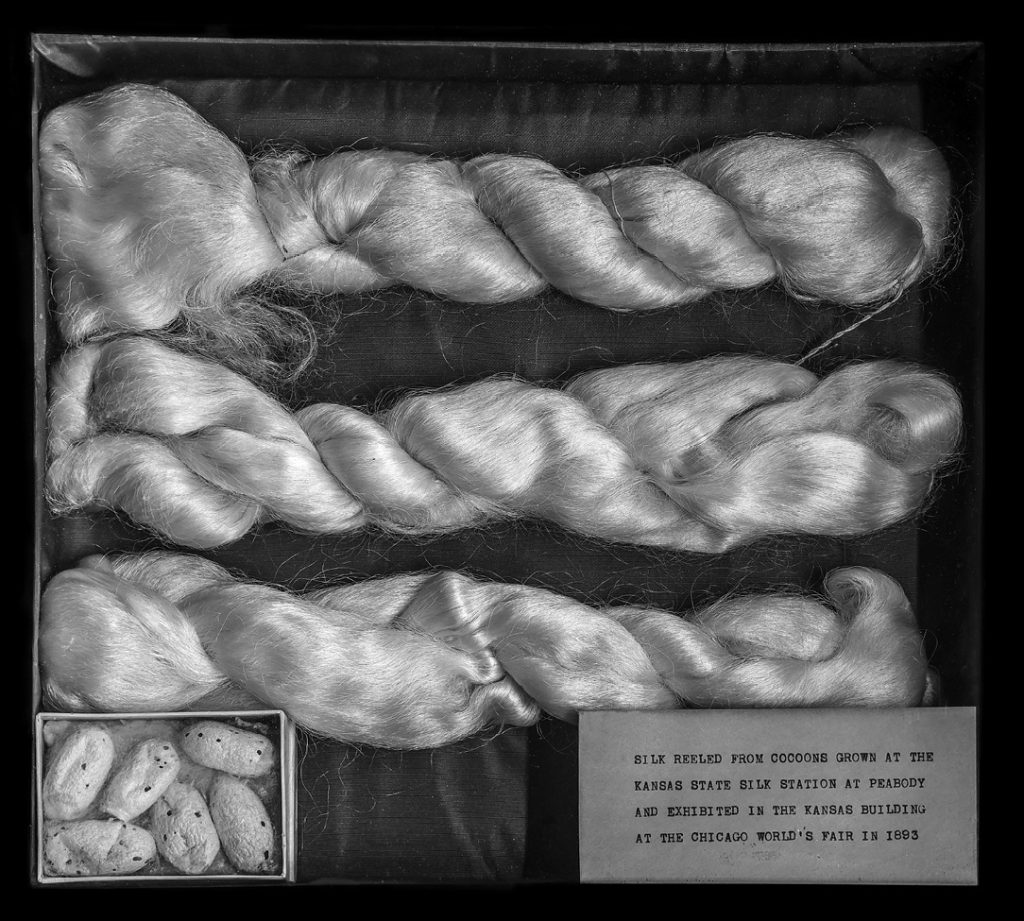
Reeling in the nineteenth century was a complex interaction between humans, cocoons, and machines. In 1871, the USDA claimed that “with four days of instruction and three weeks of practice a woman or girl can become expert in the art of reeling silk.”39 Yet Thiessen’s 1884 manual firmly stated, “We advise all, not acquainted with the art of reeling or provided with the proper machines, not to attempt to reel . . .”40 Many sericulture manuals described reeling along with information on mulberry trees and silkworms. For a top-quality skein of raw silk, the women reeling cocoons at the Kansas Silk Station managed the following tasks:41
(1) Sorting: selecting cocoons for size, colour, and overall quality, setting aside those that are too small, damaged, stained, or pierced by the moth (up to 10 per cent of cocoons are unsuitable). If not reeling immediately, the pupa must be “stifled” by heating or steaming.
(2) Floss removal: brushing away the cocoon’s coarse, irregular, and dusty outer filaments. Floss becomes waste silk along with pierced cocoons, broken filaments, and the weak, innermost cocoon filaments, and is cut and spun like cotton or wool fibres.
(3) Cooking/degumming: submerging the cocoons in hot water to soften sericin (the gum-like protein binding filaments forming the cocoon). Temperature and soaking time vary (variety of silkworm, where raised, whether stifled) to remove just enough sericin to avoid filaments sticking together (complete degumming occurs during thread manufacture). This step includes igniting the heat source and keeping the basin clean of floss, pupae, and debris that would dull silk’s natural gloss.
(4) Reel set-up: brushing to locate the filament end of four to six cocoons (ten in imperial Russia), to achieve the desired strand diameter and strength, manually inserting the strand into guides to wring out excess water and to spread out the strand, then fastening it onto the reel.
(5) Reeling: engaging the treadle or the steam-powered flywheel to turn the reel and unwind the prepared ends, monitoring the filaments for uniformity, and maintaining a continuous pace to avoid stress on the filaments – a procedure that did not accommodate worker breaks.
(6) Nourishing/lancing: stopping the reel when filaments are broken or knotty, or when reaching the innermost filaments that are thin and weak, for replacement with another prepared cocoon end. Timing varies as cocoon filaments range from half a kilometre to one kilometre in length.
(7) Drying: removing the reel from the frame to allow unwound silk to air dry for six to eight hours before detaching the skeins from the reel.
(8) Disbanding: removing filaments from the reel and forming each group into a merchandisable skein of raw silk.
Although deflossing or keeping the water basin clear could be delegated to an assistant, the reeler was responsible for simultaneously keeping all operations and their precise adjustments in unceasing motion for multiple skeins.42 The art of reeling required “skill, tact, experience, patience and watchfulness, and . . . ingenuity.”43 Nourishing required fine motor skills and “accuracy of the human eye and delicacy of the human touch.”44 Decades later it was acknowledged that “the perfection of the filature is still left with the girl’s ability.”45 The journalist who had watched Mrs. Krause reel acknowledged that “the work required infinite patience, of which few Americans are possessed.”46
The Demise of an Immigrant Industry
When Isaiah Horner lobbied the Kansas legislature in February 1887 for a state-funded silk station, he announced, “This is the golden opportunity for Kansas to become the silk center of the New World.”47 Yet the Kansas Silk Station never acquired more than ten reeling machines, when its steam power system could accommodate thirty to fifty.48 The station never raised or purchased enough cocoons to keep the reelers working beyond September.49 Thus the station never fulfilled its aspiration to become the only silk factory between San Francisco and Washington, DC. Despite immigrant Mennonites offering reeling machine experience and skills to this infant industry, their contributions could not manufacture raw silk that was competitive with less expensive imports reeled by low-wage workers in China and Japan.
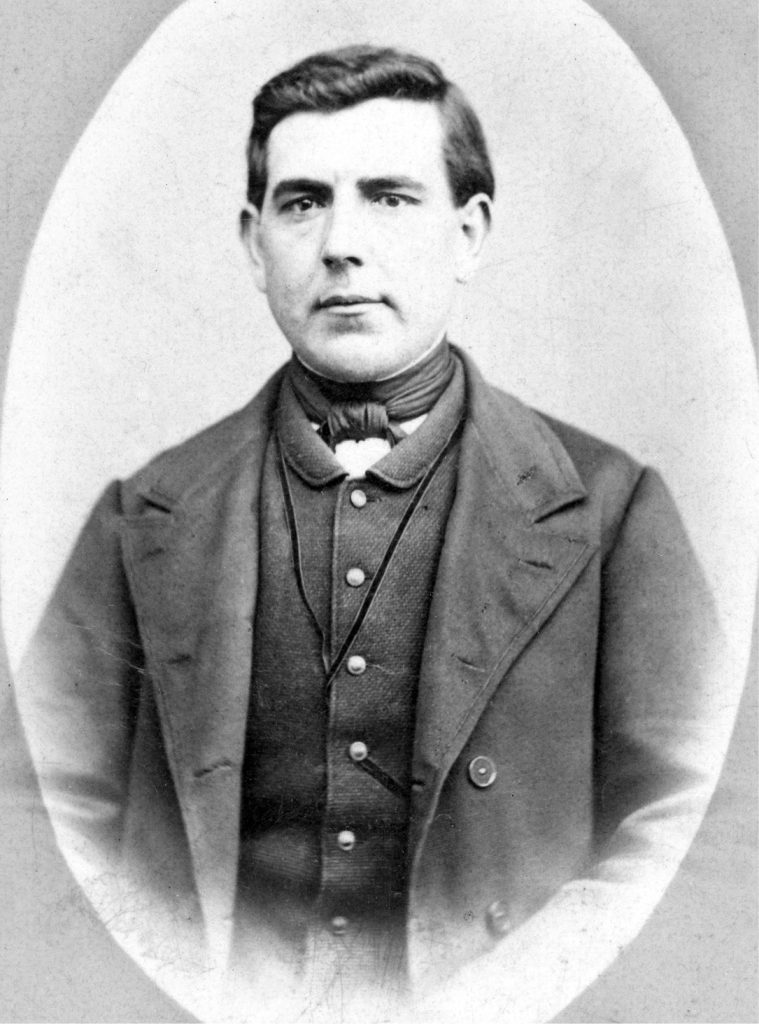
The USDA regularly acknowledged the need for tariffs and financial incentives to protect the emerging silk industry, and called on Congress to rectify the imbalance of raw silk being imported freely while heavy duties shielded woven silk goods.50 The Kansas State Silk Station likewise declared the need for protective tariffs and “bounties.”51 Mennonites were not unaware of the economic barriers to the development of a factory-based cocoonery and filature. In his 1884 pamphlet, Abraham Thiessen expressed his hopeful expectations and his concern about the financial viability of a Mennonite silk industry: “Here in America, as far as my three years’ experience goes, and that of my compatriots in Minnesota and Kansas, there seems to be no reason why silk culture should not succeed. . . . If our wiseacres in Washington would furthermore support us with a good protective tariff on raw silk, silk culture would increase largely.”52 In contrast, there were always those who adhered to a free trade philosophy and opposed this use of taxpayer money. As one newspaper put it in 1890, “The Kansas silk station is a humbug and a fraud” (“Die Kansas Seidenstation ist ein Humbug und ein Schwindel”).53
Mennonite enthusiasm for a silk industry that absorbed its sons’ inventiveness and boarded its unmarried daughters away from home was countered by several economic and social factors. Like in imperial Russia, first-generation immigrants found that the cultivation of wheat as a commodity crop using modern machines was a more profitable economic investment, especially when the June winter wheat harvest competed for a family’s time and labour. Concurrently, Kansas Mennonite education offered new opportunities for women in teaching and mission work. After an initial debate about whether to accept female students, the Halstead Seminary (1883–1893) enrolled ten girls during its first year; Bethel College opened in 1893 with twenty-one women out of ninety-eight students.54 The Kansas experiment in rural industrialization was short-lived without a dynamic advocate like Thiessen, who passed away in 1889 at age fifty. Regardless, the story of Mennonites building and operating silk reeling machines demonstrates that in the last quarter of the nineteenth century, Mennonite men and women were integrated into national and global markets and active participants in the effort to move the proto-industrial system of silk reeling to a factory-based industry.
Rachel Pannabecker is the retired director of Kauffman Museum at Bethel College, North Newton, Kansas.
- C. Henry Smith, The Coming of the Russian Mennonites (Berne, IN: Mennonite Book Concern, 1927), 207. Latitudes north of Cottonwood County, Minnesota, were considered too cold for raising mulberry trees. Charles Gibb, “Ornamental and Timber Trees (Not Natives of the Province of Quebec),” in Seventh Report of the Montreal Horticultural Society and Fruit Growers’ Association of the Province of Quebec, for the Year 1881 (Montreal: The Society, 1882), 87–90. See also Tracy Ruta Fuchs, Beauty and Sustenance: A History of Mennonite Gardens and Orchards in Russia and Manitoba (Steinbach, MB: Mennonite Heritage Village, 2007), 19; and Susan Jane Fisher, “Seeds from the Steppe: Mennonites, Horticulture, and the Construction of Landscapes on Manitoba’s West Reserve, 1870–1950” (PhD diss., University of Manitoba, 2017), 128. ↩︎
- Henry Fast, “The Kleine Gemeinde in the United States of America,” in Profile of the Mennonite Kleine Gemeinde, 1874 (Steinbach, MB: DFP Publications, 1987), 89, 98, 113, 164; “Abraham F. Thiessen (1832–89),” Preservings, no. 12 (June 1998): 13; and Cornelius Krahn, “Abraham Thiessen: A Mennonite Revolutionary?,” Mennonite Life 25, no. 2 (April 1969): 73–77. The exact date of Thiessen’s immigration is unknown, but would have followed his 1876 flight to Switzerland. Richard D. Thiessen, “Thiessen, Abraham (1838–1889),” in Global Anabaptist Mennonite Encyclopedia Online, last modified Jan. 16, 2017. ↩︎
- C. V. Riley, “Report of the Entomologist,” in Report of the Commissioner of Agriculture for the Years 1881 and 1882 (Washington, DC: Government Printing Office, 1882), 73. ↩︎
- Daily Nebraska State Journal (Lincoln, NE), Sept. 15, 1881, 3; and Die Mennonitische Rundschau, Feb. 5, 1882, 3. ↩︎
- Fast, “Kleine Gemeinde,” 113. ↩︎
- Abraham Thiessen, The Mulberry Trees and Silk Culture (Lincoln, NE: State Journal Co., 1884), 24. ↩︎
- “Nebraska’s Silk Industries,” Omaha (NE) Daily Bee, Dec. 13, 1884, 8. ↩︎
- Winona (MN) Daily Republican, Sept. 9, 1885, 2; and “Report of Hon. Oliver Gibbs, Jr., Commissioner of Minnesota, to the World’s Exposition at New Orleans, 1884–5, on the Exhibit Made by This State,” in Executive Documents of the State of Minnesota for the Year 1886, vol. 5 (St. Paul: Pioneer Press, 1887), 75. ↩︎
- Ferdinand P. Schultz, A History of the Settlement of German Mennonites from Russia, at Mountain Lake, Minnesota (Minneapolis: pub. by author, 1938), 68, 110; “Silk Raising in Minnesota,” Tribune (Minneapolis, MN), Mar. 7, 1882, 4; and “Silk in Minnesota,” Daily Globe (Saint Paul, MN), May 2, 1882, 2. ↩︎
- “Der erste Seiden-Haspel in Kansas,” Zur Heimath, Nov. 7, 1881, 164; noted in Die Mennonitische Rundschau, Nov. 15, 1881, 3. ↩︎
- Noble L. Prentis, “A Day with the Mennonites,” Atchison (KS) Champion, May 4, 1882, 2; reprinted in “As Others Saw Them,” Mennonite Life 25, no. 2 (Apr. 1970): 61. ↩︎
- Lewis Bollman, “Silk Cultivation,” in Report of the Commissioner of Agriculture for the Year 1872 (Washington, DC: Government Printing Office, 1874), 304–5. ↩︎
- L. O. Howard, “The United States Department of Agriculture and Silk Culture,” in Yearbook of the United States Department of Agriculture, 1903 (Washington, DC: Government Printing Office, 1904), 141. ↩︎
- C. V. Riley, “Report of the Entomologist,” in Report of the Commissioner of Agriculture for the Year 1884 (Washington, DC: Government Printing Office, 1884), 286, 359. ↩︎
- E. L. Meyer, “Silk Culture in Kansas,” in Quarterly Report of the Kansas State Board of Agriculture for the Quarter Ending December 31, 1883 (Topeka: Kansas State Publishing House, 1884), 84. ↩︎
- “Silk Culture,” Garden City (KS) Sentinel, Aug. 11, 1886, 3; and Hillsboro (KS) Herald, June 21, 1888, 3. ↩︎
- “Petition of Peter Loewen, Cornelius Krause and Sixty-eight Other Russians,” Mar. 3, 1887, box 9, folder 8, Records of the Kansas Governor’s Office, Administration of Governor John Alexander Martin (1885–1889), State Archives, Kansas Historical Society, Topeka. At least three German-speaking non-Mennonites signed the petition, which was handwritten in German with a typed English translation. Loewen and Krause were the first two signatures on the English page. Names represent men from Mennonite Brethren, Krimmer Mennonite Brethren, and General Conference Mennonite churches. Hundreds of area men signed similar petitions in English. ↩︎
- “The Silk Station,” Weekly Commonwealth (Topeka, KS), Feb. 2, 1888, 6; and Mrs. S. H. Bennett, “History of Marion County Silk Industry Makes an Interesting Early-Day Story,” Marion (KS) Record-Review, Sept. 8, 1949, in “Silk Culture Clippings,” 129, Kansas Historical Society. ↩︎
- First Biennial Report of the Board of Silk Commissioners of the State of Kansas, 1887–88 (Topeka: Kansas Publishing House, 1888), 6. ↩︎
- Peabody (KS) Gazette, May 5, 1887, 4, 1. ↩︎
- John F. Harms, “Die Seidenstation in Peabody,” Marion County (KS) Anzeiger, July 22, 1887, 1. ↩︎
- First Biennial Report of the Board of Silk Commissioners, 4. ↩︎
- Hillsboro Herald, June 14, 1888, 3. ↩︎
- Peabody Gazette, June 23, 1888, 2. The whereabouts of the medal and design are unknown. ↩︎
- First Biennial Report of the Board of Silk Commissioners, 4. For more on the station’s management problems, see R. Alton Lee, “The Ill-Fated Kansas Silk Industry,” Kansas History 23, no. 4 (Winter 2000/2001): 240–55. ↩︎
- “A Valuable Man,” Peabody Gazette, Nov. 3, 1887, 5. ↩︎
- L. A. Buck, Second Biennial Report of the Silk Commissioner of the State of Kansas, 1889–90 (Topeka: Kansas Publishing House, 1891), 4. ↩︎
- L. A. Buck, “Report of State Silk Commissioner,” in Report of the Kansas State Board of Agriculture for the Quarter Ending December 31, 1889 (Topeka: Kansas State Publishing House, 1890), 106. ↩︎
- Howard, “United States Department of Agriculture and Silk Culture,” 143. ↩︎
- L. A. Buck, Annual Report of the Silk Commissioner of the State of Kansas, Year Ending June 30, 1892 (Topeka: Hamilton Printing Company, 1893), 3. ↩︎
- Lee, “Ill-Fated Kansas Silk Industry,” 255; and W. C. Webb (comp.), General Statutes of the State of Kansas, 1897, vol. 1 (Topeka: W. C. Webb, 1897), 214–15. ↩︎
- Die Mennonitische Rundschau, May 11, 1887, 1. ↩︎
- Peabody Gazette, Apr. 21, 1887, 4. ↩︎
- “The Kansas Experimental Silk Station,” Wichita (KS) Eagle, Apr. 24, 1887, 2; Marion (KS) Register, Aug. 24, 1887, 3; and J. H. Morse, “The Horner Trouble,” Topeka (KS) Daily Capital, Oct. 8, 1887, 4. ↩︎
- A. Thiessen, “Our Silk Station,” Peabody (KS) Graphic, Dec. 2, 1887, 1. Sudermann, Kroeker, and Stelting were likely the three reelers seen at work in July in Harms, “Die Seidenstation in Peabody,” 1. ↩︎
- First Biennial Report of the Board of Silk Commissioners, 4. ↩︎
- L. A. Buck, “Report of the Kansas State Silk Commissioner from April 23, 1889 to January 1, 1891” and “Report of the Kansas State Silk Commissioner from January 1, 1891 to January 1, 1892,” Silk Commissioners, State Board of, 1889–1892, box 2, folder 27, Records of the Kansas Governor’s Office, Administration of Governor Lyman Underwood Humphrey 1889–1893, State Archives, Kansas Historical Society. No men are listed as reelers in the 1889–91 expense accounts. Women reelers with non-Mennonite names in the two ledgers were Blanch Beaver, Minnie Beaver, L. Ferguson, Lizzie Gibb, Alice Grayson, Ella Holler, Grace Holler, C. Johnson, K. Johnson, Alice Probst, Louise/Lulu Probst, Amelia Smith, H. Stealy, A. Sterkel, and Emily Sterkel. ↩︎
- “Kansas bietet die ganze Welt,” Hillsboro (KS) Anzeiger, Aug. 18, 1893, 3; reprinted in Die Mennonitische Rundschau, Aug. 23, 1893, 1. ↩︎
- “Silk Culture,” in Report of the Commissioner of Agriculture for the Year 1870 (Washington, DC: Government Printing Office, 1871), 238. ↩︎
- Thiessen, Mulberry Trees, 25. ↩︎
- Compiled principally from: George Richardson Porter, A Treatise on the Origin, Progressive Improvement, and Present State, of the Silk Manufacture (London: Longman, Rees, Orme, Brown & Green, 1831), 182–95; translated as Das Ganze der Seiden-Manufactur (Quedlinburg: Gottfr. Basse,1835); C. V. Riley, The Silkworm; Being a Brief Manual of Instructions for the Production of Silk (Washington, DC: Government Printing Office, 1879); An Instruction Book in the Art of Silk Culture (Philadelphia: Women’s Silk Culture Association, 1882); and Thiessen, Mulberry Trees, 23. ↩︎
- Reeling machines would stand idle while reelers spent about one-fourth of their time preparing cocoons. Delegating less skilled operations to lower wage labour was part of the “Serrell system,” an irony given the failure of Serrell’s mechanical patents to speed up the reeling process. C. V. Riley, “Report of the Entomologist,” in Report of the Commissioner of Agriculture, 1885 (Washington, DC: Government Printing Office, 1885), 218–19. ↩︎
- L. P. Brockett, The Silk Industry in America (New York: Silk Association of America, 1876), 87. ↩︎
- C. V. Riley, The Mulberry Silkworm; Being a Manual of Instructions in Silk-Culture, 6th ed. (Washington, DC: Government Printing Office, 1886), 50. ↩︎
- Leo Duran, Raw Silk: A Practical Hand-Book for the Buyer (New York: Silk Publishing Company, 1921), 39–40. ↩︎
- Prentis, “Day with the Mennonites,” 2. ↩︎
- “Silk Culture in Kansas,” Marion (KS) Record, Feb. 25, 1887, 2. ↩︎
- “Silk Station,” Weekly Commonwealth, 6; and Buck, Second Biennial Report, 5. ↩︎
- Buck, “Report . . . April 23, 1889 to January 1, 1891”; and Buck, “Report . . . January 1, 1891 to January 1, 1892” ↩︎
- Riley, “Report of the Entomologist,” 1882, 75; C. V. Riley, “Report of the Entomologist,” in Report of the Commissioner of Agriculture for the Year 1883 (Washington, DC: Government Printing Office, 1883), 101; C. V. Riley, “Report of the Entomologist,” in Report of the Commissioner of Agriculture, 1888 (Washington, Government Printing Office, 1889), 54–55; and Philip Walker, “Report of the Chief of the Silk Section,” in Report of the Commissioner of Agriculture, 1890 (Washington, DC: Government Printing Office, 1890), 266. ↩︎
- First Biennial Report of the Board of Silk Commissioners, 5. Today a bounty would be called a subsidy. ↩︎
- Thiessen, Mulberry Trees, 8–9. He was also aware of the irony that Europeans “procure fresh eggs annually from Japan, which pass Omaha, Neb., generally in the latter part of February on their way east” (9–10), an Asia-to-London trip that was facilitated by the US transcontinental railroad. ↩︎
- McPherson (KS) Daily Republican, Feb. 22, 1890, 2; translation in Marion County Anzeiger, Feb. 28, 1890, 3. ↩︎
- Peter J. Wedel, The Story of Bethel College (North Newton, KS: Bethel College, 1954), 35, 95. ↩︎