
Tariffs and Taxes on Trades in West Prussia
Ingrid Peters-Fransen
In 1789, Mennonites began to migrate from Danzig and the surrounding territory of West Prussia to the Ukrainian lands of imperial Russia. Scholars have recognized that this migration had both push and pull factors. The push factors in West Prussia included Prussian militarization, threatening the ability of Mennonites to avoid military service, and restrictions on land ownership, which limited economic opportunity. The pull factors from the Russian empire included freedom of religion, represented through exemption from military service, and the offer of land.1 Overlooked by scholars has been the role of taxes on trade, similar to tariffs, imposed by the Prussian state on exports from the new province of West Prussia to the city of Danzig, which was still under Polish sovereignty. These taxes on trade might have weakened the economic circumstances of Mennonites in both Danzig and West Prussia.
What is a tariff? A tariff is a tax by one country on goods imported from another country. For example, suppose the United States imposes a 25 per cent tariff on Canadian steel. Suppose that before the tariff, a Canadian steel producer sold a quantity of steel for $10,000 and a US customer paid that amount. After the introduction of the tariff, if the Canadian producer were to continue to charge $10,000 for the quantity of steel, the US customer would have to pay their government $2,500 on top of the $10,000 price. In this situation, it is likely the Canadian producer would lower their price so the price for the US customer does not rise by 25 per cent; however, it is unlikely the producer would drop the price enough to eliminate the full effect of the tariff. Given that the price of Canadian steel for the US customer would have increased, US customers would buy less Canadian steel and look at other sources of steel – say, US producers. US steel producers might in turn look at the increased price of Canadian steel to the US customer after the tariff and raise their prices. Therefore, as a result of the 25 per cent tariff levied on Canadian steel being imported into the United States, Canadian steel producers are worse off because they end up selling less at a lower price, US steel consumers are worse off because they pay a higher price and consequently might end up buying less, US steel producers are better off because they sell more at a higher price, and the US government collects the tariff revenue. Alternatively, a customs duty could be imposed by an exporting country on exports. This would have a similar effect of increasing prices in the importing country, reducing the quantity exchanged between the exporting and importing country, and making the producers in the exporting country worse off. Given the current discussion of tariffs, which are taxes on trade, being imposed on Canada and many other countries by the United States, it is interesting to consider the possible impact of taxes on trade on Mennonites in the past.
This year is the five hundredth anniversary of Anabaptism, a movement that had roots in Switzerland, where the first recorded adult baptisms of the movement took place, and the Low Countries (present-day Belgium and the Netherlands), and in other western European territories.2 Mennonites in the Low Countries experienced severe persecution, especially in the southern provinces. In 1579, with the formation of the Dutch Republic through the union of seven Dutch provinces in revolt against Spanish rule, religious toleration came to the territory.3 Persecution continued, however, in the southern Low Countries (present-day Belgium).
Before the Dutch Republic was formed, a significant Baltic grain trade developed between the Kingdom of Poland and the northern Netherlands. Merchants exported much of the grain grown in the Vistula River valley through the port of Danzig at the mouth of the Vistula to Amsterdam. At times, over 60 per cent of Baltic rye and wheat exports went through the port of Danzig and over 75 per cent of Baltic grain imports were destined for Amsterdam.4 In the seventeenth century, the Dutch described the Baltic trade as the “mother of all trades.” This trade resulted in the development of the Dutch merchant marine and a shipbuilding industry that facilitated later trade with the Mediterranean and the East and West Indies.5 It is hard to overstate its importance – in the eighteenth century, the Baltic grain trade exceeded the tonnage of the trade between Europe and Asia.6
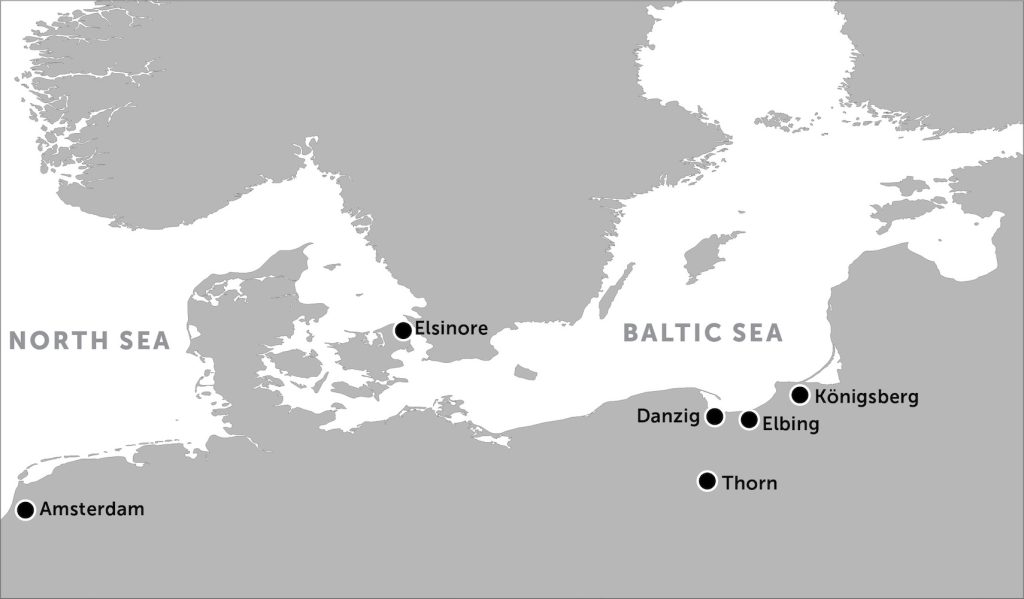
The voyage between Amsterdam and Danzig by sea was about 1,500 kilometres.7 Ships travelling this route had to pass through the Danish Sound. In the fifteenth century, tolls were levied by the Danish on every ship that passed through the strait. They were collected at Elsinore, the point at which the strait is at its narrowest, and duly recorded. By the end of the sixteenth century, tolls were levied on the commodities being shipped rather than on ships. The Sound tolls were an important source of revenue for the Danish until they were discontinued in the mid-nineteenth century.8 The accounts of the toll are an important source of information on Baltic shipping during the early modern period. Much of the data used in this article is based on the Sound Toll Register.9
From the fifteenth to the eighteenth centuries, Danzig served as an important port for the Dutch, particularly for the export of grain. Initially rye was the primary grain export, although in later years wheat became important. In the late sixteenth century, over 80 per cent of the grain exported from the Baltic was rye and approximately 10 per cent was wheat; by the end of the eighteenth century, the percentage of rye was just under 50 and the percentage of wheat had increased to over 33.10 Over the entire period, rye and wheat accounted for over 80 per cent of Baltic grain exports. Mennonites and other farmers grew much of this grain in the agrarian hinterland of the lower Vistula extending from Danzig to Thorn.
Mennonites were involved in the Baltic grain trade as merchants in Amsterdam11 and Danzig12 and as farmers in the Vistula valley.13 How did Mennonites end up in Danzig and the Vistula valley, territory that would become West Prussia? The Teutonic Knights from their base in Marienburg ruled the region that would become known as West Prussia from 1309 until 1457, when they were defeated by a Polish-Lithuanian army.14 The area became the Polish province of Royal Prussia in 1466.15 This province included the city of Danzig, which had participated in the defeat of the Teutonic Knights. The Kingdom of Poland and the Grand Duchy of Lithuania, with one person serving as both monarch and duke, officially united as the Polish-Lithuanian Commonwealth in 1569.16 This union continued to be an elective monarchy with the Sejm (a bicameral governing council of nobles) choosing the monarch. In 1573, the Sejm approved the declaration of the Warsaw Confederation, which formalized and extended the policy of religious toleration as a response to the persecution of religious dissidents in other parts of Europe.17
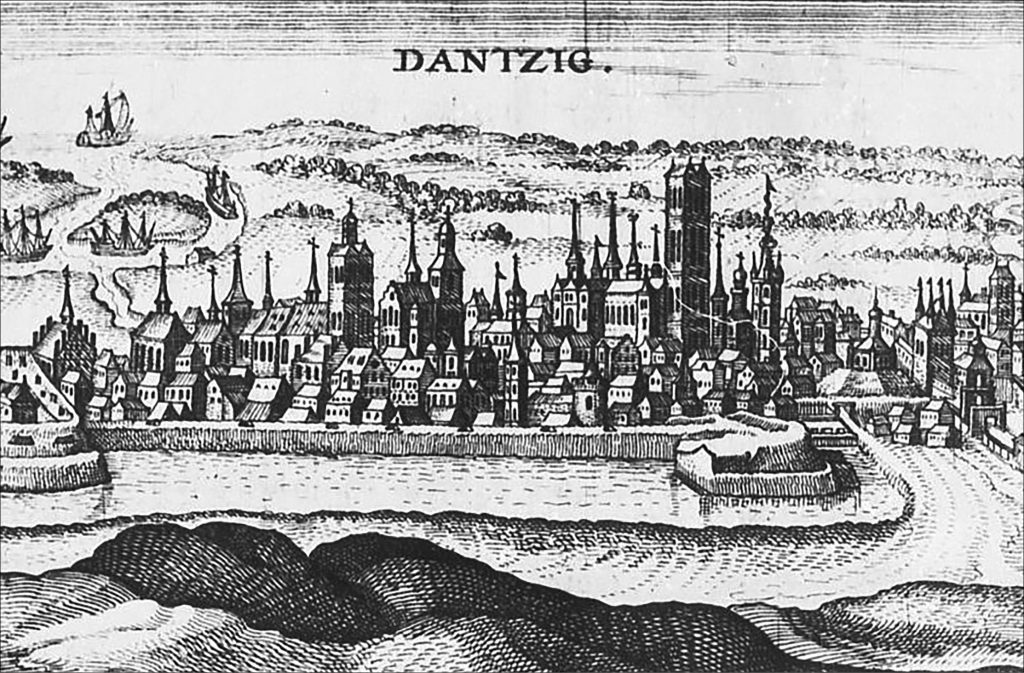
Much of the area around Danzig and Marienburg was below sea level. Although the Teutonic Knights had built dikes, wars had depopulated the area and they were not maintained. In 1547, the Danzig city council sent Philip Edzema, a Frisian, to the Netherlands to recruit settlers to drain and cultivate the Danzig Werder, watery lands in the Vistula Delta that had been vacated.18 Attracted by the promise of land and by the relative toleration of the country in a continent marked by persecution, Mennonites responded to the call. They became known for their success at land reclamation. In 1555, the Danzig council wrote a letter to the Polish king in defence of the colonists: “These Dutch, gracious King, have achieved a wonderful reclamation in a short time so that instead of deserted fields, we will have 27 Hufen [453.6 hectares]. They have improved the land so much that we will receive 108 marks annually in tax from this village where we had earlier not received more than 39 marks.”19 The letter describes four other villages that had benefited from the colonists. In total, the annual tax revenue had increased from 91 marks to 768 marks.
Almost a century later, in 1642, King Władysław IV recognized the contribution of the Mennonites in a charter confirming privileges granted by his predecessors: “We are well aware of the manner in which the ancestors of the Mennonite inhabitants of the Marienburg islands (Werder), both large and small, were invited here with the knowledge and by the will of the gracious King Sigismund Augustus, to areas that were barren, swampy and unusable places in those islands. With great effort and at very high cost, they made these lands fertile and productive.”20 This king’s praise of Mennonites was reiterated at the end of the seventeenth century by King Augustus II: “At our happy accession to the throne in Krakow on 20 September 1697, we confirmed and strengthened for the Mennonites . . . all the rights, privileges, and exemption from public responsibilities which had been granted them. With great effort and industry, they have transformed the Marienburg Werders into productive farmlands and pastures.”21
Mennonites not only settled the Vistula Delta as farmers; they also found a new home in Danzig as merchants. Many merchants in the Dutch provinces, ruled by Spain, were attracted by the teachings of the Reformation. In 1567, the Spanish King Philip II assigned the Duke of Alba the task of restoring Catholicism in the Netherlands.22 The duke was ruthless in his repression of religious dissenters. Dissenting merchants fled from Amsterdam to Danzig on the well-travelled trade route in fear for their lives. After the formation of the Dutch Republic in 1579, with its policy of religious toleration, some of the merchants returned to Amsterdam but others – including some who were Mennonite – remained in Danzig.23
During the sixteenth and seventeenth centuries, Mennonites emigrated from the Netherlands to the Polish-Lithuanian Commonwealth because of religious toleration and economic opportunities. How did Mennonite farmers and merchants fare in their new homeland in Danzig and the Vistula valley? The 1776 census of Mennonites in West Prussia provides information about the economic status of Mennonites in West Prussia, including the Danzig suburbs.24 There are five classifications for economic status: gut (good), mittelmässig (middling), schlecht (bad), arm (poor), and sehr arm (very poor). The “very poor” were only found in almshouses. Mennonite farmers were identified by the terms Bauer, Landwirt, or Landmann. In general, a Bauer was worse off and a Landmann was better off than a Landwirt. This was affected by location (fertility of the soil and distance to market) as well as by size of landholding and number of servants. Similar data collected for the early modern period in Europe has around 20 per cent of the population as middling and a significant percentage as poor,25 so overall farmers in West Prussia were doing well on average (25.8 per cent were middling and relatively few were poor).
| Good | Middling | Bad | Poor | Total | |
| Bauer | 1 | 23 | 24 | ||
| Landmann | 313 | 516 | 1 | 830 | |
| Landwirt | 2 | 172 | 854 | 5 | 1,033 |
| Total | 486 | 1,393 | 6 | 1,887 |
In terms of merchants in West Prussia, the census gives four designations: Kaufmann, Krämer, Häker, and Hakenbüdner. Of these, a Kaufmann would have been involved in foreign trade. The term likely describes merchants who dealt primarily in grain (although they would also have dealt in other commodities). The census lists four Mennonite merchants in the Danzig suburbs, three with the economic status of good and one middling; clearly they were doing well, likely as a result of the brisk Baltic grain trade.26
In the late eighteenth century, taxes on trade caused disruption. With the First Partition of Poland in 1772, Frederick II, the king of Prussia, annexed Royal Prussia, excluding the cities of Danzig and Thorn, and renamed the province West Prussia.26 The other powers involved in the partition, the Austrian and Russian empires, did not want to grant Prussia the port city of Danzig – the most important port on the Baltic. To throttle trade and thereby weaken Danzig economically and politically, making the city more likely to submit to Prussian annexation, Frederick imposed a 12 per cent customs duty on goods from West Prussia destined for Danzig.27 If the goods ended up in the Prussian-controlled city of Elbing, 10 per cent of the duty was rebated, resulting in an effective duty of 2 per cent for Elbing.28 There was a significant decline in the percentage of Baltic wheat and rye leaving the Danzig port during the decade 1771–1780. In 1761–1770, 47 per cent of Baltic rye exports had passed through the port of Danzig; this decreased to 14 per cent in 1771–1780, 15 in 1781–1790, and 14 in 1791–1795. In 1761–1770, 76 per cent of Baltic wheat exports went through the port of Danzig; this decreased to 44 per cent in 1771–1780, 29 in 1781–1790, and 30 in 1791–1795.29
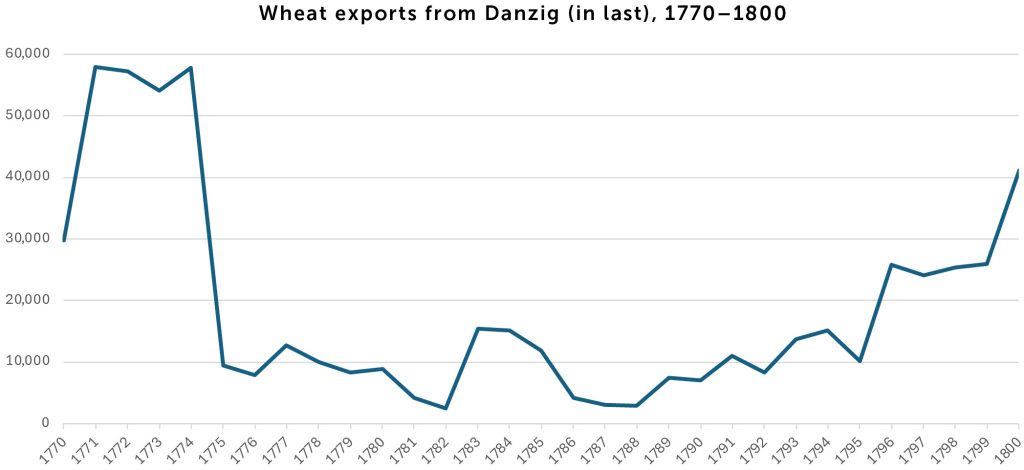
The table of wheat exports leaving the port of Danzig shows that the volume of wheat through the port dropped precipitously from over 50,000 last per annum from 1771 to 1774 to approximately 10,000 last per annum for the period from 1775 to 1795 (1 last = 30.1 hectolitres). Some of these exports were re-directed to Königsberg, a port under Prussian control. In 1771–1780, 18 per cent of Baltic wheat exports went through the port of Königsberg; this increased to 38 per cent for 1781–1790, and 40 per cent for 1791–1795.30 After the Second Partition in 1793, Prussia was granted the port of Danzig, and the taxes on trade were removed. After this change, the volume of wheat through the Danzig port increased to approximately 25,000 last per annum from 1796 to 1799, and reached 40,000 last in 1800. The customs duty impacted not only the volume of wheat exports but also their destination. In the early years of the duty, most wheat exports from Danzig were shipped to Amsterdam; after its removal two decades later, only 10 per cent of the wheat exports from Danzig were destined for Amsterdam, with the majority of wheat exports headed to England.
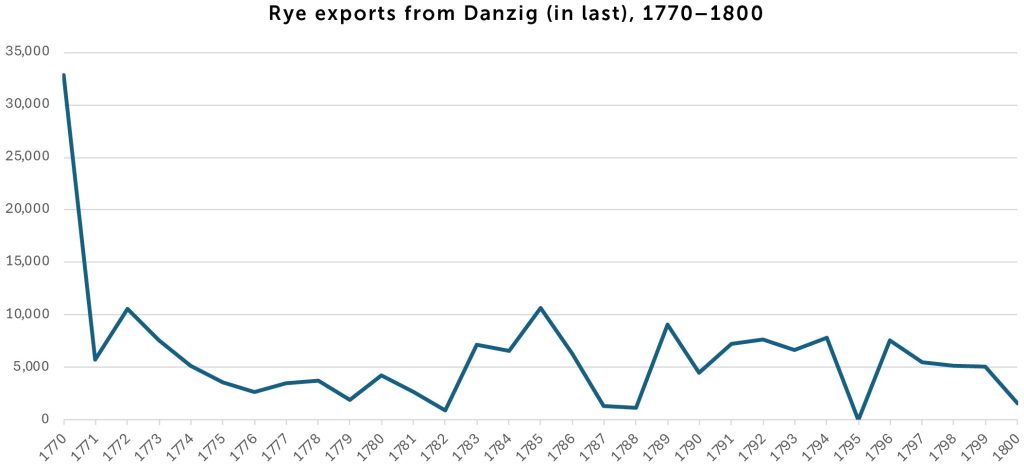
Imposing a tax on trade increases prices for consumers and decreases the quantity demanded by consumers as a result. How responsive is the quantity demanded of a commodity to price changes? In economics, this is known as the price elasticity of demand. Evidence shows that the demand for goods with few substitutes will be less responsive to a change in price. If you must buy something, then an increase in price is less of a deterrent to buying it compared to if there were good alternatives available. Necessities will be less responsive to a change in price than luxuries. Wheat was a desirable commodity, much preferred to rye for those people who were able to afford the more expensive wheat. Because rye was a necessity, the impact on rye exports of the customs duty was not nearly as significant. Even at a higher price, rye was a staple in the daily diet of most Europeans, with no good cheaper substitutes. In economic terms, rye as a necessity was price-inelastic.31
From 1770 to 1771, there was a significant drop in rye exports, from over 30,000 last to just under 6,000 last. This drop corresponded to a significant increase in wheat exports during the same period, from about 30,000 last to about 58,000 last. It is not known why a shift from rye to wheat occurred in 1771, but the chart of rye exports shows no marked decline in rye exports as a result of the imposition of the tax on trade in the mid-1770s. There was also no noticeable rebound after the duty was removed in the mid-1790s. Rye exports during the period of the duty seem to hover around 5,000 last per year. This is consistent with economic theory – rye as a necessity was less responsive to changes in price than wheat as a relative luxury item.
Overall, however, the tax on exports leaving West Prussia destined for Danzig had a negative impact. The port of Danzig was adversely affected. In 1777, a visitor from England, Nathaniel William Wraxall, returned to Danzig after four years away: “This celebrated city . . . excites at present only sensations of concern and commiseration. It is evidently much declined in population, industry, and riches, since I last visited it, only four years ago. Frederic holds it closely invested, though without the appearance of hostility; and there can be little question that the blockade will finally compel the inhabitants to surrender on terms, if not at discretion.”32
What was the impact of the tax on trade on Mennonite merchants and farmers? We have no direct evidence; however, we do have anecdotal evidence that residents of the Danzig environs were adversely affected. Hermann Gottlieb Mannhardt, a Mennonite pastor in Danzig during the late nineteenth and early twentieth centuries, wrote the following reflection about that period: “In the 1760s the economic conditions of the congregation had improved to the point that the income for the alms fund rose gradually from 3,492 florins in 1757 to 6,751 florins in 1765. They remained at this level approximately until 1770. Then in the following years they rose again until 1773. In that year they reached their highest level, 8,087 florins. Then there was a gradual drop, a sign that the times were getting worse. In 1782, only 5,177 florins came in. During the 1780s the income was between 5,000 and 6,000 florins and then fell to 3,169 from 1790 to 1798.”33 Mannhardt described the drop in donations from 1773 to 1782 (or the 1780s, in general) and then again in the 1790s as “a sign that the times were getting worse.” One of the factors contributing to these worsening times in the Danzig environs was the imposition of the tax on trade with Danzig.
The Prussian administration of the area affected not only Danzig’s importance as a port but also the relationship of Mennonites with the government. Frederick II was willing to extend the Mennonite military exemption that had been granted under Polish rule, but at a price. In lieu of military service, Mennonites as a community were to make an annual payment of 5,000 thalers towards the Culm military academy.34 He also imposed restrictions on land ownership by Mennonites, because military service was tied to landholding and he wanted to curtail any reduction in the size of his army.35 When Frederick II was succeeded by Frederick William II in 1786, he continued both the military exemption granted to the Mennonites and the 5,000 thaler cadet tax. He also made land acquisition by Mennonites more difficult by writing the restrictions on Mennonite landholding into law.36
The intensification of Prussian militarism, which added cost to the continuation of Mennonite military exemption, and the decrease in economic opportunities that resulted from restrictions on landholding were important push factors that induced Mennonites into leaving West Prussia in 1789 and after. The negative impact of customs duties on the port of Danzig and on grain export opportunities for Mennonite farmers in the Vistula Delta could also have been a contributing factor. In terms of economic motives for the emigration of Mennonites from Danzig and West Prussia to the Ukrainian lands of imperial Russia in 1789, we cannot exclude the possibility that the imposition of taxes on trade in the mid-1770s, which were only lifted by the mid-1790s, played a role.
In her career, Ingrid Peters-Fransen taught undergraduate economics. She enjoys combining her interest in Mennonite history with issues related to economics. Now retired, she enjoys travelling – mostly to visit her grandchildren.
- Global Anabaptist Encyclopedia Online (GAMEO), “Russia.” ↩︎
- GAMEO, “Anabaptism.” ↩︎
- Willem Frijhoff, “Was the Dutch Republic a Calvinist Community? The State, the Confessions, and Culture in the Early Modern Netherlands,” in The Republican Alternative: The Netherlands and Switzerland Compared, ed. André Holenstein,Thomas Maissen, Maarten Prak (Amsterdam: Amsterdam University Press, 2008), 104. ↩︎
- Milja van Tielhof, The “Mother of All Trades”: The Baltic Grain Trade in Amsterdam from the Late 16th to the Early 19th Century (Leiden: Brill, 2002), 46, 68. ↩︎
- Van Tielhof, Mother of All Trades, 4–5. ↩︎
- Fredrik N.G. Andersson and Jonas Ljungberg, “Grain Market Integration in the Baltic Sea Region in the Nineteenth Century,” Journal of Economic History 75, no. 3 (Sept. 2015): 752. ↩︎
- Jan de Vries and Ad van der Woude, The First Modern Economy: Success, Failure, and Perseverance of the Dutch Economy, 1500–1815 (Cambridge: Cambridge University Press, 1997), 352. ↩︎
- Van Tielhof, Mother of All Trades, 41. ↩︎
- Soundtoll Registers Online, https://www.soundtoll.nl/. ↩︎
- Van Tielhof, Mother of All Trades, 337. ↩︎
- In the first half of the seventeenth century, there were three grain merchants in the Mennonite church called By the Tower in Amsterdam. Mary Sprunger, “Being Mennonite: Neighborhood, Family, and Confessional Choice in Golden Age Amsterdam”, in Religious Minorities and Cultural Diversity in the Dutch Republic: Studies Presented to Piet Visser on the Occasion of His 65th Birthday, ed. August den Hollander, Alex Noord, Mirjam van Veen, and Anna Voolstra (Leiden: Brill, 2014), 154–56. ↩︎
- Van Tielhof mentions the Hooft brothers, Jan and Gerrit, as Mennonite grain merchants in the late sixteenth century. Mother of All Trades, 27–28. The 1776 census of Mennonites in West Prussia lists multiple names with the occupation of merchant (Kaufmann). They did not have the rights of burghers and therefore did not have the right to engage in foreign trade, but officials turned a blind eye to this. Maria Bogucka, “Mentalität der Bürger von Gdansk in XVI.–XVII. Jh.,” Studia Maritima 1 (1978): 68. They are not expressly identified as grain merchants, but given the centrality of the Baltic grain trade to the Danzig economy, one can assume that part of the foreign trade they would have been involved in was the grain trade. ↩︎
- It is typically assumed that peasant farmers like the Mennonites did not produce for the export market; rather, they produced for their own needs. A recent unpublished paper by the author, “Domestic and Export Market Potential of Mennonite Farmers in Late-Eighteenth Century West Prussia,” shows that the economic status of Mennonite farmers depended significantly on size of landholding and access to the export market. Mennonites constituted 10 per cent of the population in Marienburg, the most fertile county of West Prussia, and held 25 per cent of the arable land. Hans-Jürgen Bömelburg, Zwischen polnischer Ständegesellschaft und preußischem Obrigkeitsstaat: Vom Königlichen Preußen zu Westpreußen (1756–1806) (Munich: R. Oldenbourg, 1995), 446; and August Meitzen, Der Boden und die landwirthschaftlichen Verhältnisse des Preussischen Staates, vol. 4 (Berlin: Verlag von Paul Parey, 1869), 157. Given that some Mennonites held relatively large plots of very fertile land, it would seem that at least these farmers were able to provide considerably more than would be necessary for self-sufficiency. ↩︎
- Karin Friedrich, The Other Prussia: Royal Prussia, Poland and Liberty, 1569–1772 (Cambridge: Cambridge University Press, 2000), 1. ↩︎
- Friedrich, The Other Prussia, 23. ↩︎
- Peter J. Klassen, Mennonites in Early Modern Poland & Prussia (Baltimore: Johns Hopkins University Press, 2009), xiii. ↩︎
- Klassen, Mennonites in Early Modern Poland, 205. ↩︎
- Klassen, Mennonites in Early Modern Poland, 29–30. ↩︎
- Horst Penner, Die ost- and westpreußischen Mennoniten in ihrem religiösen und sozialen Leben in ihren kulturellen und wirtschaftlichen Leistungen, vol. 1, 1526 bis 1772 (Weierhof: Mennonitischer Geschichtsverein, 1978), 398. ↩︎
- Peter J. Klassen, “A Homeland for Strangers and an Uneasy Legacy,” Mennonite Quarterly Review 66, no. 2 (Apr. 1992): 119. The adversity is captured in the German adage, “Die erste Generation hat den Tod, die zweite die Not, und die dritte erst das Brot” (The first generation has death, the second has hardship, and only the third has bread). ↩︎
- Klassen, Mennonites in Early Modern Poland, 202. ↩︎
- Van Tielhof, Mother of All Trades, 17. ↩︎
- Van Tielhof, Mother of All Trades, 27–28. Cornelis Pietersz Hooft, who was a Libertarian, fled Amsterdam for Danzig and then later returned to Amsterdam to work as a grain merchant. His two brothers Jan and Gerrit, who were Mennonite, remained in Danzig to work as part of a family business of grain merchants. ↩︎
- Glen Penner, comp., “The Complete 1776 Census of Mennonites in West Prussia,” version 8, https://mennonitegenealogy.com/prussia/1776_West_Prussia_Census.pdf. ↩︎
- For example, the distribution, based on wealth, for late eighteenth-century London was 2 to 3 per cent upper class and 16 to 21 per cent middle class. L. D. Schwarz, “Income Distribution and Social Structure in London in the Late Eighteenth Century,” Economic History Review, n.s., 32, no. 2 (May 1979): 254–56. Jürgen Kocka provides a significantly lower estimate of 5 per cent middle class for nineteenth-century Germany, but he focuses on the economic and the educated middle class of the city and specifically excludes peasants, which would have best described the Mennonite farmers. Jürgen Kocka, “The Middle Classes in Europe,” Journal of Modern History 67, no. 4 (Dec. 1995): 784. ↩︎
- Mark Jantzen, Mennonite German Soldiers: Nation, Religion, and Family in the Prussian East, 1772–1880 (Notre Dame, IN: University of Notre Dame Press), 26. ↩︎
- Van Tielhof notes that the Prussian policy of cutting off Danzig from its hinterland through customs duties was effective. Mother of All Trades, 61. ↩︎
- August Skalweit, Acta Borussica: Getreidehandelspolitik, vol. 4, Die Getreidehandelspolitik und die Kriegsmagazinverwaltung Preußens, 1756–1806 (Berlin: Verlag von Paul Parey, 1931), 29. ↩︎
- Van Tielhof, Mother of All Trades, 338–39. ↩︎
- Van Tielhof, Mother of All Trades, 338–39. ↩︎
- There was a shift to growing potatoes, a New World plant, in Europe in the eighteenth century, and by the end of the eighteenth century, rye bread had been partially replaced by potatoes as the basic foodstuff for the poor in some parts of Europe, but rye continued to be an important source of calories for much of the population. Cor Trompetter, Agriculture, Proto-Industry and Mennonite Entrepreneurship: A History of the Textile Industries in Twente, 1600–1815 (Amsterdam: NEHA, 1997), 42. ↩︎
- Quoted in Bömelburg, Zwischen polnischer Ständegesellschaft und preußischem Obrigkeitsstaat, 392. ↩︎
- H. G. Mannhardt, The Danzig Mennonite Church: Its Origin and History from 1569–1919, trans. Victor G. Doerksen, ed. Mark Jantzen and John D. Thiesen (North Newton, KS: Bethel College, 2007), 130. ↩︎
- Max Bär, Westpreußen unter Friedrich dem Großen, vol. 1 (1909; repr., Osnabrück: Otto Zeller, 1965), 541. ↩︎
- On the difficulties Mennonite had buying land in 1777, see Bömelburg, Zwischen polnischer Ständegesellschaft und preußischem Obrigkeitsstaat, 447. ↩︎
- Bär, Westpreußen unter Friedrich dem Großen, 1:549. ↩︎