
Preaching in the West Reserve: Three Itinerant Mennonite Ministers
Donald Stoesz
In 1893, Abraham Doerksen was selected as a minister of the newly formed Sommerfeld Mennonite Church. He was ordained a bishop the following year.1 Doerksen served in that capacity until 1922, when he moved together with about one hundred families to Mexico. He continued his ministry in Mexico until his death in 1929.
David M. Stoesz, son of East Reserve Chortitzer Bishop David Stoesz, moved to the West Reserve in 1891 and became a Sommerfelder minister in 1912.2 He and his family moved with Bishop Doerksen to Mexico in 1922. Dissatisfied with life there, David returned with his family to southern Manitoba in 1923, and continued serving in the Sommerfeld Church until his death in 1934.
Born in 1892, Cornelius G. Stoesz grew up in the Sommerfeld Church before joining the Rudnerweider Church in 1937.3 His father, Cornelius W. Stoesz, had been a Sommerfelder minister (1920–1925), and his grandfather, a Chortitzer minister (1865–1900). Cornelius G. Stoesz was chosen as a minister of the Rudnerweider Church in 1937 and served the church until his death in 1972.
These three ministers kept detailed log books of the sermons they preached. Sommerfeld Church Bishop Abraham Doerksen kept record of the 767 sermons that he preached in his career.4 Sommerfeld Minister David M. Stoesz kept track of his 887 preaching assignments from 1912 to 1934.5 Rudnerweider Minister Cornelius Stoesz kept a log book of 507 sermons that spanned the years 1937 to 1955.6
These service schedules indicate the date, location, and Scripture text used for each of the sermons that they preached. Abraham Doerksen’s worship schedule can be found in Peter Bergen’s History of the Sommerfeld Mennonite Church.7 The worship schedules of David M. Stoesz and Cornelius G. Stoesz are included in my book Canadian Prairie Mennonite Ministers’ Use of Scripture: 1874–1977.8
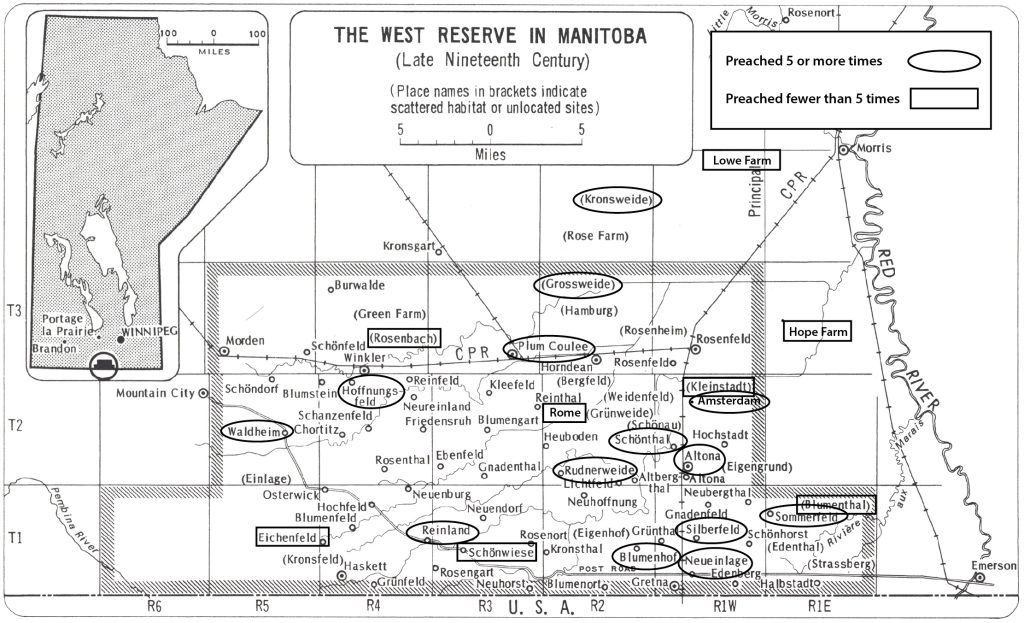
These worship schedules list over fifty villages on the West Reserve where these sermons were preached. Each minister made a circuit of preaching, visiting between fifteen and thirty congregations in their denomination.9 Church members and their ministers saw themselves as belonging to a Gemeinde (church community) rather than to a specific congregation. The ministers preached on behalf of the entire Gemeinde. The bishop was the only minister who could conduct baptismal and communion services. The Gemeinde was led by a ministerial committee (Lehrdienst) headed by a bishop. This communal approach to ministry allows for a broad overview of the dominant Scripture texts, themes, rituals, and occasions that were relevant to the religious community. I will focus on four themes reflected in the Scripture verses used by these three ministers: evangelism, supplication, the Second Coming, and nonresistance.
Evangelism
As I compiled the Scripture verses used by these ministers, I discovered that nearly 19 per cent of their sermons were dedicated to evangelism, with an emphasis on repentance and new birth.10 This emphasis was revealing because two of the ministers were from the Sommerfeld Mennonite Church, which was not known for evangelism. The church was formed in 1893 when 88 per cent of the membership of the original Bergthal Mennonite Church, in Manitoba’s West Reserve, left their church because it had introduced too many innovations. Under the leadership of Bishop Abraham Doerksen, the Sommerfeld Church maintained the traditions of following a lectionary of Scripture readings and songs, ministers writing sermons and reading them from the pulpit (rather than speaking freely), holding catechetical instruction during the Easter season worship services, and singing from the German Gesangbuch hymnal.11
Sommerfelders who found these traditional practices confining were attracted to a renewal movement that resulted in 21 per cent of the congregation’s membership starting the Rudnerweider Mennonite Church in 1937.12 The four ministers and 915 members who left felt that the Sommerfeld Church was not evangelistic enough.13 The Rudnerweider Mennonite Church was started so that believers could experience “Christ in a new and intimate way” and find “in Him a new vision for ministry.”14
One might assume based on the events of 1893 and 1937 that the Sommerfeld Church was not committed to evangelism. The entry on evangelism in the Global Anabaptist Mennonite Encyclopedia Online reflects this premise, stating that “the spirit of evangelism . . . remains extinct in such groups in North America as the Old Order Amish, the Old Order Mennonites, and the Old Colony Mennonites.”15 The Sommerfelders would be included among these tradition-bound, conservative groups.
Two factors belie this assumption. First, the Sommerfeld Church grew from a congregation of 2,500 (including children) in 1893 to nearly 7,300 in 1926. Fifty-five per cent of the Mennonite population on the West Reserve in southern Manitoba in 1926 belonged to the Sommerfeld Mennonite Church.16
Second, analysis of sermon texts demonstrates that revivalism was alive and well within this “ritual-oriented” church: 26 per cent of the sermons preached by Sommerfeld Bishop Abraham Doerksen between 1894 and 1922, and 17 per cent of the sermons of Sommerfeld Minister David M. Stoesz between 1912 and 1934, were dedicated to evangelical themes.17
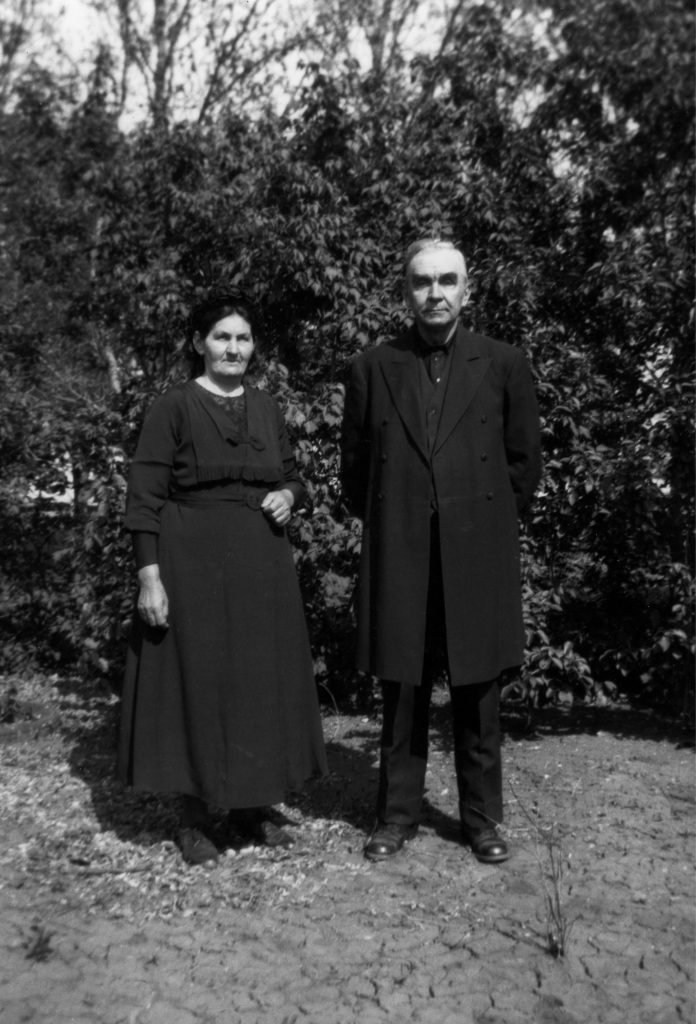
Cornelius G. Stoesz (1892–1976) devoted 10 per cent of his sermons to conversion. He joined the Rudnerweider Church at forty-five years old. Called to the ministry during this time, Stoesz continued the Sommerfelder tradition of writing and reading his sermons until 1955. Conversion, revival, and evangelism were integral to these ministers’ preaching.
Honey and Vinegar
I grew up in a Mennonite church in which evangelism was conducted on the basis of guilt-laden proclamations about the wrath of God, intended to bring about repentance and conversion. We as young people flocked to catechism classes so that we could avoid God’s punishment. Over half of the sermons reflected this kind of sin-oriented theology. Abraham Doerksen used Jeremiah 4:3–4 at a New Year’s service to warn the congregation that God’s wrath would burn everything in its path if they did not turn back to God. Elijah called fire down from heaven in 1 Kings 18 to convince the Israelites to follow God rather than Baal. Psalm 50 declared that God was a devouring fire that would consume the people of Israel if they did not offer a sacrifice of thanksgiving.
Passages from the New Testament such as Hebrews 3:12–14 and Hebrews 4:1–13 were also cited. Doerksen and David M. Stoesz compared their congregation to the Israelites in the wilderness, where they turned away from God and worshipped idols. Believers would not reach the promised land if they hardened their hearts and became rebellious. The three ministers preached eighty-three times on the above five passages of Scripture.
Given this “vinegar” approach, I was not prepared for the discovery that Doerksen and David M. Stoesz preached in total eighty-five times on Matthew 9:13, where after calling the tax collector Matthew as his disciple, Jesus declares to the Pharisees that he desires mercy for the sick. He had come to save the lost, not the righteous.
A similar emphasis was evident in the ministers’ use of Luke 15:1–10 and Luke 19:1–10. The woman described in Luke 15 celebrated together with friends and neighbours because she had found a lost coin. Jesus declared that there is similar joy in heaven when a single sinner repents.
Luke 19 has Jesus eating at another tax collector’s table, this time at the house of Zacchaeus. After dining with Jesus, Zacchaeus promises to give half of his possessions to the poor. Jesus concludes his stay at Zacchaeus’s house with the words, “The Son of Man came to seek out and to save the lost.” David and Cornelius Stoesz preached forty-seven times on these two passages. Honey was as effective as vinegar in bringing about repentance and renewal.
Sermons of Supplication
I had assumed that the ministers would use the Old Testament sparingly. Only 15 per cent of the Scripture texts prescribed for worship by the one-year Lutheran lectionary employed by the ministers were from the Old Testament. This lectionary is included under the title “Instruction in Songs”18 at the beginning of the Gesangbuch, which the ministers consulted on a regular basis.
I was proven wrong yet again. One hundred and sixty-four sermons quoted prayers of supplication for healing and deliverance from ten passages from the Psalms. Psalm 72:12–13 and Psalm 73:21–24 describe God delivering the needy and bestowing honour on believers. Psalm 34 announces that God will save believers from their fears and plight. Psalm 102 assures believers that they can live secure in God’s steadfast presence. Psalm 69:6 calls on God to be faithful to those who hope in him.
Scripture passages from the Prophets were also used. Isaiah 26:9 speaks about yearning after God and earnestly seeking him. Isaiah 49:14–16 compares God to a mother who never forgets her children. Jeremiah 17:14 announces that God heals and saves. Daniel received a spirit of wisdom and understanding when he brought his supplications to God (Daniel 9:20–21). God told Haggai to be courageous because God’s spirit abided with him (Haggai 2:5–6). Doerksen and the Stoeszes preached sixty-seven times on these verses from the Prophets. Overall, these three ministers based 19 per cent of their sermons on the Old Testament,19 while Old Testament texts represented 15 per cent of Scripture passages included in the lectionary.20
These sermons of supplication reinforced a sense of belonging and brought comfort to members of the congregation. Preaching about the mercy and salvation of God was as much a part of the Psalms and Prophetic writings as the story of the New Testament. Such sermons complemented the emphases by these ministers on repentance and discipleship.
Preparing for the Second Coming
Sermons on the Last Judgment were regularly preached as preparation for Christmas. This emphasis made sense since many lectionary texts for Advent had to do with the Second Coming.
Jesus speaks about the Last Judgment in Matthew 25:31–46. Luke 21:25–30 envisions “‘the Son of Man coming in a cloud’ with power and great glory.” John 1:1–14 describes John the Baptist as “a witness to testify to the light.” John 1:19–28 has him “crying out in the wilderness, ‘Make straight the way of the Lord.’”
Epistle texts were similar in their emphasis on the Second Coming. Romans 13:11–14 exhorted Christians to “wake from sleep” because “salvation is nearer to us now than when we became believers.” Philippians 4:4–7 combined the joy and celebration surrounding the incarnation of Jesus with anticipation of the Second Coming. “Rejoice in the Lord always. . . . The Lord is near. . . . The peace of God . . . will guard your hearts.” The three ministers preached 107 times on these six Gospel and Epistle texts during Advent.
Regarding the Advent Scripture passages that Pope Gregory selected for the one-year lectionary on which the Lutheran lectionary was based, church historian Hughes Oliphant Old, an authority on the subject, remarks: “That one should read the sayings of Jesus on the end times as preparation for Christmas is the sort of thing one might expect from the Jehovah’s Witnesses or other Adventist groups. But it makes consummate sense in the light of Gregory’s sermons on Ezekiel, which he preached when the barbarians began to march on Rome. When times are bad Christians lift their eyes to the coming of the Lord, that is, to the second coming, and that is certainly what these Gospels do.”21
The three Mennonite ministers also preached on other Scripture passages that had to do with the Second Coming during Advent. Abraham Doerksen used Isaiah 64:1 to ask God to “tear open the heavens and come down.” He preached on Revelation 22:12–20, depicting faithful Christians waiting for Christ’s return. Cornelius Stoesz preached on Luke 12:35–36. Luke asked his readers to “be dressed for action and have your lamps lit” so they could open the door to their master when he returned from the wedding banquet. These two ministers preached fifty-three times on these apocalyptic Scriptures during Advent.
I have seldom heard a sermon on the Second Coming during the Advent season. More familiar to me are the angels appearing to Mary and Joseph, the coming of the wise men, the visit of the shepherds, and the celebration of Christ’s birth. The theme of the Second Coming of Christ was generally reserved for New Year’s services or revival meetings. That future eschatology was an integral part of these ministers’ sermons during the first Advent came as a surprise.22
Nonresistance and Salvation
Associated Mennonite Biblical Seminary professor Erland Waltner introduces his Believers Church Bible Commentary on 1 Peter by remarking that, as a young seminarian, his desire to be both a nonresisting Christian (his “Mennonite ethical heritage”) and an evangelical believer came together while studying 1 Peter 2:21–25. Verses 22 and 23 affirm the nonresistant aspect of Jesus’s ministry: “‘He committed no sin, and no deceit was found in his mouth.’ When he was abused, he did not return abuse; when he suffered, he did not threaten; but he entrusted himself to the one who judges justly.” The next two verses link this act of nonresistance to Jesus’s atonement and the justification and sanctification of believers: “He himself bore our sins in his body on the cross, so that, free from sins, we might live for righteousness; by his wounds you have been healed. For you were going astray like sheep, but now you have returned to the shepherd and guardian of your souls.” Waltner was struck by the correlation: “There I saw Jesus Christ both as the Supreme Pattern of nonretaliatory love and as the Redeemer, dying on the cross for human sin and thus making our salvation possible.”23
Waltner shows how these verses were included in the writings of early Anabaptists such as Dirk Philips, Menno Simons, Michael Sattler, and Pilgram Marpeck.24 The Swiss Brethren also included 1 Peter 2:20–24 as a foundational text in the discipleship section of their 1540 concordance.25 But what role did this text play in southern Manitoba during the late nineteenth and first half of the twentieth century?
According to their log books, Cornelius G. Stoesz preached on 1 Peter 2:21 twenty-four times over the course of his ministry, and fifteen times on 1 Peter 2:24. David M. Stoesz preached thirty-six times on 1 Peter 2:24. These sermons were preached for New Year’s Day and for communion, which was celebrated twice a year.
Doerksen preached eight times on Christ’s atonement as detailed in 1 Peter 1:18–19, and Cornelius G. Stoesz preached on the passage once. Doerksen and David M. Stoesz each preached on the ethical injunctions in 1 Peter 1:22–23 twenty-one times. This shows that these Mennonite ministers operated within the stream of Anabaptist thought which viewed 1 Peter as a significant reference point for its affirmation of nonresistance along with the plan of salvation.
The preaching schedules of Abraham Doerksen, David M. Stoesz, and Cornelius G. Stoesz offer insight into Mennonite religious life in Manitoba and Mexico. The importance of evangelism in their sermons stands in contrast to assumptions about the conservative tradition of the Sommerfeld Church. The use of prayers of supplication from the Psalms and Prophets balanced emphases on new birth and discipleship. Preaching on the Second Coming during Advent reflects the influence of the Lutheran lectionary and points to a realized eschatology in which heaven and earth come together. As they travelled on their preaching circuits, the ministers also delivered sermons that linked nonresistance with salvation, in continuity with early Anabaptists.
Donald Stoesz served for thirty-five years as a prison chaplain in Quebec and Alberta. His interest in Mennonite history began in 1975 when he and his brother, Dennis, translated part of Bishop David Stoesz’s 1874 diary.
- Donald Stoesz, Canadian Prairie Mennonite Ministers’ Use of Scripture: 1874–1977 (Victoria: Friesen Press, 2018), 119–120. ↩︎
- Stoesz, Mennonite Ministers’ Use of Scripture, 137–39. ↩︎
- Stoesz, Mennonite Ministers’ Use of Scripture, 169–71. ↩︎
- Peter Bergen, History of the Sommerfeld Mennonite Church (Altona, MB: Sommerfeld Mennonite Church, 2001), 69–77. ↩︎
- David M. Stoesz wrote 2,226 pages of text for sixty-four sermons. His sermons are located in the David Stoesz Family fonds, vols. 1561–63, Mennonite Heritage Archives (MHA), Winnipeg. Two of his sermons have been translated. The one he preached on New Year’s Day, based on 1 Peter 1:22–23, appears in Stoesz, Mennonite Minister’s Use of Scripture, 237–55, and is analyzed on pp. 197–201. The other is a Good Friday sermon based on John 19:28–30. It appears in Donald Stoesz, “Sermons and Service by Sommerfelder Stoeszes,” David Stoesz Family fonds, vol. 5292, file 4, MHA. ↩︎
- Cornelius G. Stoesz wrote a total of 1,460 pages of text for fifty-nine sermons. His log book and several sermons can be found in the Cornelius G. Stoesz fonds, vols. 3273–75, MHA. Three of his sermons have been translated. A sermon based on 1 Peter 2:21 appears in Stoesz, Mennonite Minister’s Use of Scripture, 257–68 and is analyzed on pp. 201–3. The other two are based on Philippians 4:4–7 and Luke 19:41–48, and can be found in Stoesz, “Sermons and Service by Sommerfelder Stoeszes.” A partial list of Mennonite sermons that have been translated from the written Gothic German script appears in Stoesz, Mennonite Minister’s Use of Scripture, 235. ↩︎
- Bergen, History of the Sommerfeld Mennonite Church, 68–77. Jake Peters obtained these records from Bishop Jack Doerksen in Mexico in 1982 and brought them back to Canada. ↩︎
- Stoesz, Mennonite Ministers’ Use of Scripture, 153–68, 187–95. ↩︎
- Maps detailing the preaching circuits of Abraham Doerksen, David M. Stoesz, and Cornelius Stoesz appear in Donald Stoesz, Mennonite Ministers’ Use of Scripture, 231–33. ↩︎
- About 14 per cent of the ministers’ sermon texts were based on Scripture passages emphasizing evangelism; these sermons were used in 18.6 per cent of their preaching. Stoesz, Mennonite Ministers’ Use of Scripture, 186. ↩︎
- Bergen, History of the Sommerfeld Mennonite Church, 10–11, 44–46, 49–51. ↩︎
- Stoesz, Mennonite Ministers’ Use of Scripture, 28. ↩︎
- Search for Renewal: The Story of the Rudnerweider/Evangelical Mennonite Mission Conference, 1937–1987 (Winnipeg: Evangelical Mennonite Mission Conference, 1987), 39–41. ↩︎
- Search for Renewal, 41. ↩︎
- Global Anabaptist Mennonite Encyclopedia Online, “Evangelism.” ↩︎
- Stoesz, Mennonite Ministers’ Use of Scripture, 16–17. ↩︎
- Stoesz, Mennonite Ministers’ Use of Scripture, 186. ↩︎
- Stoesz, Mennonite Ministers’ Use of Scripture, 39–49. ↩︎
- Stoesz, Mennonite Ministers’ Use of Scripture, 209–21. ↩︎
- Stoesz, Mennonite Ministers’ Use of Scripture, 100. ↩︎
- Hughes Oliphant Old, The Reading and Preaching of the Scriptures in the Worship of the Christian Church, vol. 3, The Medieval Church (Grand Rapids, MI: Eerdmans, 1999), 183. See also Old’s comments about Pope Gregory’s Ezekiel sermons and choice of Gospels for Advent in The Reading and Preaching of the Scriptures in the Worship of the Christian Church, vol. 2, The Patristic Age (Grand Rapids, MI: Eerdmans, 1998), 436–40. ↩︎
- The Amish lectionary, which is based on the Reformed lectio continua practice of reading Scripture during worship, also includes Weltende passages such as Matthew 24 and 25 as Scripture readings just before Christmas. Stoesz, Mennonite Ministers’ Use of Scripture, 69. Old explains the difference between the lectio selecta practice of Scripture reading used in the Lutheran tradition and the lectio continua of the Reformed tradition. Old, The Reading and Preaching of the Scriptures in the Worship of the Christian Church, vol 4, The Age of the Reformation (Grand Rapids, MI: Eerdmans, 2002), 27–31, 153. ↩︎
- Erland Waltner, “Preface to 1 Peter,” in 1–2 Peter, Jude, Believers Church Bible Commentary, by Erland Waltner and J. Daryl Charles (Scottdale, PA: Herald Press, 1999), 15. ↩︎
- Waltner, “1 Peter,” in Waltner and Charles, 1–2 Peter, Jude, 107–9. ↩︎
- C. Arnold Snyder, ed., Biblical Concordance of the Swiss Brethren, 1540, trans. Gilbert Fast and Galen A. Peters (Kitchener, ON: Pandora Press, 2001), 8. ↩︎