
Across America: A Russian Physician Visits the West Reserve
P. S. Alekseev
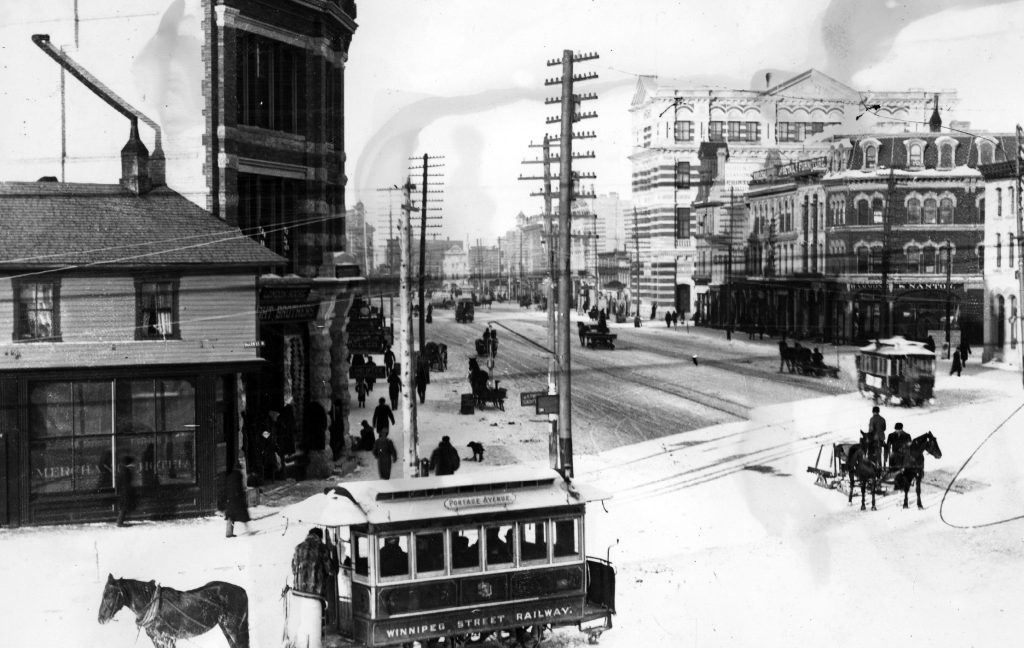
On May 27, 1887, we left Winnipeg for the south to inspect a colony of Mennonites, settlers from Russia.1 The train was late. Instead of nine in the morning, we left the station at three o’clock in the afternoon. Spring floods in the hills near the Great Lakes (the train came from the east) affected train traffic here in the Prairies. Our route was straight south to the United States border through the stations of St. James, La Salle, Osborne, and Morris to the junction at Rosenfeld, and from there to Gretna, the main centre of the Mennonite colony. Around six o’clock in the evening we arrived at our destination. As it turned out, we ended up in the place where we could most closely and most successfully get to know the colony. Around Gretna, the villages are arranged in a ring. Such villages are found only among settlers from Russia; in the rest of America, there are none. One only finds farms, hamlets, and isolated farm buildings. Farther south, there are Mennonite villages near the town of Emerson, which is still in Canada, and then also in the Dakota Territory. It is impossible to determine the present population because in the colony there have been misunderstandings and disagreements among its members, and the elders have lost count of the colonists. Some are citizens of the United States, others enjoy special rights and privileges, and still others have been naturalized in Canada. I have had occasion to become acquainted with the older immigrants from Russia, who have been living here already for fifteen years.
Beyond the city of Winnipeg is a small forest of birch and willow. The vegetation rises above the grass and bushes because of the gullies and wet marshy areas between the rivers on which the city of Winnipeg lies. Farther, after travelling about ten miles, you will not come across a single tree or even a bush all the way to the border of the United States. It is all just steppe, bare steppe. The prairie here is real. Everything is covered with thick, green grass. Large areas have been plowed. Where the plows have opened the ground, rich, unctuous black soil is visible. It is well known that Russian settlers live in the most fertile part of the New World; there is no land in North America like that occupied by the Mennonites in parts of Manitoba and Dakota, and in Russia it can be found only in the provinces of New Russia [Novorossiia].
The ancestors of the Mennonites lived in Prussia. They received their name from a certain Simon Menno [Menno Simons], who spread the idea among his neighbours that there was no need to fight in war and, like [William] Penn, the founder of Pennsylvania, advised not to kill anyone, not to take up arms, even for self-defence. Enthusiastic about this impractical teaching, Menno’s fellow villagers left Prussia during the reign of Frederick the Great and prospered for a whole century in the south of Russia.
Everyone is familiar with the way of life of the German colonists, the good example they set for their neighbours, and their attachment to the land they worked so diligently. Their isolation and the absence of ritual in their religion do not dispose many in their favour. A strict family discipline, a simple way of life, useful customs and traditions, hard work, and thrift, sometimes expressed in stinginess, distinguished and still distinguish them from their neighbours, whether they live in Russia or Canada. They have no nationality because they are German by language and origin but they have adopted and observe many Russian customs and were born in Russia. In America, they are subjects of Queen Victoria but enjoy special privileges. They live peacefully among themselves and with their neighbours; they do not need police or judges. Bound by religious principles, they have their own ways of discipline, their own elected judges from among their elders. What they can be accused of is that they seem to be frozen in their customs and way of life, that they do not strive to get out of their rut, that the progress of the entire surrounding world does not concern them.
These people, whose main rule (not to insult each other, not to fight, not to kill) is so ideal, are rough in appearance. They do not strive for higher education, remaining honest, hard-working peasants, as their ancestors were a century ago. They are all literate, but education does not go further than the village school even for the richest. They cannot even prepare teachers from among themselves; they get them from Germany or from the United States. Only a few are engaged in trade, and even then only in internal, home trade, so to speak; they keep goods only for their own people, their buyers are exclusively Mennonites. There are no wealthy individuals [kulaks] among them. Wealth is distributed evenly. Each one holds fast to his own property; the poor do not demand a share of the wealth of richer members. The community coffers are always full, from which they draw funds for institutions such as prayer houses and schools. The maintenance of these institutions is not regulated by a budget and is not constrained by economic considerations.
It is just as difficult to find out anything from the Mennonites regarding their religion, rules of private life, unwritten statutes, etc., as from the Russian schismatics. The Mennonites keep silent and believe that much should remain a secret and should not leave the inner circles of their community. I managed to learn that the mainspring driving their community is unconditional submission to the decisions of congregational meetings and the will of the elders. The main regulator of life, private and public, is thrift – frugality, and a contempt for luxury. Everything that hints at adornment, everything that is not essential for life but serves for convenience and pleasure, everything that is not simple and modest, is excluded from their lives. They are like monks in that they are not tempted by worldly pleasures, do not indulge in revelry or games, but find reading divine books a pleasant pastime. Drunkenness does not exist among them, although they are not teetotallers (i.e., people who never drink alcoholic beverages).
We travelled from Winnipeg to Gretna in a train without classes. One small compartment in the middle car stood out for its dirty furnishings and spit-stained floor – it was designated for smokers. In the other compartments, we could not find any difference – the cars were all the same and the crowd of passengers was the same everywhere. There were no simple people and no Black people; all passengers were middle class. We noticed two clean-shaven men with serious, concentrated faces and at the same time a meek expression in their eyes. Their clothes were not distinguished in any way and were very worn; their hands were gnarled and calloused. They spoke only among themselves in a language, or rather a dialect, to which I had to listen for a long time to make out the meaning of their speech. They spoke Plattdeutsch.
At Morris Station the older of the two got off; he had the face of a man who fasted, his face expressing imperturbable calm and modest contentment; gentle eyes and resolute, narrow lips completed his characteristic physiognomy. It was evident that this was a man who had achieved something in life, who had power over himself and over others. As I learned later, this was one of the Mennonite elders: Starosta they call them, preserving the Russian word. He combines the role of head of one or several villages, judge, administrator, and pastor. Perhaps it was the Kaiser himself, of whom there are now two instead of one because of a split among the Mennonites. One of the passengers hinted to me that this man occupied the highest elected office. The others did not confirm this and remained silent when I asked about him. If, as is very likely, this was indeed the Kaiser, then, as befits a Mennonite who emphasizes simplicity, this person travelled without an entourage. On leaving the train carriage he got into a buggy, a kind of tarantass harnessed to a pair of magnificent horses, driven by a village boy.
Another of the Mennonites travelling with us began to speak with me in pure German. He remembers some of the Russian language, but after spending ten years in America, he has forgotten much of it. His language was more like Little Russian [Ukrainian] than the language of the interior provinces of Russia. He left Europe with his brother and father, now deceased. At present, he owns a plot of land that is smaller than what was given to the family when they migrated. The village assembly distributes evenly the amount of land depending on the number of workers. The community sees to it that the land does not go to waste and that everyone owns only what they can cultivate. Following Russian custom, women help with fieldwork, which is seen as a great wonder in America, where a woman knows nothing but housekeeping and, if she does anything outside the home, limits her activity to milking and looking after cattle. On large farms, however, the men always do the milking. Just as it would be surprising to see a Russian peasant man sitting at a spindle or spinning yarn, it would be equally surprising to see an American woman turning hay or putting sheaves on a cart. My companion could not praise his well-being and contentment enough; he said that it was as good and free here as in the Poltava province, where he was born and raised.2 He grows wheat on forty acres; cattle breeding and a stud farm are flourishing for him. He works exclusively with machines, some of which cost up to a thousand rubles. He runs the whole farm himself; he shoes the horses and repairs the machines. He was returning home, having sold a herd of cattle collected from his neighbours.
Around Gretna there are up to three thousand inhabitants in the villages, but there is no doctor due to the absence of diseases and epidemics. The doors are not locked, there are no guards or theft, fires are extremely rare, and there have been no mass deaths of cattle since the settlement of this area. I did not believe all this and attributed the rosy colours with which my companion painted the local situation to his mood after a successful sale of cattle and perhaps his pleasure at meeting a Russian. On the way back, however, I was convinced that all his accounts were true and not exaggerated. Visiting the Mennonite villages, I could but not admire the contentment of the inhabitants, the order that prevailed in them, and the healthy appearance of the population. Near the village of Altona, three miles before Gretna, my companion threw his baggage out of the window, intending to walk from the town to the village. He showed me his house; it was a real Little Russian cottage: the whitewashed walls had tiny windows, the roof was thatched with brush, and a wattle fence surrounded it; the well had a carrying pole.
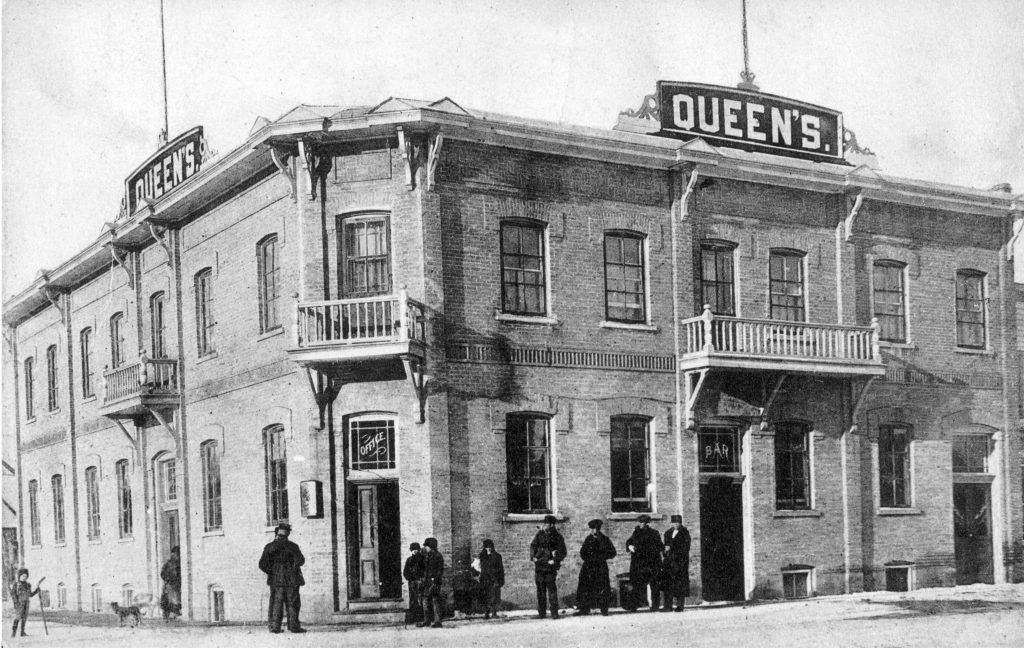
We got out of the train car and boarded the Queen’s Hotel carriage, which had pulled up right next to the tracks. Not all stations have platforms, so you often step from the train car onto the carriage step. A girl about eleven years old in a wide-brimmed straw hat deftly ruled a pair of thoroughbred horses and took us to a two-storey house, a hotel kept by John Braun. This person, a local rich man and bigwig, was recommended to us in Winnipeg as a Russian, but he turned out to be a Swiss. He was known as “the Russian” because he dealt with immigrants from Russia. His hotel was second or third class. It had everything that is required of an American hotel, including a ladies’ entrance, a bar, and a parlour with a piano, but everything was in the most pitiful, bad shape. There was no reason to complain about the dirt, but the cramped conditions and primitive household items proved to us that we were not in an American’s house. Here, some things reminded us of Russia: a porcelain Easter egg hung from the ceiling as a ornament, portraits of the late Sovereign and of General [Mikhail] Skobelev hung on the walls, a Russian abacus was on the writing table, and old Russian dishes stood in the cupboard.
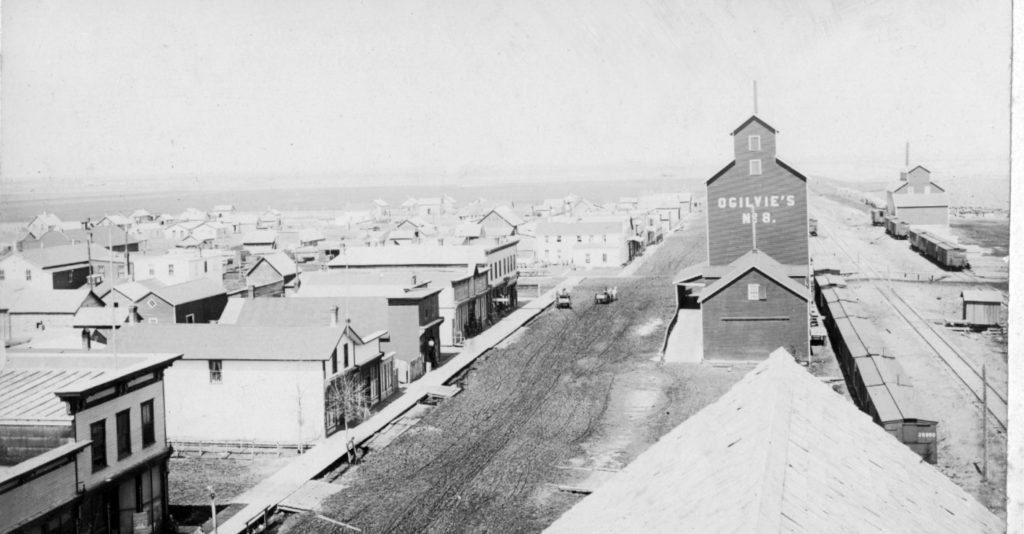
Gretna is a town with one unpaved street running along the railroad track. There are no stone buildings at all. Near the station are two huge elevators. The Mennonites drive up in pairs and dump their grain in one window, then go to the other and receive their payment. Grain is sold here for cash, without haggling. There are no concessions or special treatment for a good, regular customer; no promissory notes are written, and payment is not delayed. You only have to tip your sacks into one window and walk two steps to get money from the other. Grain is accepted at any time of the day and there are no refusals because too much grain has accumulated. The grain prices for all North America are determined twice a day on the Chicago exchange and telegraphed to each elevator. The prices are posted in a prominent place on the wall immediately upon receipt of the dispatch. You can sell your grain silently, without wasting a single word, without cursing, without taking the Lord’s name in vain, without trickery, without demands, and without wasting time. All Mennonites receive the newspapers and, taking into account current prices, take their goods to the elevator or keep them until a favourable time. The elevator is, in a sense, a monopoly; but because it belongs to many competing companies, strikes and artificial price changes are rare.
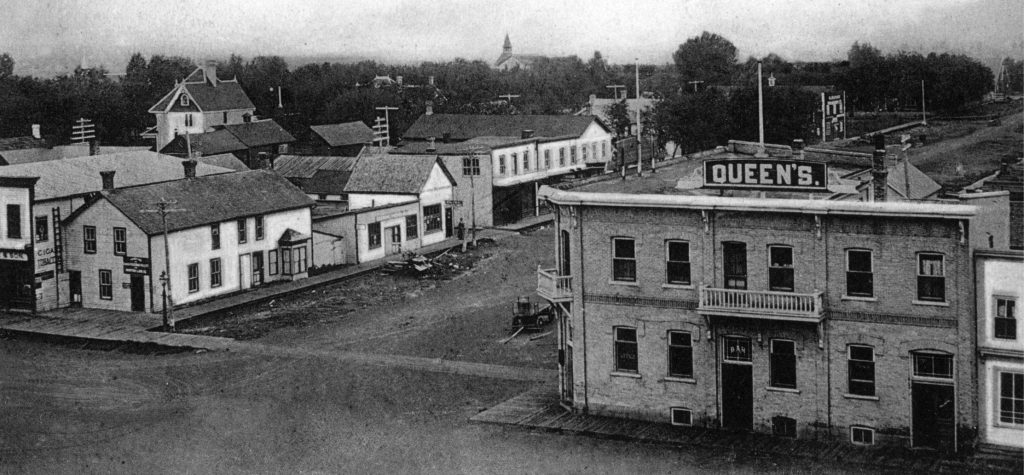
I spent the evening walking along the railway line. Here, at 49° north, parallel to Poltava, the May evening was fresh and the vegetation had not yet fully blossomed; the oaks were barely green. The line of the border is marked by pits, but there is no border guard cordon. A customs official lives at the station, inspecting the baggage of passengers and the goods arriving from the States. A wide field of steppe plains is open to smuggling.
During the walk I asked questions of my Swiss companion, who, being an old-timer (he has been here since the founding of Gretna – about twenty years), had a true understanding of colonization and could impartially judge the way of life of the Mennonites, who had all arrived during his time. He did not understand everything regarding the internal affairs of the colony and its organization. He could not give precise information about the unwritten rules and laws, passed down orally from generation to generation, by which everything is kept in order in this flourishing society.
In the hotel, we fell asleep with the window open in a stuffy, cramped room. The clean, fresh air of the steppes could not supress the smell of wine rising from the bar below, where they made noise late into the night.
In the morning the owner took us to see the surrounding villages of Rosenfeld, Altona, Blumenthal, Schönau, Lilienthal,3 Schönthal, and other “thals” [valleys], although there are no mountains or valleys here, and the names are more like a memory of the homeland. I would call these villages Rovnaia [flat], Ploskaia [flat], Dalnaia [distant], Lugovaia [meadow], etc., on the basis that there is so much here that resembles Russia. German names also adorn the signs in Gretna: Adam and Esau, Pritzlau, Fobel. We were driving through the real New Russian steppe as if we had suddenly been transported to the province of Kherson: the black dust of the road, smoothly rolled, without ruts like we have in the south, the curves and turns of the road as they are only found in Russia. Here one could not see straight lines crossing at right angles like all the transportation routes in America. All around to the horizon, the arable land was black and the meadows were green. Villages stood five or six versts from each other, which was also a peculiarity for the landscape in America.4 Villages here consisted of ten to twenty-four yards, all cottages with thatched roofs. Only schools and prayer houses have roofs with shingles. They heat only with straw, as there is no wood for fuel at all and building materials are very expensive. The Mennonites have recently begun to move out of the villages and establish separate farms, in order to be closer to their fields.
The four of us travelled together; in the front seat next to John Braun there was a well-dressed person who spoke pure English and interfered in our conversation. The Swiss spoke German. We rode without hurrying, at a light trot, because despite the morning hours the soaring sun’s heat was making itself felt in this area where there was no trace of shade. The left wheel began to creak. We changed seats to lighten the left side of the buggy, and rode at a walking pace, but the creaking grew louder, and the wheel stopped turning. Moving carefully along the smooth steppe, we reached the village of Schönau. Several men with German features, clean-shaven and simply but neatly dressed, came out of the cottages. They wore Russian-style boots and caps. These two pieces of clothing are not found anywhere in America except in this region. The women wore dresses and kerchiefs like our women. The children ran around barefoot. In America, this is a great rarity. The crowd began to pull off the wheel, the hub of which was already smoking; they doused the axle with water. The American and the Swiss were very surprised to be offered salted cow’s butter for lubrication – for them this Russian method of lubrication was new and unknown; they could not understand that a dairy product is cheaper in the villages than store-bought wheel grease. There is little tar in America. Fishing, especially whaling, and the slaughter of livestock for meat delivery to Europe provide large supplies of lubricants, not to mention kerosene and its products.
While they were busy around the buggy, we entered the nearest house. On the threshold, my wife saw a copper dish, which she recognized undoubtedly as a piece of Russian craftsmanship. According to the hostess, this copper basin had indeed been brought from Russia; it had belonged to the family back in the Samara province and had been serving them for two decades.5 In America, one cannot find anything so durable and convenient, either in material or form – in the States and Canada, all such goods are made from tin. The floor at the entrance of the house was earthen. In the living room there was a real Russian stove. The furniture was remarkably simple, homemade. Everything was clean in a German or even Dutch way. On the walls hung Russian sheepskin coats, essential clothing during the harsh local winters and an object of envy for Americans. All of the furnishings were Russian; the only things missing were icons and a samovar. The Mennonites drink coffee and, although they are familiar with the advantages of a samovar, they are unable to use one due to a lack of charcoal or kindling.
When we set out, they shouted to us, “Good luck!” It was impossible to have a real Russian conversation; only the old men remembered a few things, greeting us and saying goodbye in Russian. When they learned my rank, they knew how to use the appropriate title, but they conversed with us in German. Those who were younger and the children did not understand Russian at all. In another village, we visited a wealthy house, blessed with many children. Only the father had left Russia; the other ten members of his family had seen nothing but the far west prairie. The cottage was spacious; there was a stove with a sleeping bench, and on the table lay a Russian abacus next to a German newspaper published in the state of Illinois.6
Calico is worn much less in America than in Europe; here the patterns on the dresses of women and children are the same as those produced in the calico factories of Serpukhov or Ivanovo for the southern provinces. The Mennonites are conservative in appearance and do not change their tastes. In Winnipeg there are warehouses where they keep goods for them, which are printed in England in imitation of Russian designs. The same is true of headscarves. Only here in all of America can you see the streaked patterns, bean-shaped motifs, and colours that the eye has become accustomed to in Russia.
The cattle yard was covered, which is not found on English or American farms. Milk was served to us in a glazed pot, not in a pitcher as is always the case across the Atlantic Ocean. Even the outside thermometer was in Réaumur, not in Fahrenheit. The owner, who had lived here for fifteen years, still could not break the habit of the Russian scale and kept his weather journal in the same way as in Russia. He showed me his record of frosts and informed me that meteorological observations were very important to him; he compares the local climate with the climate of Samara province and sends tables with temperatures to his relatives to give them an idea of the climate of Manitoba.
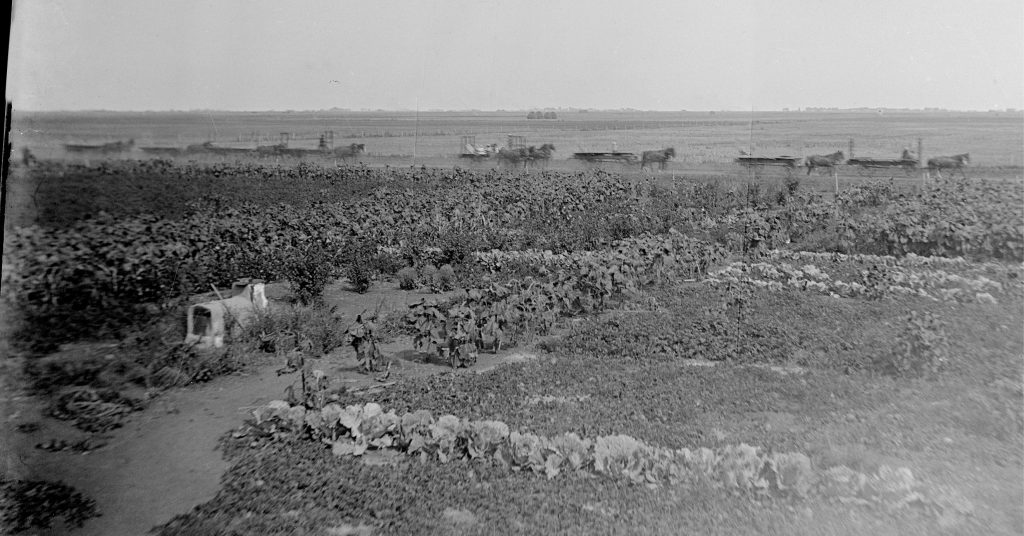
The garden near this house is considered the most luxurious among the Mennonites, but in fact it is pitiful. All attempts to grow apple trees fail; severe frosts destroy all fruit trees. There are many gardening enthusiasts here, but their efforts are not crowned with success. For some reason, plums somehow still withstand the climate and sometimes even ripen. Gooseberries and currants grow successfully and are the only fruits that the locals enjoy. Gardening and vegetable growing are the weakest aspects of Mennonite farming – the main focus is cattle breeding, horse breeding, and wheat. Here wheat reigns; everything depends on it. Wheat commands the prizes – it determines the prices for everything, and the balance of the year depends on its harvest. So far, there have been no hailstorms, locusts, or mass deaths of livestock. There are gophers, but not on Mennonite land; they are much farther west in the countryside where there is still little plowed land. Here, people only know about the Hessian fly through the newspapers.
We spent the whole day travelling through the villages. In some places, the grass was already tall, despite the early time of year, and provided excellent fodder for the cattle – large herds grazed in the meadows. The cattle must have been brought from Texas – they resembled South American cattle. Everywhere the horses were thoroughbred; some resembled those from stud farms and were similar in build to those from our southern provinces. Between villages, human-made, properly planned roads were built. The communities are obliged to build routes of transportation and annually increase the number of versts (here they count not in miles, but in versts), gradually expanding the network of roadways throughout the colony. In one place you can see how trenches are being dug; in another, gravel has already been laid. Some villages are connected by the same excellent roads as those you would find between villages in England and America.
It seems to me that exclusiveness, extremity, and originality – bordering perhaps on holy foolishness – are needlessly considered reprehensible by many. Mennonites are undoubtedly a one-sided people, carried away by their beliefs. Nevertheless, wherever they appear, like the Puritans, total-abstainers, and other exceptional people who have broken off contact and communication with their contemporaries, they have a beneficial influence on others, serve as a good example to their neighbours, and contribute their part to the general progress of the world. They are silent companions, invisible workers, useful labourers in the cause of spreading morality and improving people.
Born into a merchant family in Moscow, Pyotr Semyonovich Alekseev (1849–1913) was a physician and writer dedicated to public health and social reform. He travelled extensively, visiting North America, China, and Japan.
- Excerpted in translation from P. S. Alekseev, Po Amerike: Poezdka v Kanadu i Soedinennye Shtaty [Across America: A trip to Canada and the United States] (Moscow: A. Lang, 1888), 290–300. Thanks to James Urry for submitting this source. ↩︎
- During the migration to imperial Russia in the early nineteenth century, some artisans may have settled in the province of Poltava. However, a Mennonite settlement in that province did not exist. ↩︎
- Perhaps he is refering to Grünthal. ↩︎
- One verst equals approximately one kilometre. ↩︎
- A migration from Prussia to Samara province took place during the mid-1850–1870s. It is unclear how many Mennonites from here moved to Manitoba. ↩︎
- Likely a reference to Die Mennonitische Rundschau, although it was published in Indiana. ↩︎