

The Lost Kauenhoven-Pauls Bible
Reinhild Kauenhoven Janzen
I tell this story to keep alive the memory of a lost Bible. This Bible embodies the Kauenhoven-Pauls family’s history and identity, encompassing more than three centuries, two continents, war, and upheaval. My quest to find this elusive heirloom and the answers it might hold to genealogical questions that were of great interest to my father has put me in contact with scholars in Europe and North America and taken me to archives and libraries in St. Petersburg, Russia.1
The only surviving tangible link to the Kauenhoven-Pauls Family Bible is a copy of the family tree it contained, believed to have been drawn by Marie Kauenhoven (1813–1889) in Chortitza, and preserved by her descendants in Canada. Marie Kauenhoven’s copy of the family tree allows us to track the sequence of households that kept the Bible. Its first owners were Abraham Kauenhoven and Aganetha Havermann, who immigrated to Danzig (Gdansk) from the Netherlands in the early seventeenth century. From Danzig it would have been brought to Chortitza in the late 1780s, most likely in the travel trunks of Phillip Kauenhoven (1748–1806). He was the first of the Kauenhovens from Danzig to migrate to the Ukrainian lands of imperial Russia with his wife Magdalena and their five children.2 His father was Berend Kauenhoven (1707–1763), a brewer, who was a deacon and, as of 1749, a preacher in the Danzig Mennonite congregation. Other Kauenhovens, including brothers Bernhard and Abraham, soon followed Phillip and Magdalena, settling in Rosenthal, Chortitza.3
Later the Bible was passed on to Phillip’s son Bernhard and his wife Marie. When their only heir, daughter Maria (Marie), married Heinrich Pauls,4 the new couple received the farm and the Kauenhoven Family Bible, which now became the Kauenhoven-Pauls Family Bible. Oral tradition of their descendants in Canada suggests that Marie copied the family tree from the Bible, but this can only be true of the earlier portion of the family tree, because it continues past her death into the twentieth century. The Bible then entered the possession of Heinrich and Marie Pauls’s son Heinrich Pauls (1835–1900) and his wife Maria Hildebrand (1845–1921). From them the Bible and the farm were likely passed on to Bernhard and Helena Epp, who experienced the turbulence of the First World War, the end of tsarist Russia, and the Bolshevik Revolution. It was from them that the Bible supposedly was taken. In 1923, they left for Canada.
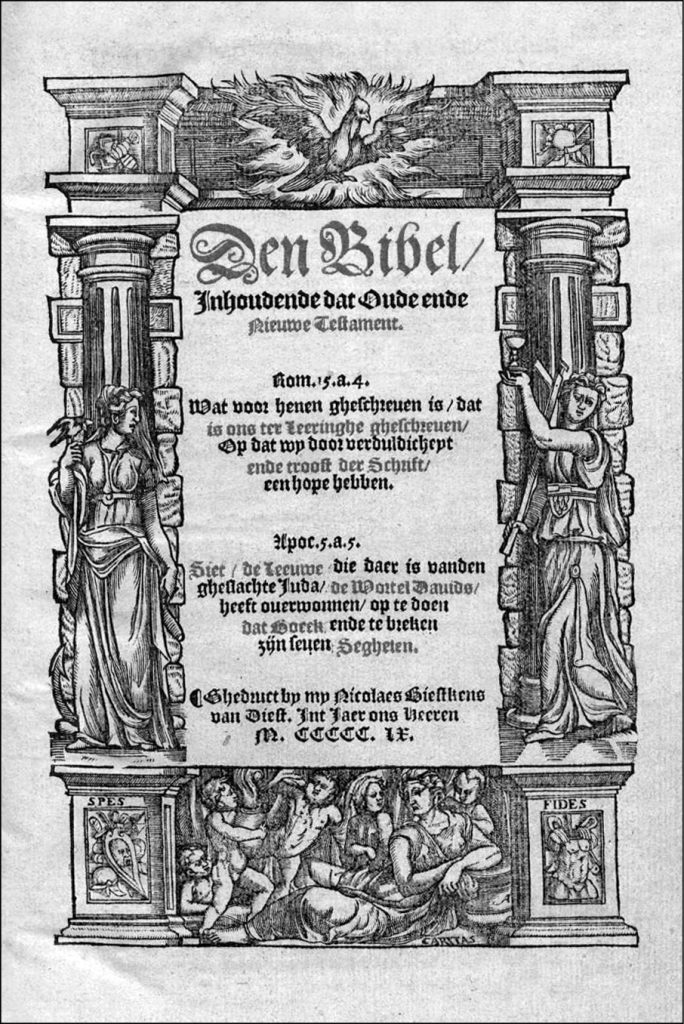
We don’t know the edition of the Kauenhoven-Pauls Family Bible. Early Dutch Mennonites commonly used the Biestkens Bible, published by Nicolaes Biestkens.5 It might have been a so-called Schottland Bible, printed in Haarlem in the 1590s for Dutch Mennonite settlers around Danzig in the Vistula Delta. Mennonites were not allowed to print religious literature in the walled city of Danzig itself. The Mennonite elder and merchant Crijn Vermeulen distributed these bibles from his home in the suburb of Schottland, hence the name.6
Though the vernacular language of these Mennonite settlers had become Plautdietsch – an amalgam of the local Low German dialect with Dutch words – the language of worship and Bible-reading remained Dutch. As contact with the Netherlands diminished, the language of worship among Mennonites in the Vistula Delta gradually became High German. H. G. Mannhardt reports that the first High German sermon was preached on September 19, 1762, in the Flemish congregation of Danzig. He adds, “Since we were not used to this, there was no general affirmation.”7 Daily speech remained Plautdietsch.8
A Father’s Challenge
In Göttingen, West Germany, on my twenty-first birthday, my gentlemanly and gentle father, in his signature bow tie, presented me with a gift to mark my passage from childhood to adulthood. He gave me two stout volumes, bound in cornflower blue linen, their spines’ gold-embossed letters spelling Danziger Mennoniten-Familien 1935–1939 and Danziger Mennoniten-Familien 1940–1944. Both were inscribed by my father with his fountain pen in blue ink: “To his daughter Reinhild on the day of her coming of age as remembrance and as duty, from her father Kurt Kauenhoven,9 June 17, 1962. Blessed is the one who honours the memory of their forebears. Goethe, Iphigenia.” The Goethe quote is but one line of a longer verse from his play Iphigenia in Taurus: “How blest is he who his progenitors with pride remembers, to the list’ner tells the story of their greatness, of their deeds, and, silently rejoicing, sees himself link’d to this goodly chain!”10
The volumes contained the issues of the journal Mitteilungen des Sippenverbandes der Danziger Mennoniten-Familien Epp-Kauenhowen-Zimmermann, founded in 1935 by my father.11 I understood that with Goethe’s words in his gift’s inscription, my father – a teacher, pedagogue, and scholar – was giving me, his first-born, an admonition and a task: to keep the memory of the family’s history alive. I grew up aware of my father’s lifelong research and writing of the history of the Kauenhoven family, its far-flung branches, and his many publications on Mennonite history.12 His study held thousands of books and his carefully organized research card-files with names, dates, and places. These “cards” were recycled pieces of paper, Zettel, each scissor-cut to the same size. Often Vati – as we addressed our father – read out loud after lunch or at afternoon teatime letters from distant Kauenhoven relatives in Canada, Mexico, and Paraguay. There was also his ongoing correspondence with Mennonite historians and writers in Germany, the United States, and Canada. And there was a steady flow of Mennonite visitors from abroad who wanted to speak with my father about Mennonite history and enjoy my mother’s warm-hearted hospitality.
Occasionally he would express his regret about the lost Dutch-language Bible, with its family tree, that had accompanied Kauenhoven forebears on their migrations. He learned of its disappearance from his 1937 correspondence with B. H. (Bernhard Heinrich) Pauls, a grandson of Maria Kauenhoven and Heinrich Pauls, whose family emigrated from Ukraine to Canada in 1923. According to the family, the Bible was confiscated by the Soviets and put into “a museum in Leningrad.” Access to the genealogical information contained in the Bible’s family tree would have allowed my father to trace the Kauenhovens’ history further back in time, possibly to a common origin in the Netherlands in the sixteenth century.13 My father had traced the lineage through the paternal line of two Danzig Kauenhoven families. In his genealogical chart, these two patrilines were tentatively linked at the top by two unknown ancestors. He believed the lost document might have allowed him to replace the two question marks on his genealogical chart.
In September 1945, when I was four, my mother and I returned home from buying groceries to find the door to my father’s study taped shut with a handwritten note: “Do not enter.” My father was gone, arrested by soldiers of the British Army and imprisoned in their internment camp at Westertimke, near Bremen. He had been a member of the National Socialist Party and was active in the party’s Göttingen branch of the Office of Racial Policy. British soldiers ransacked his study and stole all its valuables, and took with them all my father’s research and photo files with family history, his correspondence, and his academic writings.14 When my father was released from prison in May 1946 because his tuberculosis had flared up, he began the task of reconstructing his Kauenhoven family history.
The Heinrich Pauls Family Connection
I began my quest to retrieve this lost family history after receiving an unexpected letter. In 1991, fifty-five years after my father had corresponded with his grandfather Bernhard Pauls, Henry Pauls Jr. wrote me a letter of thanks for my review of his father’s book, A Sunday Afternoon: Paintings by Henry Pauls. He said that his father’s first question was, “Why would she choose to review my book? What is the connection? Then he noted your name. Kauenhoven also features in our family history. Maria Kauenhoven, born Sept. 26, 1813, married my great-great-grandfather Heinrich Pauls. She died March 14, 1889.” Henry Pauls Jr. added a copy of his family tree to his letter, going back to 1659, the birthyear of Bernhard Kauenhowen in Danzig. He signed off saying that his parents would “love to hear from you.”15
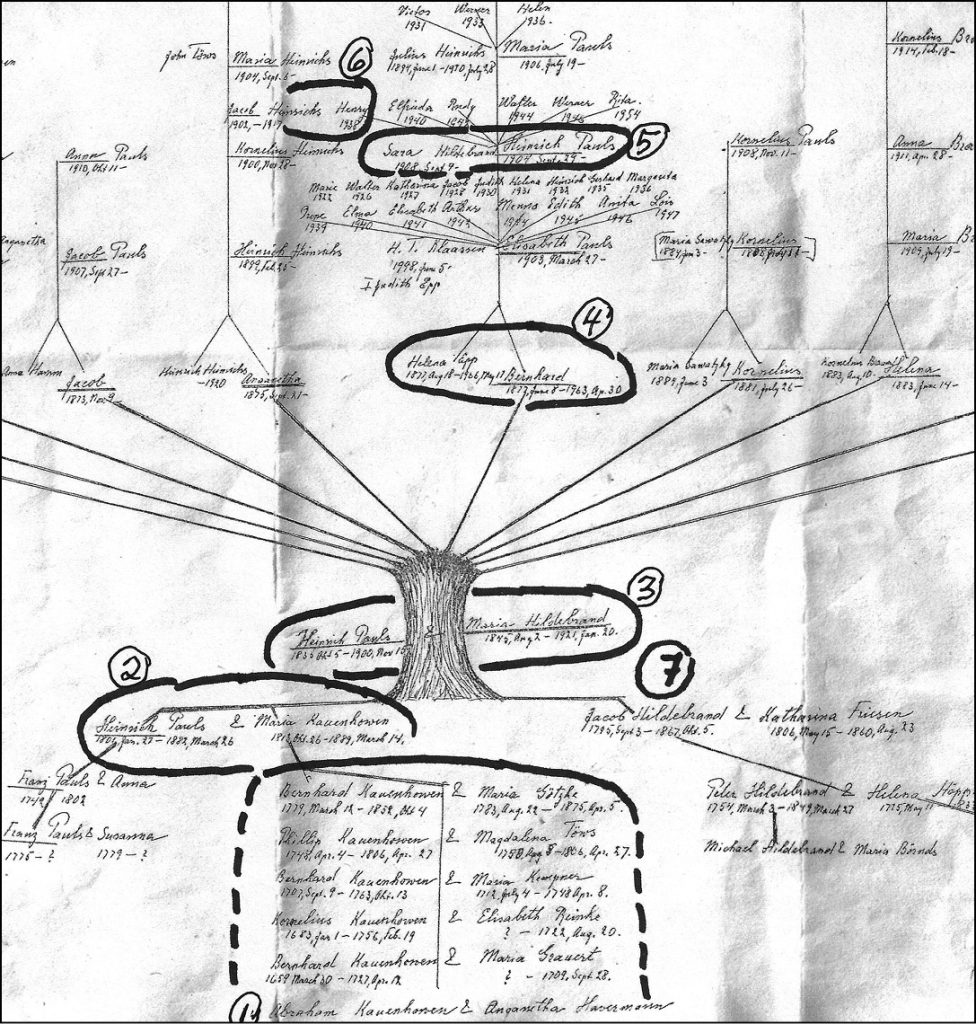
I gladly wrote to Henry and Sara Pauls, and with my letter I sent my and my husband’s book Mennonite Furniture: A Migrant Tradition, 1763–1910 as a gift. Their thank-you letter to me of November 20, 1992, included a copy of Heinrich Pauls’s family tree to show the connection to Maria Kauenhoven.
[Great-grandmother] Maria Pauls (born Kauenhowen) had copied it [the family tree] from the Kauenhowen Bible. . . . I learned from my father Bernhard H. Pauls . . . [that] the name Kauenhoven is Dutch. My grandparents had a large Bible, printed in Dutch. It came from the Kauenhovens and had a large family register. . . . The Soviet government took it from my grandmother [Maria Hildebrand] in 1920, and it is now in the Leningrad Museum.
Henry Pauls also shared that his cousin, historian David G. Rempel (1899–1992), asked about this Bible while researching in Leningrad in the 1960s but got a decisive rejection.
The letter my father received in 1937 from Bernhard H. Pauls, grandson of Maria Pauls née Kauenhowen, offers a more detailed account of the transmission of Kauenhoven family inheritance:16
Bernhard Kauenhowen, farmer in Rosenthal near Chortitz in South Russia, born March 12, 1779, died October 4, 1852, married Maria Goetz, born August 22, 1783, died May 5, 1875. They had two sons (names unknown) and one daughter Marie, who was born October 26, 1813, in Rosenthal near Chortitz, and died there March 14, 1889. She married Heinrich Pauls, born January 27, 1806, died in Chortitz March 26, 1882. After his death Bernhard Kauenhoven’s farm came into the possession of his son-in-law Heinrich Pauls. At the Rosenthal cemetery one finds next to the burial mounds of Heinrich and Maria Pauls, born Kauenhowen, also the burial mounds of Bernhard Kauenhowen and his wife. Standing there are unhewn blocks of granite which are engraved with the names of the Kauenhowen couples as well as the dates of their births and deaths. My grandmother Marie Kauenhowen was the last Kauenhowen in the old mother colony. She died in my parents’ home, also in Rosenthal. With the death of my grandfather the Kauenhowen farmstead and landholdings went to different hands, but the buildings are still standing, changed very little. Their straw roofs have been replaced with shingle ones.
Further information about the Bible from a Pauls family member is included in an excerpt of a letter from a Mrs. Hildebrand in Canada to her son Peter Hildebrand in Wilhelmshaven, Germany, on May 23, 1939, included in my father’s family history writings:
Also interesting was a book written in the Dutch language which had been passed on to my parents’ home. It was a thick book with a hard leather cover. The writing [was] very clean; all initial letters were drafted in a very elaborate manner and large in [size]. Family matters were supposedly recorded by Behrend Kauenhowen in Gdansk or its vicinity. There were lists of names of young people who wanted to get baptized: “Mariecke” instead of Maria. “Triencke” instead of Katharina. “Behrend” instead of Bernhard. Unfortunately, this book stayed in Russia.17
It must be noted that only the congregation’s elder (Aeltester) was authorized to baptize and distribute communion. Therefore, could it be that this Bible, with its family tree and list of candidates for baptism, had been brought to Russia by a Kauenhoven immigrant who was an elder in the Danzig church?
I decided that one day I would travel in my father’s stead to St. Petersburg’s Museum of the History of Religion, whose archive might hold the lost Bible and family register, and hopefully find the answer to his search for the common origin of Kauenhoven family branches in the Netherlands.
The Search Begins
In June 2014, I began preparations for my trip to St. Petersburg. Two years later I flew to the city with my sister Hendrikje. We began our library explorations at the archive of the Museum of the History of Religion, near St. Isaac’s Cathedral. Our guide and translator was Olga Zadirako, a student of German. She had grown up in Ukraine and begun her studies in Kyiv, but going home now would be problematic, she said, given the war Russians were waging in eastern Ukraine. At the reception desk I presented my letter of introduction, translated into Russian, and mentioned the name of the director of the archive with whom I had exchanged emails. We were ushered to the office of the next higher administrative level, and I explained what I was looking for. A student assistant, Elena Kravtsova, who was writing her dissertation about thirteenth-century Franciscans in France, brought out three seventeenth-century Dutch Bibles for us to see, but they showed no connection to the Kauenhoven name. I was assured that the Museum of the History of Religion archive did not have the lost Kauenhoven-Pauls Bible.
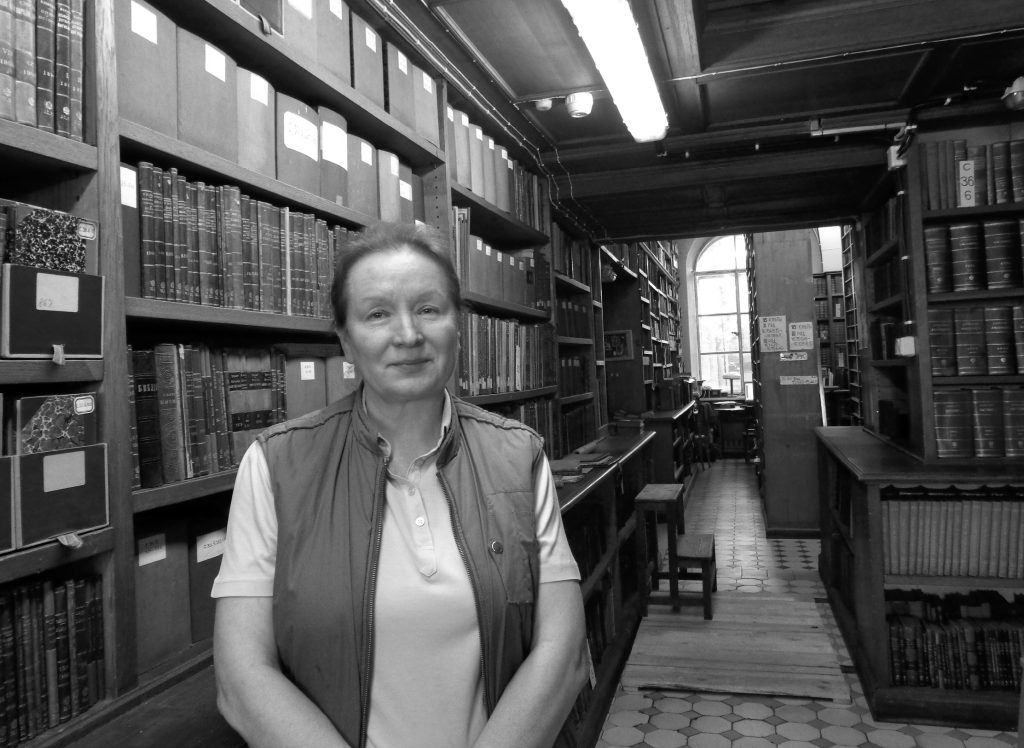
Since the day was still young, Hendrikje, Olga, and I now walked to the National Library of Russia on Nevsky Prospect, St. Petersburg’s main avenue. This is a palatial late eighteenth-century building, the ornate façade painted pale blue with white trim. Once we were registered, a staff member guided us to the Department of Rare Books to hand us over to the friendly and accommodating librarian Mr. Fafurin. Through the tall windows of the reading room, we could see a larger-than-life statue of Catherine II, who had invited Mennonites to settle in Ukraine. Mr. Fafurin climbed a tall ladder to reach for three seventeenth-century Bibles printed in Dordrecht and in Amsterdam. One Dutch-language New Testament bore the bookplate of Theophan, archbishop of Novgorod. Mr. Fafurin also showed us a special period room called Faust’s Library, and lifted the protective cloth covers from display cases that held some of the greatest treasures under his protection.
Next Mr. Fafurin handed us on to his colleague Maria Tkachenko, chief librarian of the National Library of Russia, whose realm was on the second floor. She pulled eight seventeenth-century Dutch Bibles from the stacks for Hendrikje and me to leaf through. Unfortunately, again, there was no handwritten Kauenhoven name to be found. Tkachenko, middle-aged, motherly and with a fine sense of humour, exclaimed that she would jump over the very table in front of her if we indeed found what we were searching for, a quest she compared to trying to find a needle in a haystack. She advised us to go and check the holdings of the Academy of Sciences in St. Petersburg, and other libraries in Kyiv and elsewhere in Ukraine.
The Library of the Russian Academy of Sciences is located on Vasilyevsky Island. It is Russia’s oldest state research library, and one of its largest. Visitors are greeted by a modern portrait of the famous Russian physicist and Nobel Peace Prize laureate Andrei Sakharov (1921–1989). The guard at the entry led us to an office near the front door, and it was immediately obvious that the “gatekeeper” would be unpleasant. Her general expression was one of discontent and disappointment with life. I showed my letter of introduction, which she read carefully. She shook her head and asked whether I was still working at Washburn University. I explained my title “professor emerita,” describing how scholars typically continue to work on research projects after retirement. Olga had to fill out a green identity card in Russian and I was asked to hand over two passport photos. I had only one. This caused the receptionist to be upset with me, as did the fact that my passport photo was slightly larger than the space designated for it on her form. My photo was supposed to fit perfectly inside the outlined rectangle where she had to glue it. Finally, she folded the form with my photo and stuck it into a file drawer. Reluctantly, she handed me my green cardboard pass without the officially requested second photo. Hendrikje had to undergo the same procedure while Olga and I were asked to wait outside in the hall.
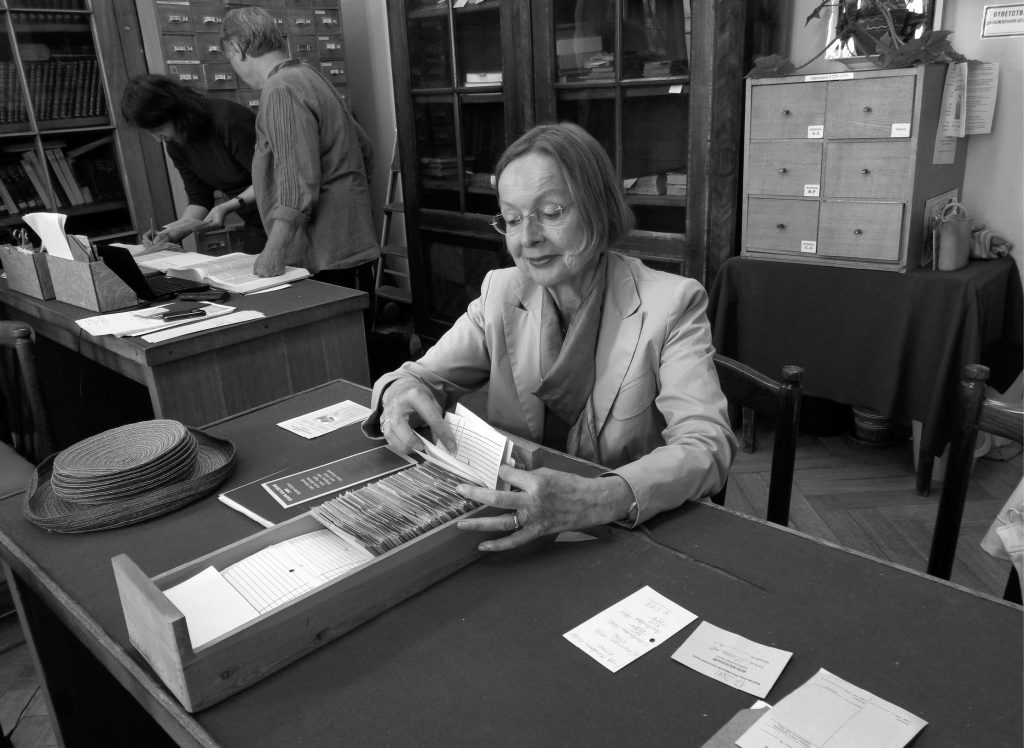
Up the stairs two women guards allowed us to walk through the turnstile, where our shoulder bags and our pass cards were checked once more. A guard guided the three of us up more stairs and along seemingly endless corridors crowded with wooden bookshelves, wooden card file drawers, sickly looking potted plants on the windowsills, and an occasional cleaning woman in her smock, pushing a broom or a mop. Once we arrived at the department responsible for old or rare books, we met the most friendly, helpful women librarians, some of whom spoke a smattering of English. We were given a wooden card catalogue file drawer from which to select the Dutch-language Bibles relevant to our search time frame. The ones we selected were then brought to us from the stacks to a small reading room with about five tables and an assortment of old chairs. The green felt covers on the tables were worn, some in tatters, as were the curtains at the windows. That morning Hendrikje and I looked through ten seventeenth-century and two eighteenth-century Dutch-language Bibles printed in the Netherlands.
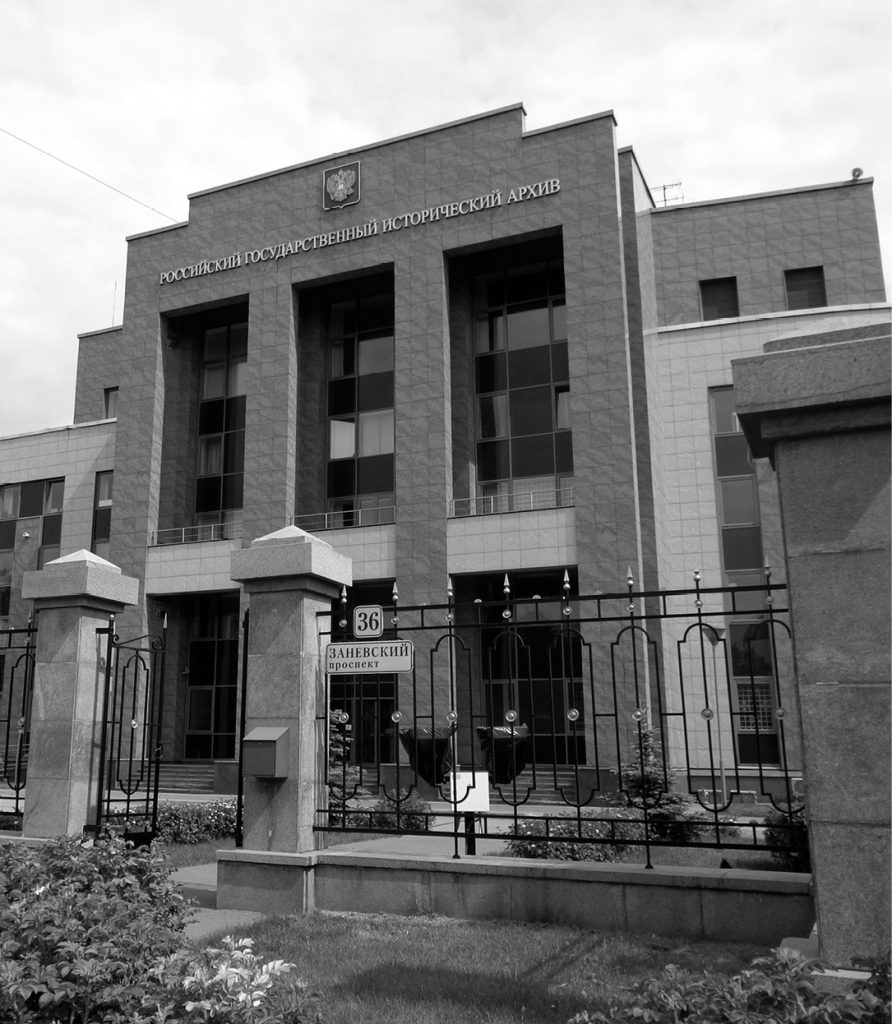
The fourth and last St. Petersburg library we visited was located at the Russian State Historical Archive, a long distance away from our centrally located hotel. Finally, we found ourselves in front of a formidable iron fence with gilded tops, mounted on a stone wall. Behind it rose an imposing modern building, surrounded by manicured grounds. Inside the entrance hall the magisterial scale and opulence continued. Marble walls were decorated with huge, elaborately framed red panels featuring an official seal with a golden imperial crown; leather-upholstered chairs and sofas offered comfort for visitors. We were required to slip blue plastic covers over our shoes as we entered, and thus slid on the slick and sparkling tile floor toward an office where I presented my formal letter of introduction to an employee, another “lioness” at the gate of the treasures. I could describe in English what I was looking for, and was given a list of a dozen or more departments in this vast archive, a list I could not read because it was in Russian, so I had to rely on Olga again. We were to wait and could almost enjoy, but not relax in, the exquisite seating in the palatial lobby.
After twenty minutes we were curtly told that the archives and library held no Bibles in their collections and were coldly dismissed. We took off our blue sanitary shoe covers at the door and left, disappointed. Our consolation was a richly rewarding sisterly exploration of St. Petersburg’s other cultural treasures, including museums and churches. We took in The Bronze Horseman, a ballet based on Pushkin’s poem about Peter the Great, and chamber music in the park at Peterhof.
Chipping Away at the Unknown
Soon after my return from St. Petersburg to my home in the prairies of Kansas, I learned of a second story to explain the loss the Kauenhoven-Pauls Family Bible. Aileen Friesen, a scholar at the University of Winnipeg, brought to my attention David G. Rempel’s memoir, A Mennonite in Tsarist Russia and the Soviet Union, 1789–1923, co-authored with his daughter Cornelia Rempel Carlson. Rempel was a great-grandson of Marie Kauenhoven and Heinrich Pauls.18 He wrote:
On 2 February 1915, the [Russian] government issued two land liquidation decrees [aimed at subjects of Austrian, Hungarian, or German descent]. . . .
The big question for Mennonites was, would the decrees apply to them? Would they be labelled as “German,” as various chauvinistic newspapers and extreme nationalistic leaders assumed? Or would they be identified as “Dutch,” as they themselves had long maintained?
. . . [In August 1916] the government, indeed, declared Mennonites to be of German descent. . . . The Mennonites mounted an aggressive campaign to overturn the application of the [land liquidation] decrees to themselves. . . . Their leaders sent delegates to Petrograd to argue for our Dutch ancestry. The delegates were armed with an extensive collection of Dutch-related materials: Bibles, old letters, genealogies, catechisms, and other religious materials. To this effort, our family donated a treasured family register which, sadly, was never returned.19
Cornelia told me later that her father had visited the archives in Moscow and Leningrad (as St. Petersburg was then known) in 1962, but she did not believe that he had asked about the Bible.20 In short, our family’s spiritual heirloom may have been sacrificed for what became known as “the Dutch argument.”
The tsar’s justice minister, Nikolai Dobrovolsky, was tasked with investigating the validity of the Mennonites’ claim to be of Dutch descent and identity. His private notes were published in 2003 in Moscow by Aleksandr Zviagintsev and Jurij Orlov.21 Nina Vyatkina, professor at the University of Kansas, kindly translated the following passage from that text:
The accusation appeared more than once in the newspapers that I had prevented the liquidation of the German landowners by having the sale of the Mennonite estates cancelled. A note about this case appeared in Novoye Vremya and was inspired from a source personally hostile to me, about which I was informed by telephone on the day it appeared by a certain Levin, a representative of the newspaper Rus, with which I myself sometimes cooperated. This note, first of all, contained a lie: there was no talk of cancelling the sale of these lands, but the question of the sale of share auctions and the revision of the case was raised in view of the evidence presented that the vast majority of the Mennonites were Dutch and had never been German subjects. The Sovereign became interested in this case, instructed me to report to him the petition of the Mennonites, and, having familiarized himself with the evidence they relied on, instructed me to convey to the chairman of the Council of Ministers an order to review the case in a special meeting and then submit it for his approval. In the Council of Ministers, everyone unanimously recognized the need to verify the evidence presented, and the ministers of finance and external affairs immediately announced the need to urgently send telegrams to the relevant institutions to suspend trading. And here are the grounds for revisiting the case. The Mennonites, undoubtedly immigrants from Holland, settled about three hundred years ago in the Gdansk region of the kingdom of Poland. One hundred and twenty-six years ago, during the reign of Catherine, they moved to Russia. They have preserved until now, in their religious affairs, relations with the Dutch Mennonites. Both the Dutch embassy in Petrograd and the Dutch government recognize them as Dutch immigrants. In their domestic life, they have retained their language to this day. After the first partition of Poland, part of the Mennonites with their lands fell under the rule of the Prussian kingdom, but the vast majority moved directly from Poland to Russia, where they have been living for 126 years. In the 1870s, for some reason, our government found it necessary to introduce teaching in German in Mennonite schools.22 The Mennonites protested. They repeatedly petitioned for teaching in Russian and I was provided with notarized copies from the declarations of the ministers of internal affairs and public education about the refusal of such petitions. And that’s the whole point. . . . You can’t put these people in the same bag with the German colonists.23
The acknowledgement of the Mennonites’ Dutch identity by the embassy in St. Petersburg and the Dutch government caused me to shift my focus. I began to consider that the Dutch-language documents might have been taken to the Dutch embassy in St. Petersburg to verify the Dutch identity of Mennonites in imperial Russia. An inquiry at the International Institute of Social History in Amsterdam connected me with the historian Hans van Koningsbrugge of the University of Groningen, who in turn forwarded my question to his fellow historian Ad van de Staaij. During his research in the files of the Dutch embassy in St. Petersburg at the National Archives in The Hague, van de Staaij had found a letter from Mennonite delegates in Petrograd addressed to Abraham Kuiper, a Doopsgezind (Mennonite) minister in Amsterdam, dated February 6, 1917, requesting more documents from Amsterdam to support the Mennonites’ Dutch argument.24 The letter was written in Dutch and signed with Dutchified versions of its authors’ names: J. Nieuwveld (Neufeld), A. Schrader (Schroeder), and H. Bruyn (Braun). Van de Staaij suggested that the Kauenhoven Family Bible may have been in possession of this team, “and maybe one of the members took care of the Bible after the Revolution.”25
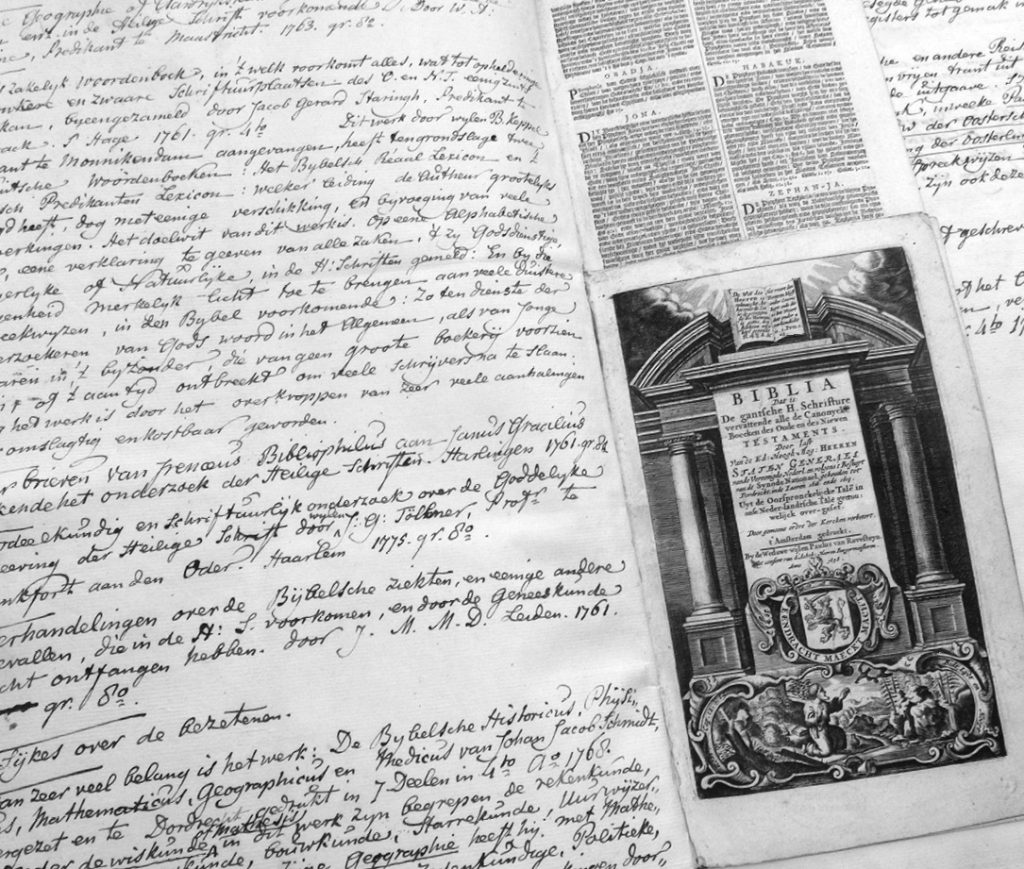
Could some of these documents have eventually been deposited at the Russian State Historical Archive after all? When I was there in 2016, I had asked about a Kauenhoven-Pauls Family Bible with a family register in their holdings, but I did not know then of the Dutch identity issue and thus did not frame my question in terms of Dutch-language documents that would have been seen by Dobrovolsky in January-February of 1917. How could I find a Russian archivist whom I could ask to search there in my stead? Help came once again through personal connections26: Gabriel Superfin, called Garik for short, a renowned Russian archivist who was forced to leave the Soviet Union in the early 1980s after seven years of imprisonment, and became in 1995 archivist at the research institute Forschungsstelle Osteuropa of the University of Bremen. Garik remembered the archive from 1967:
The library of the [Russian State Historical Archive] was in a terrible state. Books which once belonged to the Synod were not worked with; everyone could take what he wanted or simply throw it away. I had a New Testament in the Rumanian language, written in Cyrillic. Surely no one could work with books published in the Dutch language. Family registers were usually Bibles with notes by the owner – continued from one generation to the next generation. . . . I write this in order not to create too much hope. But [such] documents taken to St. Petersburg in 1916 can hopefully still be found there.27
Garik asked his former colleague in St. Petersburg, Victor Dzevanovsky, to search for the Kauenhoven materials in the Russian State Historical Archive and asked for Cyrillic transcriptions of the Kauenhoven name. These were provided by Rolf Fieguth, but Garik’s internet search with the two Cyrillic transcriptions of “Kauenhoven” did not yield results.28 At the same time, Garik did internet searches of St. Petersburg’s National Library and the archive of the Museum of the History of Religion but found that neither held any manuscripts, documents, or other writings (Schriftstücke) which pertained to Mennonites. Garik suggested that I inquire at the National Archives of the Netherlands.29 Their response to me was: “We don’t have any records from around 1920, because all political ties in that period were cut off with the Soviet Union. . . . You can search by query the word ‘Mennoniet,’ which has very little unfortunately.”30
This story is an example of the inconsistency that can occur in a family’s oral history over the course of generations. I learned there are two divergent narratives about the loss of the long-cherished book, placing the event either in 1916–17 or around 1920.
Epilogue
I continue to wonder what could have happened to the Kauenhoven Family Bible with its family register. There is a possibility that it was returned to its owners by the delegation who took it to St. Petersburg upon their return to their Mennonite colony, as Ad van de Staaij suggests. It might have been taken by the Bolsheviks in the 1920s, because under the new atheistic regime, religious objects were often destroyed or could be sold to collectors; it might still be part of a private collection. The Bible might have stayed in the office of Dobrovolsky and gotten taken away, lost, or destroyed when he lost his job – and life – with the fall of Tsar Nicholas II’s empire. Alternately, the Bible might have been deposited at the Dutch embassy in St. Petersburg. According to van de Staaij, in 1918 or 1919 “some of the possessions of the Dutch consulate in St. Petersburg were put in a safe which was buried in the garden of the embassy when the officials fled, in the hope it might be dug up after the Bolsheviks would have disappeared. Unfortunately, they did not. A list of its contents can be found in the National Archives but there is no reference to a Bible.”31
Even though my search has been inconclusive, I have tried to honour my father’s admonition to me about the centrality of memory for one’s identity and one’s place in history, and therefore one’s obligation to preserve it. However, my motivation to work toward closure in my father’s endeavour in family genealogy in no way justifies or diminishes his role in the German race science of the Third Reich. I loved, admired, and deeply respected my father. As the oldest child of four, who left to live abroad at a young age, I wanted to contribute to the family in a way I could despite the great geographical distance, wanted to fulfill his expectations of me and please him even after his death. I was brought up to finish what I started, to be dutiful – I find that gratifying. And, I admit, imagining the triumph in the event my search were rewarded also spurred me on. My reward has been a learning journey through several centuries shaped by major political events and ideologies, and spanning two continents, and the help I received on my way from a great number of knowledgeable people.
Reinhild Kauenhoven Janzen is a professor emerita of art history at Washburn University and former curator of cultural history at the Kauffman Museum at Bethel College in North Newton, Kansas.
- There is great variation in the spelling of the Kauenhoven name throughout the centuries and across the lands. Here I use Kauenhoven throughout, except when I quote from a source that might have a different spelling. In 1949, my father changed the spelling of his name from Kauenhowen to Kauenhoven because, as his brother Walter agreed, the v spelling corresponds more closely with earlier historical spelling of the name. See Global Anabaptist Mennonite Enyclopedia Online (GAMEO), “Kauenhowen.” See also Kurt Kauenhowen, “Zur Bedeutung des Familiennamens Kauenhowen,” Mitteilungen des Sippenverbandes der Danziger Mennoniten-Familien Epp-Kauenhowen-Zimmermann 4, no. 5 (Oct. 1938): 156–57. ↩︎
- For the most current source on Kauenhovens who migrated from Danzig to Chortitza with the first migration, upon invitation of Empress Catherine II, see Henry Schapansky, Mennonite Migrations (and The Old Colony) (pub. by author, 2006); and Glenn H. Penner, “The First Mennonite Settlers in the Chortitza Settlement,” https://mennonitegenealogy.com/russia/First_Mennonite_Settlers_in_Chortitza.pdf. ↩︎
- Kurt Kauenhoven, “Die Kauenhoven im Ausland,” Mitteilungen des Sippenverbandes der Danziger Mennoniten-Familien Epp-Kauenhowen-Zimmermann 1, no. 1 (June 1935): 15–17. See also “Auf der Spur von Rußland-Kauenhowen,” in the same issue, 13–14. The Danzig church register does not use the word “emigration” but just says “travelled abroad” (außer Landes verreist) or “travelled to St. Petersburg.” They travelled with papers attesting to their professions. For Berend Kauenhoven, see also Kurt Kauenhoven, “Kauenhowen 2,” in Deutsches Geschlechterbuch, vol. 132 (Limburg an der Lahn: C. A. Starke, 1963), 337. ↩︎
- The family’s records state that they had two sons; their names are not known. Most likely this means they were stillborn. ↩︎
- GAMEO, “Biestkens Bible.” ↩︎
- Kat Hill, “Varied Vernaculars and Material Memories: Mennonite Bibles and Their Histories,” Anabaptist Historians, Dec. 3, 2029, https://anabaptisthistorians.org/2019/12/03/varied-vernaculars-and-material-memories-mennonite-bibles-and-their-histories/. ↩︎
- H. G. Mannhardt, The Danzig Mennonite Church: Its Origin and History from 1569–1919, trans. Victor G. Doerksen, ed. and annotated by Mark Jantzen and John D. Thiesen (Kitchener, ON: Pandora Press, 2007), 118. ↩︎
- GAMEO, “Danzig Mennonite Church.” ↩︎
- See Mennonitisches Lexikon, “Kauenhoven, (Kauenhowen) Kurt Julius Max,” https://www.mennlex.de/doku.php?id=art:kauenhoven_kauenhowen_kurt_julius_max. ↩︎
- Goethe’s Iphigenia in Tauris, trans. Anna Swanwick (Reading, PA: Handy Book Company, n.d.), 11. ↩︎
- The journal was preceded by Die Kauenhowen: Mitteilungen aus der Geschichte und dem Leben des Geschlechtes Kauenhowen, edited by my father (1888–1975) and his younger brother Walter Kauenhowen (1900–1942), which published a single issue (Jan. 1926). ↩︎
- See, e.g., his articles published in Mennonite Life and The Mennonite Encyclopedia. ↩︎
- See Kurt Kauenhoven, “Kauenhowen 1,” in Deutsches Geschlechterbuch, 132:193–94. ↩︎
- I am indebted to Benjamin Goossen for sharing with me documents in the British National Archives that hold my father’s letter written in English on July 28, 1947, to the British military’s religious affairs branch, asking for “restoration of property referring to the Mennonite Church,” listing all the materials taken from his study by British soldiers. The response was that all written materials, including photos, had been burned in the Frontier Service’s headquarters in Göttingen. See FO 1050/1565, The National Archives, Kew. ↩︎
- Hildi Froese Tiessen and Paul Gerard Tiessen, eds., A Sunday Afternoon: Paintings by Henry Pauls (Waterloo, ON: Institute of Anabaptist-Mennonite Studies; St. Jacobs, ON: Sand Hills Books, 1991). ↩︎
- My father published a key section of B. H. Pauls’s letter in his article “Die Kauenhowen in Rußland,” Mitteilungen des Sippenverbandes der Danziger Mennoniten-Familien Epp-Kauenhowen-Zimmermann 3, no. 3 (June 1937): 74–75. ↩︎
- Bernhard H. Pauls’s memory of the Kauenhoven Bible in his letter to my father is also included in my father’s essay “Die Kauenhowen in Russland, seit 1784, 1788, 1806 und 1870,” in his bound typescript Das Kauenhowen-Buch 1. Teil, Beiträge zur Geschichte Danziger Mennoniten-Geschlechts Kauenhowen-Couwenhoven 1656–1957, ed. Kurt Kauenhoven (Göttingen, 1962), 334. ↩︎
- Aileen Friesen, email, July 24, 2016. ↩︎
- David G. Rempel with Cornelia Rempel Carlson, A Mennonite Family in Tsarist Russia and the Soviet Union, 1789–1923 (Toronto: University of Toronto Press, 2002), 160–61. ↩︎
- Cornelia Carlson, email, Aug. 18, 2022. I had asked her whether she knew of family members who might since have searched for this Kauenhoven Bible/register, who might have a memory about it. I thank James Urry in Australia for contact information for Cornelia Rempel Carlson in California. ↩︎
- A. Zvyagintsev and Ju. Orlov, Neizvestnaya Femida: Dokumenty, sobytiya, lyudi [The unknown Themis: Documents, events, people] (Olma-Press, 2003). I am grateful to Renate Döring and her friend Garik for alerting me to this publication. ↩︎
- Dobrovolsky is mistaken in his claim that German was introduced into Mennonite schools during the 1870s. Mennonites taught their children in German until the imperial Russian state introduced mandatory Russian language training. ↩︎
- Nina Vyatkina’s translation of justice minister Dobrovolsky’s private notes published in Zvyagintsev and Orlov, Neizvestnaya Femida, 213 (email, May 8, 2023). In summer of 2022 I met with friend Harley Wagler, who had just spent 23 years teaching in Russia, to summarize for me, in English, this text. But very sadly und unexpectedly he died soon after, before I could ask him for a full, written translation. ↩︎
- “Brief van Minister van BuiZa., namens,” Correspondentie zoals beschreven in het “Brievenboek,” maart 1914–augustus 1917, inv.134-343, Archief van Abraham Kuyper, Vrije Universiteit Amsterdam, https://sources.neocalvinism.org/archive/?id_item=11357. The letter was mistakenly delivered to the Reformed pastor and politician Abraham Kuyper. ↩︎
- Ad van de Staaij, email, Sept. 5. 2020. ↩︎
- My sister Berthild’s schoolmate and friend Renate Döring, email, May 9, 2021. ↩︎
- Renate Döring, email, May 13, 2021, forwarding to me Garik’s response to her in Russian with her translation into German. ↩︎
- Renate Döring, email, May 17, 2021. ↩︎
- Renate Döring, email, July 5, 2021. ↩︎
- Nationaal Archief, email, Aug. 20, 2021 ↩︎
- Ad van de Staaij, email, June 2, 2023. See access no. 2.05.03, inv. no. 1161, Nationaal Archief, The Hague. ↩︎