
Letters from a Delegate’s Journey
Wilhelm Ewert
Aboard the Frisia on the French coast near Le Havre, May 16, 1873.
Beloved wife and children,
The Frisia is at anchor here and won’t sail farther until tomorrow afternoon, so we have a lot of time and the opportunity to send you letters. I want to use this time to tell you how we’ve been doing so far, which hopefully will be very dear to you.
On the 14th [of May] at 8 a.m. we boarded the Makinehe near Hamburg, which by 12 p.m. took us to the Frisia, which lay anchored at the mouth of the Elbe. The sea was pretty choppy all day; the wind was west, i.e., against us; the signs of seasickness soon appeared in one and the other, especially in the passengers on the steerage deck who have their accommodations on the forward parts of the ship, which swayed much more than the middle of the ship where the cabin passengers are accommodated. Of our travelling party, only I and Brother Schrag have seasickness, but this ailment is not as bad as it is made out to be, unless it is more severe in stormy weather. A little dizziness and nausea causes vomiting, and then you feel better again for a while, and this repeated itself a few times from about 6 a.m. to 8 a.m., so that I couldn’t eat supper, but as soon as you go to bed, all discomfort disappears and you could eat while lying down – but as soon as you lift your head the dizziness is back. In the morning I tried to get up, believing that all the nausea would disappear in the fresh air, but since I didn’t find this confirmed, I went back to bed, and then drank coffee and some bouillon at lunchtime. But after lunch I went on deck and felt completely fine.
On the 15th we had beautiful weather all day, and almost complete calm; this soon enlivened all kinds of rowdiness so that even among the steerage passengers some began to make music and dance. The way of life on the ship is all celebrations, more enjoyable than at our wedding parties. In the morning at 8 a.m. the bell calls us to table. Then cutlets and potatoes will be passed around; rolls, butter, cheese, and sugar are on the table, which everyone can take as they please, and then there is a cup of coffee with milk. At 10 a.m. the bell rings again, and then the table is again filled with buttered bread with cheese, sausage, tongue, and anchovies, and everyone can eat as they please. At lunchtime there is soup, and probably six other dishes – various roasts, fish, tropical fruits, etc.; in short, one can’t think of anything better and finer. The service is very attentive and proper, and as soon as some of the dishes are gone, more is brought in, so that almost as much is taken from the table as was served. Coffee like in the morning. In the evening, tea, roasts, and a variety of cold dishes. Now the description of the ship: it is 390 feet long, 48 feet high, 37 feet wide, and the engine has 750 horsepower; the crew consists of 124 men. There is a doctor, midwife, a barber, two bakeries, and a pastry shop. The meat and milk are stored in the ice cellar and kept fresh. There are over 700 people travelling in steerage, 97 in the second-class cabin, and 18 in first-class cabin – one expects several more passengers to join the former cabin here.
In steerage, the single women are in a separate space; the single men are also separate and the families are also separate but together. The berths are little enclosures partitioned with boards, two of which are on top of each other, each intended for one or more people. They have to get their own food from the kitchen using their own dishes. Everyone gets half a pound of meat and vegetables, bread, and coffee or tea every day. The bed, that is mattresses and bedding, everyone has to bring with them. In addition to these sleeping areas, there is a larger space on the steerage deck in which they can stay and move freely. But my favourite place to stay is on deck when the weather is nice. There are quite decent people among them. But the cabin passengers have it much better, apart from the food.
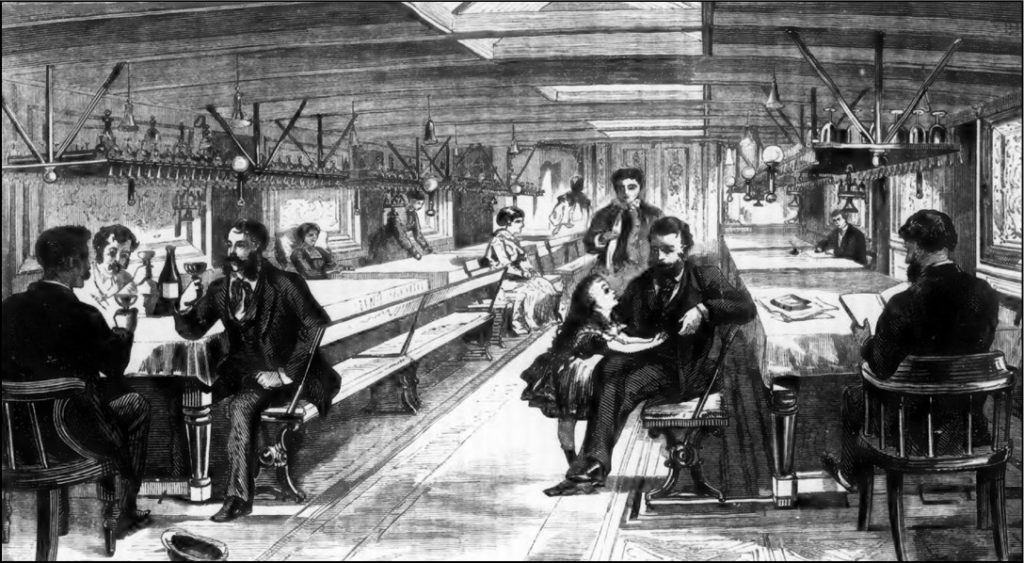
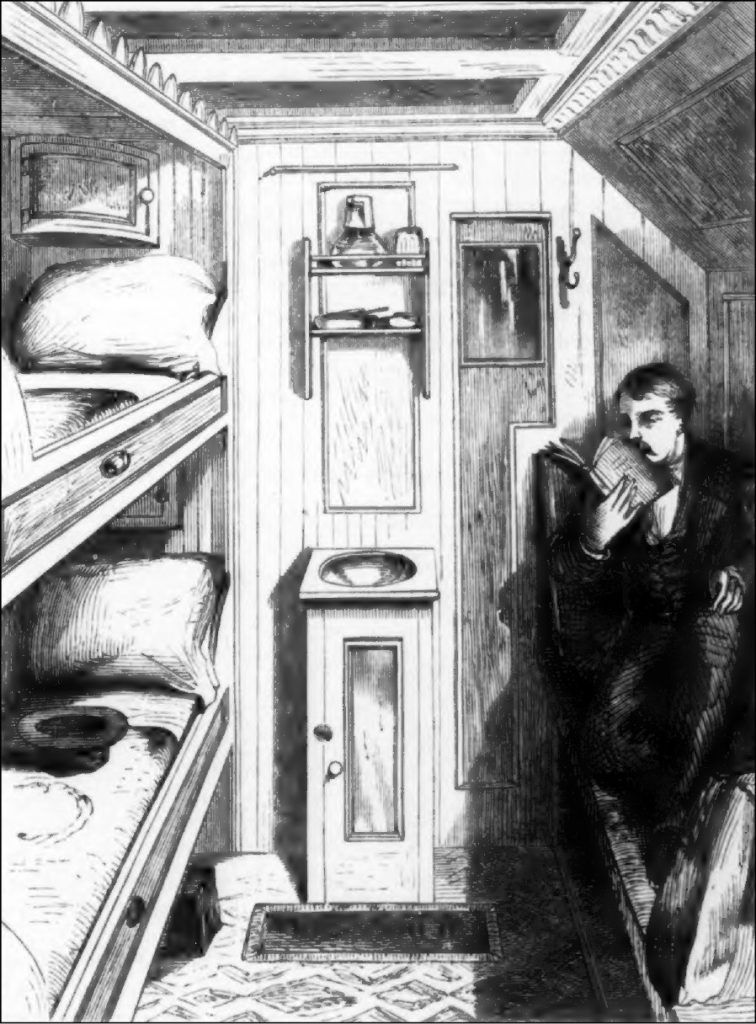
There is a hall for one’s free use, which is located in the middle of the ship and is 100 feet long and located on the second floor. This hall is 8 feet high and 16 feet wide; in the middle of it, the whole length of it, there is a table 4 feet wide, on each side a bench upholstered with velvet, and the hall is lit day and night with eleven shaded lamps; at this table we eat together. The cabins are on each side of the hall. Our cabin is 11 feet long and 6 feet wide. There are two beds, one over the other, fitted onto each of the two broad sides, which are not very soft but are clean and comfortable. There is a tin can attached to each bed, into which the seasick person can vomit – and which the waiter cleans immediately. We get water for washing and our boots are cleaned. The travelling company is very decent and we soon became friends with one another. In an emergency, six people can be placed in a cabin, then two beds are also added to the long side; now there is a sofa on the long side because there are only four of us together.
The passengers in the first-class cabins have their stay in the upper ship at the front, and probably in a way similar to ours, although everything is still much finer there than with us; the walls are covered with large mirrors, the pillars that support the ceiling have gold-plated capitals, etc. If everything goes very well, one reckons that we can be in New York from here in ten days, so since we don’t leave here until tomorrow noon, you won’t be able to receive a letter from me before a letter addressed on the 27th. During the journey up to here we saw no land on the North Sea other than in the straits of Calais, on the left side the coast of France and on the right the coast of England, where on one side Calais is visible and on other, Dover.
Well, thank God we are all very well; the brothers send their greetings. Johann [Funk, b. January 6, 1857, emigrated on the Frisia as a sixteen-year-old] also requests that you greet his parents. He will write from New York, because he can’t very well write anything else other than what this letter already reports to you. Greet Brother Sudermann when he visits you and give him this letter to read. If you receive the dispatch of the Frisia’s arrival in New York, then also report it immediately to Kozelitzke [village in West Prussia]. But write everything in detail, to the given address – what is happening at home, including whether the yearling is improving, how the grain is doing, in short, how everything is going, etc. May the gracious God bless you and protect you as well as ourselves; this is our daily prayer. Greetings to all friends, from me.
Your husband and father,
W. Ewert
Fargo. Station of the Northern Pacific Railway on the Red River in the Territory of Dakota, June 12th, 1873.
Dear wife and children!
You have not yet received a letter from me in America, but I hope you will have received detailed news from Johann Funk of New York and Wadsworth, Ohio, and I wish that it gave you pleasure to learn from this that I am doing very well. Yes, thank God, today, too, I can delight you with the fact that all our undertakings are proceeding very successfully under the noticeable care and concern of our faithful and gracious God, and that we are all very healthy and that so far we enjoy a lovely unity. I want to continue my reports briefly up to where Johann [Funk] will hopefully have already shared the essentials.
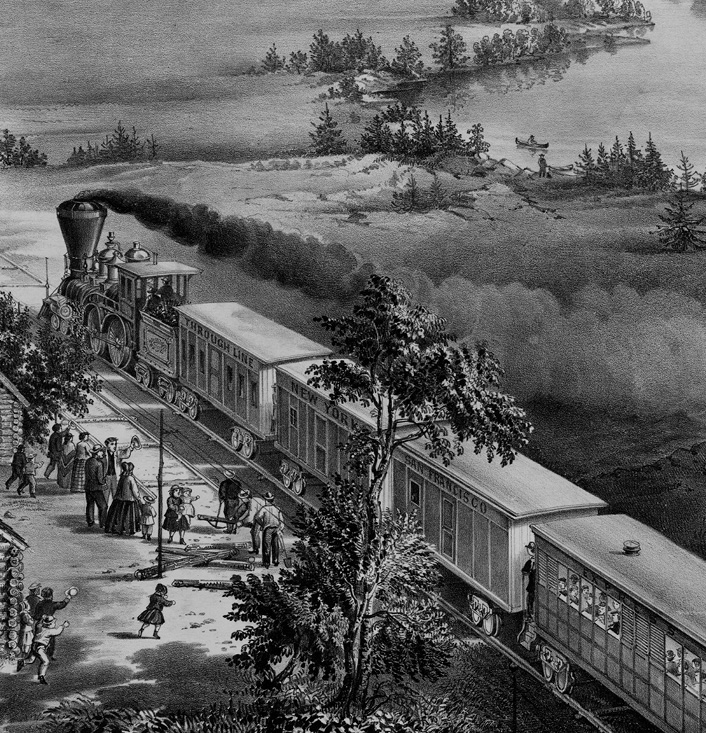
When we arrived in New York [on May 29], we found a letter from the Russian deputies [Mennonite delegates from imperial Russia] who had already gone to America two months before us, saying that we should meet together in St. Paul, Minnesota, in the first week of June; and that means we have to hurry. Johann will have written that we deputies in New York separated, myself and Brother Schrag deciding to visit Mr. J. Cooke, the so-called Rothschild of America and partner in the company of the Northern Pacific Railway, the other brethren deciding to visit the brethren in Canada [Ontario] and take along Brother Shantz from there as a guide for Manitoba. We arranged to meet in Elkhart by June 5th at the latest. We arrived there on the morning of that day, but the others weren’t there yet. When they still didn’t arrive in the afternoon on the four o’clock train, we continued travelling without them, as we had already telegraphed the brethren in St. Paul when we would arrive there. We spent the night in Chicago, and as we were having coffee in the morning, our dear travel companions also came in. The next train then took us all farther west. The journey to St. Paul took almost twenty-four hours on the railway; here we met the first three deputies [Sudermann, Buller, and Unruh]. Four other delegates from Russia from the Kleine Gemeinde and from the Hutterites, who had Brother John Funk from Elkhart as their leader, had, however, already hurried ahead again. So we too soon left there and came to Duluth on the 7th [Saturday] towards evening, on Lake Superior, a very nicely situated harbour town, which is only three years old and already numbers five thousand inhabitants, but when we saw ice drifts still in the harbour – driven by the north wind, which caused the air to be fairly cold, so that one could appreciate quite well that there was still heat on [in houses] – and [when] from St. Paul we travelled through only sandy, rocky, mountainous forest terrain, we almost felt like turning back. However, we stayed there on Sunday and left from there early Monday morning. We could very easily have had great misfortune along the way. Several days of rain had so softened the railway embankment, which was on a berm of quicksand, that the accumulated water had found a drain under the rails and had washed away the sand under the sleepers to a depth of perhaps two feet. This couldn’t be detected from a distance, and when the train came to these places the rails bent down and this caused terrible jolts; the train engineer immediately recognized our situation correctly and used all his steam power to pull the train through with full force. When the train was over the bad spot and stopped, we looked at it and were able to assess the danger we had been in, because several rails were bent down over a foot and one was even broken. Such places were encountered several more times, but one was more cautious and the damage was repaired somewhat by workers travelling along before the train passed over them, for there was enough wood everywhere to provide underlay.
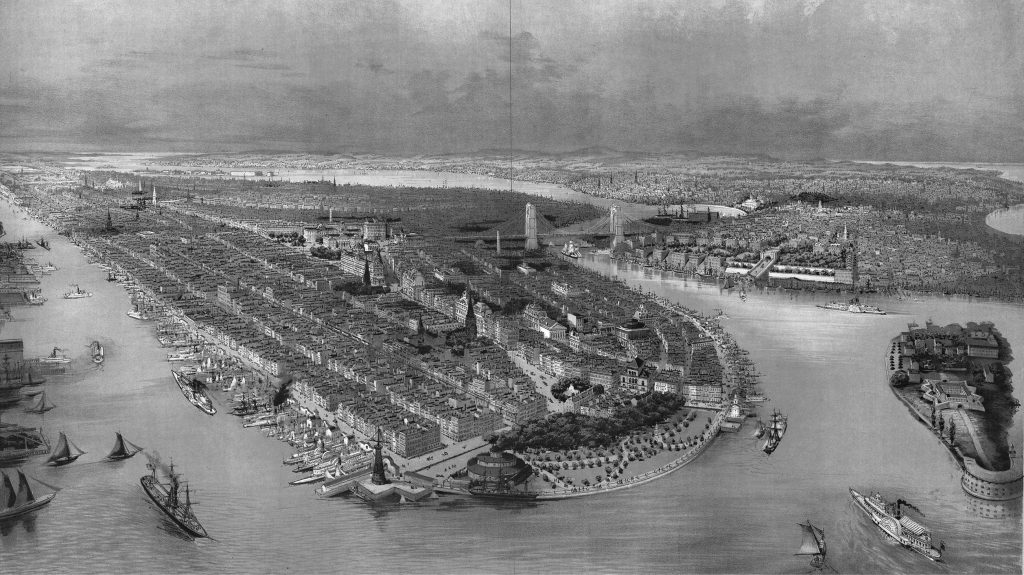
According to everything I have seen in America, it is astonishing how quickly industry develops here. The people are all very nice and friendly and modest. There is absolutely none of the insecurity that people in Europe talk about or imagine when speaking of Americans. I have seen no drunken person, no strife, no meanness nor crudity. It is said that the climate brings with it intelligent, alert being and communicates not only to all classes of the population but also to the livestock. For example, in the maze of carts and horse-drawn streetcars, you often see ladies driving with complete safety, because the horses are so clever that they know how to turn on their own. The horses and wagons are also on average more elegant than we are used to in Germany.
But the impression made upon me up to that point of what I had seen in relation to the immigration of our co-religionists who wanted to farm in colonies was very unfavourable. The whole states of New York, Pennsylvania, Indiana, Ohio, Wisconsin, and also the greater part of Minnesota, which we drove through, offered, as far as the eye could see from the railway, no suitable place for settlement, because the country was either rocky and mountainous, or dense forest, mostly in swamp and sandy desert, or too varied, or just as expensive as near us [at home].
And since I noticed that every good piece of land had already been utilized very carefully, I felt very disappointed in my expectations. But when we got to the westernmost part of Minnesota, about 10 [20 is overwritten with 10] miles east of the Red River, there came a different world. Open prairie with a lovely variety of deciduous forests along the rivers and lush grass growth pleased the eye; only here and there did we notice the beginnings of a settlement. We took the train to Fargo where I am writing this [arriving June 9]. This city is two years old; it is not expanding to the same extent as Duluth because the hinterland is not yet populated, and so trade and industry do not yet have an area to make use of, but after a few years, because the railway has only just been completed here, this wonderful country will quickly be populated. Yesterday the 11th, I and five other deputies, with a government geometer [land surveyor] and our two tour guides, Hiller from J. Cooke & Company, and J. Funk from Elkhart, were driven overland on two wagons that belonged to the government and were used here for land surveys. We drove about 2½ [Prussian] miles [about 12 English miles] up the Red River, then across a very fertile plain for about 1½ miles to the Sheyenne River, which runs fairly parallel with the former and flows into the Red River below Fargo, then not far again along the Sheyenne River through the plain back to Fargo. People who worked on the railroad settled back and forth along the rivers and built log houses. We stopped in at one; it was an Englishman. The family consisted of two men, perhaps father and son, a young woman, an infant, and a young man. They have lived there for two years, and have fenced in a piece of about 4 Morgen [7 acres]; the cattle graze overall without fences. We learned from them that they had two cows and each would give twelve Stoof [almost ten litres] of milk at a time. The woman was very nice and hospitable. She offered a few bowls of milk, which was pure and rich, and the cream on it was completely yellow. We informed her that we would like to settle down with them, to which she said it was just so very cold there (as is well known, the last two winters here were among the coldest). We learned that from the 1st of May to November 15th the cattle feed outside, that corn, planted five days ago, was already two inches out of the ground, and potatoes planted three weeks ago were already hilled up. Apart from these few settlements, the entire area is overgrown with grass. The land, as far as we examined it, consists of a layer of black humus at the top up to about one or two feet, at places also deeper, and at the bottom the subsoil is about the same mixture as the best land here [at home], just a little more calcareous earth, but the land is almost too flat, and a few ditches may have to be created for drainage – but this is very possible because the two rivers are only 1½ miles away. The winter here is very snowy and there is a lot of water when it thaws, and since the water has no outlet, we found large stretches where cutgrass [Leersia oryzoides] grows, like that on our lake meadows, but without hair moss, and the water likely stands for a long time in the lowest places. Since it had rained heavily a few days ago, we drove entire stretches where the water was a foot deep, but everywhere the grass had grown high above the water. We thought that the soil perhaps had a layer of [impervious] clay, but since we were still easily able to poke a stick into the ground its entire length, we were convinced to the contrary and were further strengthened in this belief when people said that the entire field dries up in the summer, but that the heavy rain had caused the water to accumulate again. I believe that if in the dry season a ditch would be made in each such depression, which run about a thousand paces apart pretty parallel across the entire plain from one river to another, the water would collect and could be reserved for watering livestock during the dry season. Since experience shows that eastern Dakota very rarely has rain from mid-July to the beginning of September, this area must be the best there could be for establishing colonies, because the cattle will find food in the low places if the higher ones should become too dry. The rivers flow between banks, which were about twenty feet high at the present water level and should therefore never flood.
There is little timber on the banks of the rivers, but there is a sufficient supply of firewood and wood for making tools. There is oak, elm, willow, and poplar, and there are also willows for making hedges and weaving baskets. The Red River is about one hundred paces wide, the Sheyenne River about thirty paces wide. The valley between these rivers is said to be 66 English miles of exactly the same nature, as the geometer assured us. The lumber, cut in all dimensions, is available by railway from Minnesota, and is not expensive: 1,000 square feet of one-inch boards cost 24 to 27 Thaler. The geometer assured us that when we settled on the railway, train stations would be built on our settlement as needed, because now at most stations there is just a post where the switches are, or a water reservoir. Why build train stations when no people live here yet.
The day before yesterday, we were going to take the train to the Missouri River. On this river are the beginnings of a city [Bismarck?], and a military station, Fort Seward, is located on the James River a little over 100 English miles west of here, not very far from where the railway crosses the Missouri. [The party decided to turn back at the James; they would have crossed the Sheyenne but did not reach the Missouri.] We saw several Indian tents there, but these people don’t seem to be wild at all. They are poorly clothed, have cattle, horses, and wagons; everything is pitiful, but I think that they are almost on the same level of education as the residents of Wygoda and Koperno.
Yesterday evening we visited a farmer near here, an American. In a very friendly way, he showed us around his farm, which he settled three years ago. He had fenced in about 15 Morgen [about 26 acres], which he had planted very neatly. He had planted all types of fruit, corn, beans, peas, beets, onions, about a Culmer Morgen [1.4 acres] sown in rows, cabbage, potatoes, watermelon, melons, and, as an experiment, probably six varieties of wheat. Everything had already sprouted; the corn, for example, planted twenty-two days ago was already ten inches high. He had a prairie plow, which could also be used to plow everything else, which with a steel coulter and mouldboard, very strongly built, costs 29 Thaler (smaller ones cost 18 Thaler), a Gehr [brand name?] double-disk seeding machine at 12 Thaler, a mowing machine, a good work wagon with accessories for hauling hay costing 100 Thaler, and so on.
The inn in which we are staying was built last fall; the front is 150 feet long and it has two wings at the back, each about 90 feet long, a long annex. Everything is two stories high and along the entire length of the house is a balcony about 14 feet wide, which is used entirely for the veranda. It has cladding on the outside and is plastered on the inside, which the Americans do so exactly that it almost looks like a wall of figures.
I have only said this so that you can see how skilfully and quickly the Americans build. Whoever has money, for them settling here is no problem at all. A house for 600–800 Thaler offers space for the largest family, because such buildings are built here with raised eaves so that there is a nice space for sleeping upstairs.
Well, my dears, up until now we have imagined that when you are across the ocean, you will have reached your new home; but it’s still a long way till there. We have travelled at least 1,800 English miles to this point, and the straightest route will be about 1,600 miles, which you still have to cover in America, requiring at least four times twenty-four hours. Therefore, it is very wise if you don’t bring a lot of things here because most of them are not more expensive here, but all of them are better than in Germany – e.g., cotton things are cheaper and much better than in Germany. As a rule, bed covers are made of calico, which is said to be almost indestructible, and costs about 6½ silver Groschen for 45 inches at three feet wide. They even make the finest shirts from white calico, and although there are very few shirts here and they are therefore washed very often (the Americans are very clean), they should still last at least four years.
We waited for the steamboat today and will go up the Red River to Manitoba (400 English miles), in order to look at the land there, too; that will take about three weeks. Then we will come back to this country to carry out a detailed examination of the entire area, which will take about another eight days. Then we want to travel to southern Minnesota and Dakota, Nebraska, Iowa, Kansas, and maybe even Texas, so my absence will last no less than four months. After everything I’ve seen and heard, I have concluded that we can’t look for anything better than this area. Where there is more timber, it will either be farther away from populated areas or the land will no longer be available in large blocks.
[Vertical postscript in margin] Here the adherents of the nonresistant churches number in the many hundreds of thousands and are amazed that this precious gospel of peace finds so few faithful believers in Europe.
Here is a very pleasant climate, just the way you like it, dear wife, a humid, warm air, but the sun is not scorching hot, a real growing weather, as they say. I wish our brethren at home were decided and knew when they wanted to emigrate and would commission me to secure and save land, for it is just as I said, as soon as it is announced that a larger settlement will be formed, there will be thousands of them who take possession of the government land, which, as you know, always lies between the railway sections, and is given to people free of charge, so that in such an area the only thing left to buy is the railway land and thus we would live among a mixed population. We are assured that the railway land can be bought for an average of 3 Thaler per acre, and in between the same amount of land is designated as homesteads by the government, so the agricultural land costs an average of 1½ dollars. I just spoke to a German adventurer who has been living in this area for ten years He confirms that the low land is the most valuable because it is fertile even in the driest time. But if we can’t decide to secure land now, good land will still be available later, too, but farther from the railway.
Now, my dear ones, if only I could come home for twenty-four hours to see you and what you are doing, then God’s beautiful nature, which delights our senses in so many different ways, would bestow a renewed attraction again. But the firm hope that the dear Lord will lead us safely to you keeps me cheerful. Have the children copy this letter often and send one to Brother J. Ewert in Dragass, one to Kozelitzke [West Prussia], one to Dirks in Targowek [a district in Warsaw], one to Brother H. Ewert in Russia, and one to Joh. Nickel in Hamberg in Russia.
Greetings to all our dear friends at home; do not forget us in your prayers. We remember our precious ones and our dear congregations every day. May the Lord bless you all, and strengthen everyone in the willingness to follow his word and example and, out of grateful love for him, to willingly bear his yoke and his cross in order to then be able to experience the truthfulness of all his promises of grace. Yes, I feel every day that the Lord is faithful and does what he promised. I can’t receive letters from you until I return here from Manitoba, because from Elkhart they are supposed to forward them to us here. I would then wish to receive quite a few; until now I have not received any yet. Therefore, write often.
So I commit you to God. Pray for your husband and father,
W. Ewert
[Written below the signature] Our travelling party and deputation consists of the following people. (1) L. Sudermann, Berdiansk, (2) Jacob Buller from Alexanderwohl, (3) C. Buhr, Bergthal, (4) H. Wiebe, Bergthal, (5) Peters, Bergthal, (6) Dav. Klaassen, Heuboden, (7) Corn. Toews, Heuboden, (8) Paul Tschetter and (9) Lor. Tschetter from Hutterthal, (10) Th. Unruh from Karolswalde, (11) Andr. Schrag from Kotosufka, and (12) I. As guides we have (1) Brother Shantz from Canada, (2) Brother J. F. Funk from Elkhark, (3) Mr. Hespeler from the Canadian government, and (4) Mr. Hiller from the Northern Pacific Railway Company on behalf of Jay Cooke & Company.
[Vertical postscript in the margin] What is dear grandmother doing? Ohm Unruh once dreamed that she had died. I wish her, too, the peace of God.

Published in Der Mitarbeiter, October 1929. Fargo, Dakota Territory, June 29, 1873.
Dear wife and children!
We, a part of the deputation, have just returned here from Manitoba under God’s guidance, and I have received your two letters of May 19th and June 3rd. Ah, dear wife, if you knew how happy I was to receive such good news from home (I couldn’t help but cry for joy) you would write quite often.
I hope you will receive my letter of the 12th of this month from here, and will therefore continue with my report where I ended then. Don’t be impatient if I repeat what’s in the first letter, because I didn’t keep a copy of it and I don’t know exactly what I wrote back then.
On the 13th we travelled from here down the river by the steamboat Nationale [sic] to Fort Garry, our twelve deputies – being curiously twelve, bringing to mind the number of the Lord’s disciples – and four guides: Mr. Hiller, commissioned by the Northern Pacific Railway, brother J. F. Funk of Elkhart, brother Shantz of Canada, and Mr. Hespeler, agent for the Canadian government. This trip took four days and four nights, for it is 650 miles by water from here to Fort Garry, or the town of Winnipeg, which is nearby, while by land it is said to be only about 250 miles straight from here. But since the journey by land is more expensive and less comfortable and takes just as much time, as long as navigation is possible, one travels only by water. The trip went quite well so far, but it was immediately apparent that we were no longer under American stewardship. On the Canadian boat we greatly missed the unassuming, courteous treatment one experiences in America, from the waiter to the president, and although we paid well, the food was very poor. The trip costs $18 per person including meals. But thank God, we arrived happily at the destination of our journey [Tuesday, June 17].
A request was forwarded to us that we visit the governor in Winnipeg. There we were greeted with great friendliness, served with champagne and biscuits, and the advantages of the country were presented to us. Since I was already biased against this country by the inquiries I had made previously, my acquaintance with its population aroused even more antipathy towards it, and I paid very little attention to the pretenses and flattery offered to us. But I will add something here: the progress of industry was made clear to us by the example that two years ago 1,000 board feet would still have cost $100, but now after two saw mills were erected the price fluctuates between $35 and $45, while the price here in Fargo is only $20–$25 and entire shiploads go from here to there.
Then it was strongly emphasized that eight townships of land had been reserved and would be given to Mennonite settlers free of charge. However, I already knew that in all of Manitoba, two sections of land, i.e., the eighteenth part in each township, belonged to Hudson’s Bay by contract, and the rivers and the land 4 miles on each side are guaranteed to the Indians as property [likely referring to Métis land grants]. Since passage there [to Winnipeg] from Russia is cheap, they offered $55 per person from the Black Sea to Winnipeg, but the so-called Dawson route was designated for the journey in America, about which I learned that one would have to be unloaded from the wagon onto the boat and vice versa about twenty-six times, and this tour can be completed at best in four weeks in addition to the sea journey, while one can get here [Fargo] in a straight line from New York by train in three days.
In terms of markets for products, Manitoba was considered to have a great advantage because all products here are more expensive than in the United States. In my estimation, this could only last as long as we have to buy them for our subsistence, because the population of 18,000, three-quarters of whom are Indians and mixed-bloods [Indigenous peoples], who do not buy or sell anything, who live only from hunting and are too lazy for any other work, contribute nothing to the commercial and trading population. Therefore, foodstuffs are obtained from the United States, and a Mennonite colony would soon produce to excess for these 4,000–5,000 souls, and since no other market can be made possible, the products would be worthless in the future. To this objection it was replied that sales up the Red River [to the United States] were also possible. But the shipping company gets paid 1½ cents per pound of freight up to here [Fargo], which is exactly as much as wheat is worth here. We were then led into thinking that the intention was to build a railway from the Atlantic to the Pacific, which was projected to run 40 miles from the settlement and would cost roughly $150 million, for which the necessary cash was still lacking.
We were also told that although there was a shortage of heating and building material, coal had been discovered about 200 miles from here, which could be sent up the Red River and the Northern Pacific Railway to St. Paul, and from the proceeds lumber could be obtained from the United States, so the country would soon flourish. All this information led me to conclude that we must really be considered to be very stupid. But everything is being tried to win us over to Manitoba, because the governor gets a salary of $10,000 and the few tax-paying residents can no longer afford this in the long run.
Meanwhile, lured by the champagne, the government house had filled with several more people, who I took for domestic staff and servants, because it is not at all remarkable here when the servant clinks glasses with the master. But I learned that they were councillors and government ministers. The whole place didn’t look very parliamentary either, for the torn wallpaper and the slovenliness suggested nothing like a governor’s office. The contrast between the United States and Manitoba is even greater than that between Prussia and Poland. At the end of our conference, we toasted the Queen and were dismissed.
Mr. Hiller and I made efforts throughout the city to ascertain the conditions of the land. We learned that the report of the coal discovery was a ruse, that the journey on the Dawson route was life-threatening, that the reason that no grain was cultivated is that the grasshoppers often destroyed it, and finally, that typhoid fever was claiming many children, which too seemed credible because there were almost no children to be seen. The fault was attributed to bad water.
Throughout America, I had encountered lively, civilized activity, for there are entire states where no spirits may be served. At many railway stations you cannot even get beer in the restaurants because the companies do not allow it for moral reasons. In Manitoba, however, old and young, brown and yellow and white cavort in the drinking dens, bickering, gambling, and fighting. And the Indians in their primitive state, adorned with quaint ornaments according to their rank, who do their business here in Winnipeg by the hundreds, are not enticing neighbours either. Even if the Indian is not to be feared otherwise, his revenge knows no bounds as soon as he knows he has been cheated. They have already revolted against the government here several times, and since the latter was too powerless, promises were made to them of which it is questionable whether they can be kept, so that for this reason alone, although there is a lot to be earned there by the industrious, those who are sensible have returned to the United States. I think that if a larger settlement were to be established here, the buffalo, shying away from civilization, would retreat farther into the wilderness, whereby the Indians, having their only occupation impaired, could easily seek compensation at the expense of the settlers. Then the Mennonites who want to settle there would have the opportunity to see nonresistant Christianity put to the test. We pray to God that he lead us not into temptation, so why then subject ourselves to temptation if it is not necessary?
While Mr. Hiller and I went out to explore, the others, led by Mr. Hespeler and company, had gone out to the countryside to look at farms and had a lot to say about the fertility of the soil, but also that they had seen billions of locusts.
The next morning [Wednesday] was to be the inspection of the reserved lands. For this purpose, seven carriages were prepared, two with provisions and five for the conveyance of the passengers, whose number had increased to thirty people, although Mr. Hiller was not taken along, for the ministers and councillors were so interested in this expedition that they also wanted to be part of it. The supply wagons were sent ahead; the five passenger wagons had to drive in a group and a photographer had to photograph them. Then the procession started moving. But they had also very carefully allowed for inspiration, for eight barrels of schnapps and wine were taken, but to the chagrin of the gentlemen we made little use of them.
It would take too long to describe all the adventures and details of this journey, but suffice it to say that before we came to the reserved land, we got stuck in the swamps about ten times and had to pull out first the horses and then the wagons.
With the first day’s journey we had not yet reached the homeland chosen for us. It was only in the dark of night that we arrived near a trading post belonging to the Hudson’s Bay Company. A government building standing next to it, which was set up to accommodate immigrants, was not opened to admit us, so we were forced to pitch our tents in the mud and rain. Through the fire we lit, the caretaker of the trading post became aware of us, and most kindly offered us accommodation at his place. The next day we had to wait here until afternoon, for the supply wagons did not reach us sooner than that. Then we travelled a few more miles, until the boundary mound was pointed out to us where the promised lands began. A land where the water in the man-made ditches was level with the surface! We drove and walked around on it until evening and found some good spots. There was also woodland there, aspens, the thickest of which were not more than eight inches in diameter, which could not be reached at all in summer because they stood in a bog. We camped in our tents on a gently sloping elevation, on which were many boulders.
We were very fortunate, for the weather was fine, and our songs of praise, which brother Sudermann led from his rich repertoire, rang through the silent night up to the throne of God. The next morning we went on again. We also met some settlers who had chosen nice places and were lured here as victims of unscrupulous agents – in isolation, cut off from all traffic. We plodded along through the day until our advance apparently became impossible, for a meadow flooded with water obstructed our journey. But when we had struggled forward a stretch, we came to a ditch several rods wide. We tried to dam it up with mowed grass, but it floated away, and so we had to risk chasing the horses through and then pulling the carriages through on ropes, with the minister and coachman helping, and luckily we succeeded. We reached higher ground again, where we spent the night.
But here I endured a plague like almost never before in my life. Because it was muggy and rainy, the mosquitoes were so bloodthirsty that one suffered terribly from their bites. There was no thought of sleeping, and I spent the night smoking the tents of my travelling companions, using a frying pan filled with hot coals and fresh grass, to drive the mosquitoes out of them, so that those who were less sensitive than I could at least get some sleep. I wrung my hands in desperation and whimpered in pain.
In the morning, everyone had swollen faces and hands from the mosquito bites. They wanted to take us around here longer, but since the new day was Saturday and we didn’t want to spend Sunday travelling, and they also admitted that from this route one could not get to the other end of the land [the East Reserve] because of swamps and rivers, it was decided to return to Winnipeg, about 35 miles away, in order to take another tour on Monday to see the rest of the land, where there is also supposed to be better wood. Since I and several of the deputies had openly declared our opinion of this land, in order to requisition accordingly the necessary carts for the next week the question was asked as to which of us did not want to take part in a further reconnaissance. Therefore I, the two Tschetter brothers from Hutterthal, Brother Schrag, Brother Unruh, and Brother Funk stepped forward. We all arrived safely in Winnipeg in good time and I was delighted to meet Mr. Hiller there. Since a steamship left from there that same evening, the seven of us gladly used the opportunity to return here [Fargo]. For the reasons given, to which a great many drawbacks can be added, I consider it quite impossible to set up a settlement here [in Manitoba]. Some of the deputies, however, seemed to have no eyes, ears, or feelings for all this, but rather expressed their approval and willingness to lead their people into this wasteland. Should this happen, I could only conclude that God, in his gracious will, was providing for the light of the gospel to shine upon the poor Indians through them.
We had received a recommendation from the American consul [J. W. Taylor in Winnipeg] to inspect the lands around the Pembina River in Dakota near the Canadian border. For that purpose we received a four-horse carriage from Fort Pembina free of charge, and travelled around the area for three days [June 23–25]. We stayed with some settlers, very wealthy people. One is estimated to be worth $80,000, while the other is said to own almost the entire town of Pembina. They were very accommodating and amiable, like almost every American. There is a lot of good land here, which extends with the same quality beyond the Canadian border. The river is suitable for mills in many places, and there is sufficient timber and firewood available for many years. In the forests there are oaks, elms, maples, ash, aspens, plum and cherry trees, wild grape vines, and many berry bushes and hazel bushes.
If we don’t find anything similar farther south or closer to the railroad, I have nothing against settling here. We were assured of the fertility of the soil – e.g., onions grown from seed would be eighteen inches in circumference. Someone had cut up a potato and harvested 15 bushels from it; another was to have planted 2 bushels, not worked the land at all, and gotten 95 bushels. Wheat is said to bring 60 bushels per acre, etc. The grass and hay are said to be so tasty and nutritious that the horses, if they get such, spurn oats. The cattle were all well-larded and every cow gave a pail of milk. Millions of acres of this land are still available for free; indeed, we are being asked to settle here.
With heartfelt greetings, your loving husband and father,
Wilhelm Ewert