
Machines on the West Reserve, 1870s–1920s
Hans Werner
Mennonites arriving in the Red River Valley of Manitoba in the 1870s settled the long-grass prairie on the eve of a dramatic transformation in agricultural work. Machines would replace people and animals for many farm tasks. The advent of machines would also change the energy balance away from wind, organic, and animal power to that provided by fossil fuels. The transformation, with its attendant tension between innovators and naysayers, was, however, largely uncontroversial. That is, until the advent of machines increased individual mobility and brought “the world” to the Mennonite village. It was then that machines began to take on religious and ethical meanings for West Reserve Mennonites. By the time of the migration to Mexico in the 1920s, machines had become controversial and their use had become a marker of identity.
In its basic form, the definition of work is moving an object a certain distance. Doing “work” requires energy, and the units used in physics for “work” and “energy” are the same. Early agriculture used primarily the wind and human or animal energy to do the work. Even here, different animals were used in different situations and times. The horse had replaced the ox by the time Mennonites settled in the Ukrainian lands of imperial Russia in the late eighteenth century, and in the early years of the Chortitza colony, the average farm had four or five horses. The first census taken in 1797 does not list any machines for individual farmers, but notes that the colony had ten windmills, a sophisticated machine that used the wind to do work.1 Although the 1797 census listed only the animals kept by individual households, the 1801 census of the colony, taken almost a decade after the first settlers arrived, lists some rudimentary implements. Harrows, plows, looms, and spinning wheels were now listed, although they still relied on animal or human power to do the work.2 By the time Mennonites left the Russian empire for the prairies of Canada, a lot had changed. Mennonites who settled the West Reserve in Manitoba came with an eighty-year history of farming the steppes, a landscape not that different from the Canadian prairies, although with a milder climate. By the time of their emigration in the 1870s, machines were already transforming agricultural work.
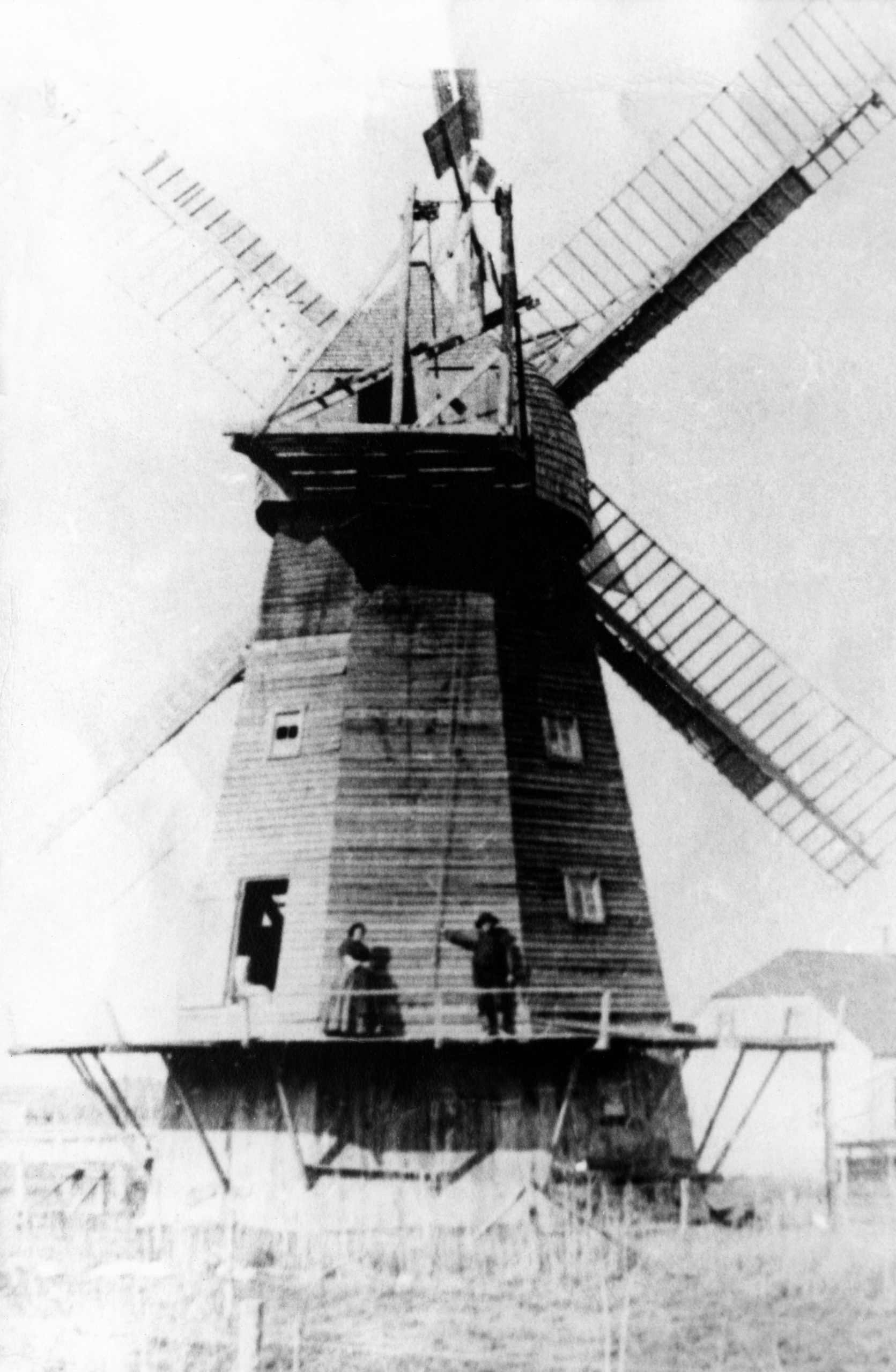
The windmill was an immediate need for the new settlers, if the wheat they grew was to be milled into flour for bread, or feed for animals. Windmills had a long history among Mennonites. They had been used to pump water and grind grain in the Netherlands and Prussia, and to grind grain in the southern Ukrainian lands. A relatively complicated machine, the windmill converted the energy provided by the wind to rotate huge grindstones that ground the grain. The miller had to be skilled at employing the available wind to maximize the output of ground grain. Too strong a wind or variability in its direction put the mill at risk, and fires from excessive braking or brakes not holding the vanes were not uncommon.3
The Mennonite settler, like most colonial settlers, imagined the future of the grasslands of the Red River Valley as neatly ordered and cultivated fields that produced grain and forage crops. For that to be a reality, the first task was to break up the sod. Although they had come from an agricultural setting where horses supplied the draft power, oxen were called into service especially to break up the virgin grassland. John Warkentin’s landmark study of the Mennonite Reserves lists the advantages of oxen: they did not require oats for feed, were easier to shelter in winter, were cheaper, could walk on the land sooner in spring, and, most importantly in the early years, were stronger.4 When Peter Wiens compiled his summary of the progress made in the West Reserve up to 1879, he listed 718 horses and 639 oxen in the thirty-six villages.5 As the number of acres under cultivation increased, the disadvantages of oxen began to outweigh their benefits. The faster horse gradually took over.
Early machines on the West Reserve, such as windmills, looms, and spinning wheels, still relied on wind and human power. Yet even as farmers were breaking the prairie with their oxen and gradually switching over to horses, new machines were appearing to transform field, harvest, and processing operations. James Watt’s improvements to the original Newcomen steam engine soon revolutionized work on the farms of the West Reserve. Watt had pioneered the inventions that allowed the steam engine to create rotary motion, a development that expanded the earlier use of steam engines to pump water out of mines. The first inroads of steam power in Mennonite agricultural enterprise were stationary engines used to grind grain for feed or flour. The rotary motion of the steam engine was transferred to the grinding mechanisms by a wide rubber belt. Some of the first businesses to be established when the town of Winkler emerged beside the railway tracks in 1892 were the steam flour mill owned by Jacob B. Dyck and William Peters, and a grist mill owned by Peter Harms.6 A four-storey, well-equipped steam mill also operated in the village of Rosengart. By the 1890s, the windmill was on its way out and steam power for milling became the norm.
The 1880s and 1890s also saw the rapid adoption of a range of new seeding and threshing machines. The seed drill, which offered the advantage of placing the seed right in the ground where it could find moist soil and be protected from birds, arrived in the late 1880s. Binders with revolutionary tying technology eliminated much of the hand labour involved in cutting, stooking, and hand-tying the grain sheaves. The threshing machine was already available when Mennonites moved onto the West Reserve, and by 1877 there were both horse- and steam-powered threshing machines, often owned by an individual farmer but used by the entire village. According to Peter Wiens, in 1879, some four years after arriving, the Reserve had twelve steam-powered and seven horse-powered threshing machines.7 The new machines required a complete reorientation of work for some. The new machines “were fragile, complicated machines, and they required knowledgeable individuals to operate them. The success of a threshing . . . operation rested on the engineer and the separator man. Their job was to constantly monitor the machines, oiling the bearings, lacing and setting the belts, and adjusting the engine and sieves to accommodate changes in the crop being fed.”8
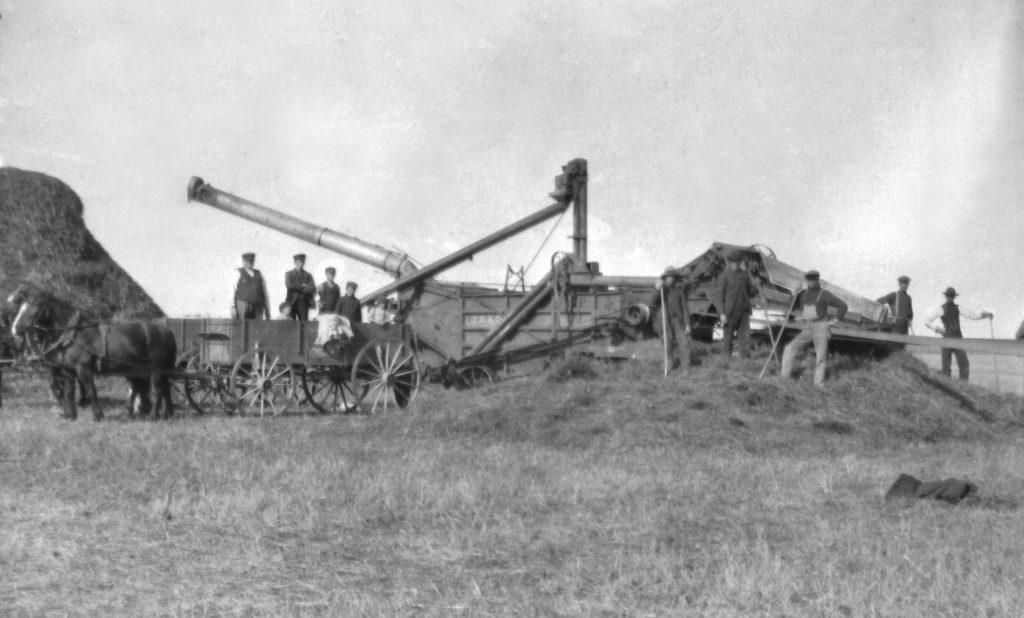
The threshing machine and its accompanying steam tractor did not compromise the values of the Mennonite villager to any extent. Threshing became even more of a community operation than before. Large crews were needed, and the entire village was put to work. Besides the specialized task of keeping the machines running, people were needed to haul the stooks and take away the threshed grain. Water and fuel had to be brought to supply the steam engine and the women and girls were called upon to feed the threshing gang.
The advent of steam power marked a significant change in the energy balance of agricultural work on the Reserve. Stationary steam engines used straw as fuel, a source of energy that, while not wind, animal, or human, was still organic and locally produced. Early steam tractors were primarily used to power the threshing machine, and since there was an abundance of straw, it was the fuel of choice.9 Steam tractors had the advantage of being able to move “under their own steam,” but it was a slow process. In an 1897 letter to Peter Martens in southern Ukraine, Peter A. Elias, a West Reserve blacksmith and farmer who owned a threshing outfit, described the advantages of the steam tractor: “The self-propelled steam engine hauls the threshing machine, and frequently also the water wagon, to a convenient place for threshing.”10
The steam-powered railway locomotive was another matter. Here the steam engine’s rotary motion was transferred to wheels that propelled the entire steam engine along steel rails. Straw was not a practical fuel for a moving boiler, so coal became the fuel of choice, marking the debut of the fossil fuel era. While the steam locomotive was not owned or operated by Mennonites, it would have a significant impact on the agricultural economy. It brought products to the Reserve from faraway places and opened markets for surplus grain.
The 1870s Mennonites who settled the West Reserve were not averse to train travel. They had travelled by train through Europe, and the trip from Duluth on Lake Superior to the railhead at Fisher’s Landing near Grand Forks, North Dakota, was also by train. Their new home did not have train connections, but two years after their arrival on the West Reserve, the Countess of Dufferin, the first locomotive on the Canadian Prairies, was making its way by riverboat to Winnipeg. The railway was still some distance from the Reserve, but it immediately changed the economics of farming. The railway connected producers of surplus grain to distant buyers, and soon caravans of ox carts travelled the Post Road to Emerson. When the Southwestern and Pembina Mountain Branch went through the Reserve in 1882, the new railway towns of Gretna, Plum Coulee, Altona, and Winkler brought the steam locomotive and its cars even closer to West Reserve families.
While the railway improved the economic viability of West Reserve agriculture, it brought with it “the world,” which for the more conservative of the West Reserve’s Mennonites presented a problem. The Old Colony Mennonites frowned upon their members living in the railway towns. Frank Brown tells the story of P. H. Goertzen, who moved to Winkler and set up a store. He sent his children to the public school and was subsequently boycotted by members of his church. Although “the Anglo-Saxon and the Jewish citizens in town took compassion on Mr. Goertzen and patronized his store,” it could not survive, and he eventually moved to Saskatchewan.11 It was clearly not the machine itself that was the problem, but the temptations it fostered.
A similar situation involved the bicycle. While a fairly basic machine, it allowed for mobility on an individual level. Like many machines that would follow, acquiring ownership was related to financial ability and drew attention to individual difference rather than community unity. Peter A. Elias lamented the inconsistencies in the resulting discipline:
At the beginning there was also such a strong prohibition of bicycles that no one owning one was baptized. Baptized members who already owned a bicycle were not dealt with as strictly; they were not to own one, but were generally not forced to get rid of them. As a result, non-baptized persons who owned a bicycle did not get rid of it, but merely refrained from using it until they were baptized. This led to a very uneven practice, since someone owning and using a bicycle was denied baptism. How could such a practice be maintained?12
The era of the steam tractor was relatively short. The advantages of the gas tractor over the steam engine paralleled those that favoured the horse over the ox. The gas tractor was lighter, faster, and used a more convenient fuel source. The gasoline tractor’s ratio of power to weight was significantly greater than that of the steam engine. The 1915 Case 18-50 steam engine was rated at 50 horsepower and weighed approximately 10,000 kilograms. It travelled at 3.7 kilometres per hour. In contrast, an early model of the popular Fordson gas tractors weighed 1,324 kilograms and was rated at 20 horsepower; its top speed was 10 kilometres per hour.13 The gas- or kerosene-powered tractor soon appeared in agricultural extension schools throughout Manitoba. In 1915, an agricultural school in Winkler introduced two gas tractors and a seeder that arrived by train. By the time of the migration to Mexico, gas tractors had become common, and Mennonites arriving in Mexico with such modern equipment in the 1920s “were heralded by President Álvaro Obregón as the harbingers of northern progress, able to modernize agriculture on the broad mountain plains of the eastern Sierra Madre.”14
The advent of gasoline as a commonly available fuel also stimulated the adoption of the automobile, a machine used almost exclusively for personal transportation. The March 11, 1909, issue of the Morden Empire reported that J. G. Loewen of Winkler had become an authorized dealer for the Columbus Automobile Company, and was expecting to receive a sample automobile soon.15 The next year, an issue of the Morden Chronicle announced that Bernard Loewen had purchased a McLaughlin and that Frank Derksen from Winkler had “autoed” to Haskett and back in one day. He had, however, broken through the bridge at Blumenfeld and smashed his front wheels.16
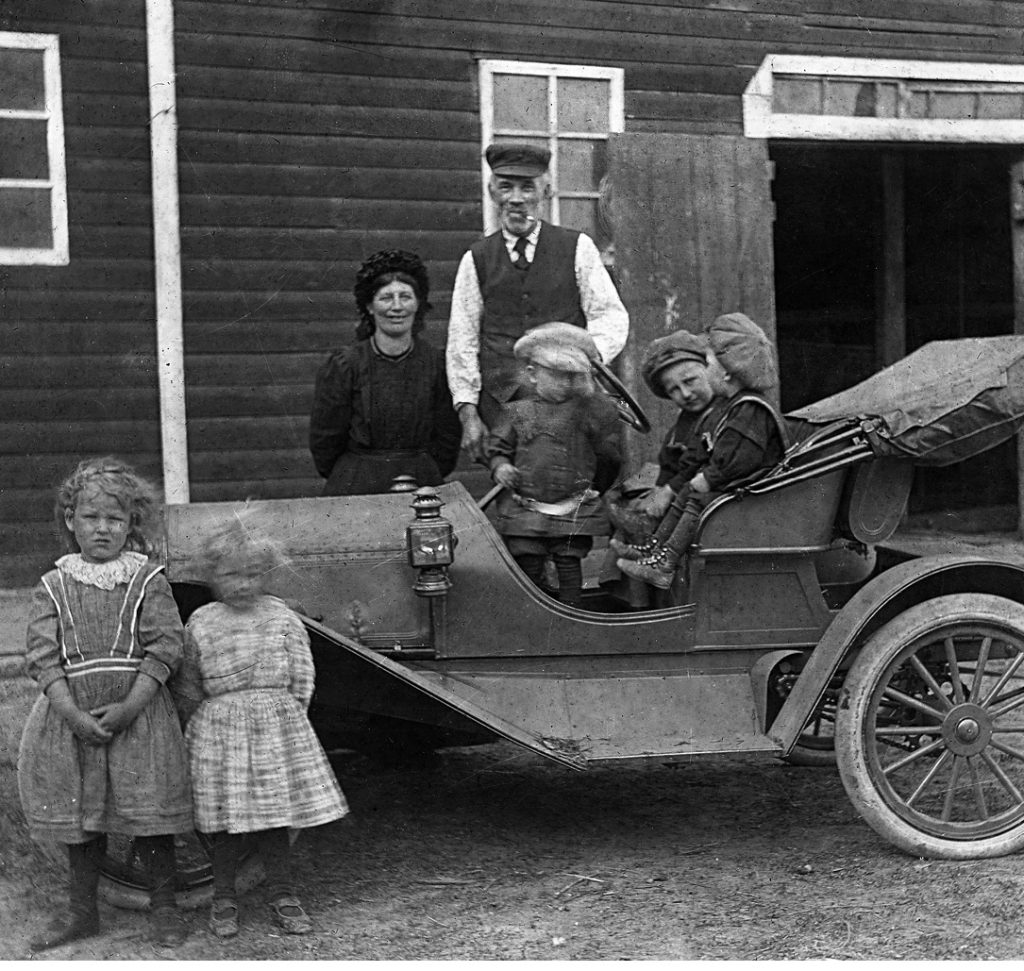
The automobile raised the level of individual mobility considerably over the buggy, the bicycle, or the gas tractor. By the 1920s, automobile dealers were regular advertisers in West Reserve newspapers, and in 1928 the local council in Winkler removed the hitching rails on its Main Street.17 Not everyone, however, adopted or considered the automobile an appropriate thing to own. The more conservative Mennonites, although they used gas tractors, continued to use the horse and buggy for personal transportation.
The household and farmyard were not immune from the transformation brought by machines. Although the spinning wheel and loom were machines of a sort, one of the first new machines to invade the household economy was the cream separator. By the early 1900s virtually every farm had one. Earlier methods of separating the cream from milk relied on gravity and time. The milk had to be set aside, allowing the cream to rise to the top of the container, where it was ladled off. The process was somewhat risky in that the milk might spoil if not attended to promptly. The cream separator was a centrifuge and for many years still driven by human power. Other than the tedious task of washing the cups and bowls, the process was faster and safer than the old gravity method. The separator would remain a feature of the milk room well into the 1950s, and underwent little technological change during that time. The cream was shipped to the local creamery to be made into butter, while excess skim milk was fed to the pigs.
Tractors, binders, cream separators, threshing machines, and locomotives transformed West Reserve Mennonite life. By the 1920s, West Reserve Mennonites had adapted to many changes to the world they knew when they arrived in the 1870s. Although it is difficult to determine the milestones, gradually the more conservative embarked on a path to resisting technological change. They began to worry about the increased mobility offered by the automobile and tractor, and the accompanying threat to the sense of village and church unity that they believed was integral to a Christian life. Although he offers no specific source, Leonard Sawatzky suggests that around 1916 the Old Colony leadership began putting the brakes on the adoption of new machines. They banned the automobile and agreed “to arrest technological in agricultural machinery at the then existing level.”18 When the more conservative elements left for Mexico and Paraguay in the 1920s, the brakes on adopting new technologies loosened even more for those remaining in Manitoba. The pace of change would continue with electrification, larger equipment, and the move from semi-communal village life to individual farms. The advent of the rubber tire in the 1930s would create controversy in Mexico, but not in the West Reserve.19
The new machines also heralded a dramatic change in the energy sources for work. Although hard work was still a feature of agricultural life, by the 1920s fossil fuels had replaced wind, the ox and horse, and straw as sources of energy. Coal had been the first imported source of energy, and for a time the coal dealer was an important business in town. But kerosene and gasoline soon replaced coal, other than for heating, and here it would be replaced before long by heating oil. At the end of the 1920s those processes of change were still underway, but the path towards reliance on fossil fuels had been set.
Hans Werner is an associate of the Centre for Transnational Mennonite Studies and a senior scholar at the University of Winnipeg. He is the author of several books, including The Constructed Mennonite (2013).
- “Chortitza Mennonite Settlement Census for 14 October 1797,” Central State Historical Archive, St. Petersburg, fond 383, opus 29, delo 159, ed. Richard D. Thiessen and Glenn H. Penner, https://mgr.mennonitegenealogy.com/russia/Chortitza_Mennonite_Settlement_Census_for_1797.pdf. ↩︎
- “Chortitza Mennonite Settlement Census for 1 September 1801,” State Archives of Odessa Region, fond 6, series 1, file 67, ed. Tim Janzen and Richard Thiessen, https://mgr.mennonitegenealogy.com/russia/Chortitza_Mennonite_Settlement_Census_September_1801.pdf. ↩︎
- A comprehensive survey of early Manitoba windmills is Jake Peters, “Pioneer Windmills, A History of Mennonite Windmills in Manitoba: Their Design and Impact,” Preservings, no. 16 (June 2000): 120–26. ↩︎
- John H. Warkentin, Mennonite Settlements of Southern Manitoba (Steinbach, MB: Hanover Historical Society, 2000), 90–91. ↩︎
- Der Nebraska Ansiedler, Feb. 1880, 1. Wiens’s table is also reproduced in John Dyck and William Harms, eds., 1880 Village Census of the Mennonite West Reserve (Winnipeg: Manitoba Mennonite Historical Society, 1998), 62–63. ↩︎
- Hans Werner, Living Between Worlds: A History of Winkler (Winkler, MB: Winkler Heritage Society, 2006), 19. ↩︎
- Der Nebraska Ansiedler, Feb. 1880, 1. ↩︎
- “TimeLinks: Steam Tractors,” Manitoba Historical Society, https://www.mhs.mb.ca/docs/features/timelinks/reference/db0067.shtml. ↩︎
- “TimeLinks: Steam Tractors.” ↩︎
- Peter A. Elias to Peter Martens, Apr. 29, 1897, in Voice in the Wilderness: Memoirs of Peter A. Elias (1843–1925), trans. and ed. Adolf Ens and Henry Unger (Manitoba Mennonite Historical Society, 2013), 144. ↩︎
- Frank Brown, A History of Winkler (Winkler: pub. by the author, 1973), 129. ↩︎
- Peter A. Elias, “Memoirs,” in Voice in the Wilderness, 64. Emphasis in the original. ↩︎
- Steam tractor manufacturers were reluctant to specify the weights of their products, fearing that farmers would find them too heavy. The weight for the Case 18-50 is an estimate from a table provided on the Smokstak antique tractor forum at https://www.smokstak.com/. The specifications for the Fordson tractor are from https://www.yesterdaystractors.com/. ↩︎
- Royden Loewen and Ben Nobbs-Thiessen, “The Steel Wheel: From Progress to Protest and Back Again in Canada, Mexico, and Bolivia,” Agricultural History 92, no. 2 (Spring 2018): 175. ↩︎
- Morden Empire, Mar. 11, 1909, 8. ↩︎
- Morden Chronicle, Nov. 24, 1910, 8. ↩︎
- Morden Times, June 6, 1928, 4. ↩︎
- Harry Leonard Sawatzky, They Sought a Country: Mennonite Colonization in Mexico (Berkeley: University of California Press, 1971), 352. ↩︎
- See Loewen and Nobbs-Thiessen, “Steel Wheel.” ↩︎